DEVOURED
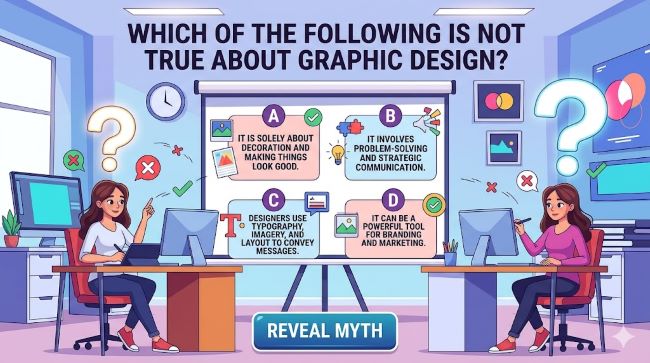
Which of the Following is Not True About Graphic Design? Common Myths Debunked
Many widely-held beliefs about graphic design are false, including that it's purely subjective, only for print, or that software skill makes a designer.
What: The article debunks common myths about graphic design, emphasizing it's visual communication with established principles like hierarchy and contrast, not just aesthetics or software use. It highlights that graphic design is a broad, ancient discipline, distinct from art, and that bad design has significant consequences, referencing the 2000 US election butterfly ballot.
Why it matters: This piece clarifies the fundamental nature of graphic design as a problem-solving communication discipline, countering common misunderstandings that can lead to ineffective or even harmful designs. It stresses that design choices are purposeful, grounded in human perception, and have real-world impact beyond mere aesthetics.
Takeaway: Understand graphic design principles like hierarchy and contrast, and apply them with purposeful communication in mind, rather than solely focusing on aesthetics or client preference.
Deep dive
- Graphic design is defined as visual communication combining images, words, and ideas to convey information to an audience.
- It is not purely subjective; it has principles like Hierarchy, Contrast, Alignment, Proximity, White space, and Repetition, grounded in human cognition.
- Adding more design elements does not make a design more effective; often, minimalism is key to clarity.
- Graphic design is not limited to print; it encompasses UI, motion graphics, environmental design, social media, and data visualization.
- Proficiency in software like Photoshop does not equate to being a graphic designer; design thinking and understanding principles are crucial.
- Good design's primary goal is effective communication with the intended audience, not merely client satisfaction.
- The discipline is not new; while the term was coined in 1922 by William Addison Dwiggins, the practice is ancient, seen in cave paintings and early printing.
- Bad graphic design has real consequences, costing money, confusing audiences, and potentially causing harm, as exemplified by the 2000 US election butterfly ballot.
- Graphic design is distinct from art; art is self-expression, while design is problem-solving oriented towards a specific communication goal.
Decoder
- William Addison Dwiggins: American typographer, calligrapher, and book designer who coined the term 'graphic design' in 1922.
- Bauhaus: Influential German art school (1919-1933) known for its functionalist approach to design, merging craftsmanship with fine arts.
- Swiss International Style: A graphic design movement developed in Switzerland in the 1950s, characterized by clean, readable, sans-serif typography, grids, and asymmetric layouts, emphasizing clarity and objectivity.
Original article
Full article content is not available for inline reading.
Explore all 58 articles in today's digest
Fresh dev news, AI-digested daily. Never miss a trend at devoured.fyi