Devoured - November 10, 2026
Google and Anthropic have both made significant infrastructure-related moves, with Google launching specialized TPU 8i Max and 8tx accelerators, and Anthropic securing $3.4 billion in natural gas generators to bypass power grid constraints. Meanwhile, Anthropic’s Claude Fable 5.2 and Meta’s new Muse Ember models highlight a trend toward higher performance and cost-efficiency in agentic reasoning.
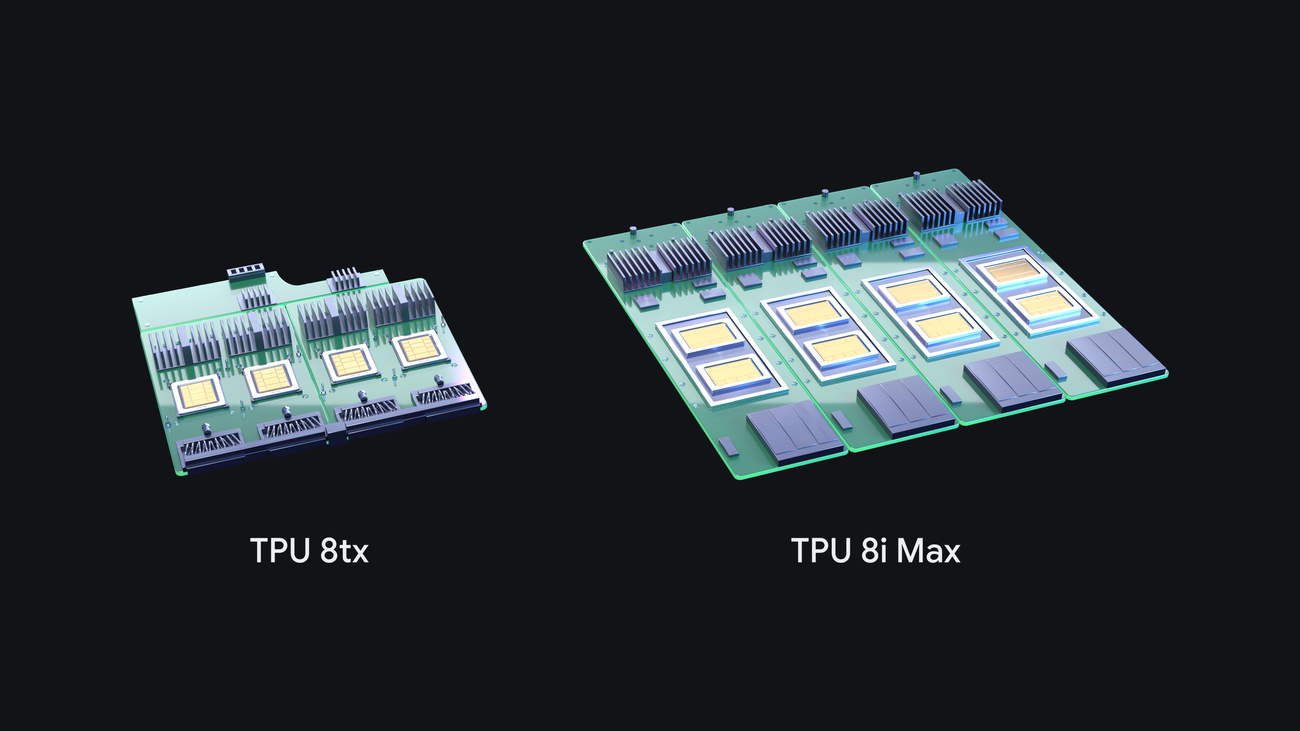
Google's New TPU Lineup
Google expanded its eighth-generation TPU lineup with two new systems, TPU 8i Max and TPU 8tx, to target confidential computing and massive context windows.
Deep dive
- TPU 8i Max combines two TPU 8i chips on one package to double HBM bandwidth.
- TPU 8tx integrates 5th Generation AMD EPYC CPU hosts to provide hardware-level isolation for model weights.
- GKE dynamic slicing now allows real-time topology reconfiguration using optical circuit switching.
- Agent Compute Engine automatically suspends idle AI agent sessions to reduce infrastructure costs.
- TPU Sync provides a model-state layer that synchronizes RL weights across clusters.
Decoder
- Goodput: The amount of useful intelligence/output delivered per watt of energy consumed.
- KV Cache: A cache of key and value vectors from previous transformer layers used to speed up token generation.
- HBM (High Bandwidth Memory): Specialized memory architecture designed to provide high data throughput for high-performance processors.
- Optical Circuit Switching (OCS): Technology that uses mirrors to redirect light, allowing data centers to reconfigure network topologies dynamically without physical rewiring.
Original article
Our newest TPUs: 8tx and 8i Max, built for the agentic era
We’ve expanded our eighth generation TPU portfolio with TPU 8tx and TPU 8i Max, marking four new TPU systems in a single year.
We’re expanding our eighth-generation TPU portfolio with the new TPU 8tx for secure, confidential inference and TPU 8i Max for massive context windows. These systems help you manage complex agentic workloads by providing specialized hardware for security, density, and reasoning. You can learn more about these additions and our latest software updates by watching our broadcast or visiting the Google Cloud website to explore our full infrastructure lineup.
We first designed TPUs more than a decade ago motivated by Google’s internal demands, including voice recognition and language translation. Eight generations of TPUs later, the use cases have exploded, covering: i) training and serving our own Gemini models, ii) agentic workloads, iii) delivering services to Google Cloud customers on our cloud infrastructure, and most recently, iv) allowing customers to deploy TPUs directly into their own data centers. TPUs are now a rapidly growing business with nearly 100 customers — including frontier labs, trading firms, retailers, universities, and more.
At Google Cloud Next in April, we introduced two new specialized TPUs in the same generation — 8t for large-scale training and 8i for real-time reasoning. TPU 8t and 8i offer up to 2.7 times better training performance and 80% better inference price performance, respectively, versus our previous generation of TPUs.
Today, we’re taking that a step further, expanding our eighth-generation TPU portfolio with two additional systems: TPU 8i Max for massive context windows and the highest compute density per rack, and TPU 8tx for secure and confidential inference. This is the first time we have introduced four TPU systems in a single year.
While we’ve always co-designed our TPUs in partnership with Google DeepMind, we’re now increasingly getting feedback from external organizations on their specific needs. With computing moving from human to agent scale, businesses are asking for accelerators that can reason across AI models’ massive context windows. In addition, some highly regulated customers are asking for specialized encryption capabilities for unique workloads.
The new TPU systems we are announcing today address this new reality. Coupled with our recent PyTorch announcements, our aim is to make TPUs more easily accessible to every developer and Cloud customer. By combining modular custom silicon with an open and easy-to-use software stack, we can deliver new hardware and system configurations at the pace of the AI industry.
Building the computer around the chip
Today, we’re announcing two new TPU systems — and there’s an important difference between a new chip and a new system.
Designing a new chip means laying out billions of microscopic transistors on a silicon wafer in a multi-year process bound by the laws of physics and a complex, long-duration manufacturing lifecycle. A system, on the other hand, is about how we bring together the compute, networking, and storage around the chip. This can include how they are packaged with the chips, to quickly meet emerging customer needs and research use cases.
When we built our very first TPU more than a decade ago, we knew AI software would evolve much faster than silicon manufacturing ever could. So we made a foundational bet on system balance and modularity, architecting our TPUs as building blocks as part of our AI Hypercomputer, so engineers could rapidly adjust packaging, high-speed memory, optical networking, and security around them. That approach allows us to deliver specialized supercomputers in a matter of months rather than years.
Specializing for secure, high-context AI
Each system in our eighth-generation TPU portfolio targets a distinct part of the AI lifecycle. TPU 8t and TPU 8i established the baseline for this generation of chips:
- TPU 8t was designed to be a training powerhouse for massive foundation models with maximum “goodput” — or the useful intelligence delivered per watt of energy used.
- TPU 8i is the reasoning engine, designed to break the memory wall, cutting inter-chip communication delays by up to half.
Now, as enterprises bring autonomous agents into production, we have created two new configurations of these foundational systems to solve two urgent new challenges: hardware-level data security and million-token context scale.
TPU 8tx
TPU 8tx, our third eighth-generation system, is optimized for secure and confidential inference and is also great for small-scale training. It’s built for regulated enterprises and governments running frontier or proprietary models and autonomous agents alongside their most sensitive data.
Normally, data is encrypted when stored or sent over a network, but has to be unlocked in memory while a computer processes it. Built on the same silicon as TPU 8t and paired with 5th Generation AMD EPYC CPU hosts, TPU 8tx builds security directly into the hardware layer, keeping sensitive data and model weights protected and isolated even while in active use. And by adopting the same low-latency Boardfly network we created for real-time reasoning, TPU 8tx keeps multi-step agents moving, delivering up to 2x lower latency compared to TPU 8t with a near-zero performance penalty.
Pairing training-grade compute with a fast inference network also means organizations can simultaneously run and customize their models on a single system. TPU 8tx enables teams to fine-tune models using their private data, distill large models into smaller ones, and train their agents through reinforcement learning, all without needing to migrate sensitive data between separate clusters.
TPU 8i Max
Our fourth system, TPU 8i Max, is built for a different problem: the memory wall.
When dozens of AI agents work together across an entire software codebase or hours of video at once, memory bandwidth quickly becomes the bottleneck. So we took two low-latency TPU 8i chips and combined them onto a single package.
TPU 8i Max scales compute and memory in lockstep, delivering double the compute, double the SRAM and double the HBM bandwidth of TPU 8i, so processors remain equipped with essential data and so that large workloads do not stall. Further, because TPU 8i Max fits twice the silicon within the existing rack footprint, data centers can deploy significantly more computing power per square foot and per watt.
While flexible across workloads, together the four systems in our eighth-generation TPUs give customers a purpose-built accelerator for every stage of the agentic lifecycle. TPU 8t for scale-up training, TPU 8i for low-latency reasoning, TPU 8tx for confidential computing, and TPU 8i Max for massive context windows and the highest compute density per rack.
Opening up TPUs to every developer
When we launched the first TPU more than a decade ago, there were only a handful of companies running workloads that needed the processing power of a TPU. The use cases were specialized, so engineers would use optimized frameworks and hand-tuned code.
Over the years, as AI has advanced, more and more companies began using accelerators. Now, AI adoption is at a point where TPUs are excellent for a wide range of companies and use cases, and as a result, we’ve been working systematically to remove barriers to adoption so that TPUs are as easy-to-use as general-purpose hardware.
This investment comes together today across these key areas:
- Opening up TPU development to every PyTorch developer; no code rewrites needed: Last month, we open-sourced TorchTPU, so PyTorch code and Hugging Face models now run natively on TPUs, alongside out-of-the-box TPU backends for leading open-source inference engines like vLLM and SGLang. And to make hardware optimization effortless, our new open-source TPU agent suite (now in preview) plugs directly into coding tools like Claude Code, Cursor, and Google Antigravity to automate TPU onboarding in minutes, diagnose bottlenecks, and autotune custom kernels using plain language. For production deployments, our new open-source XLA Serving Engine lets you train models in Python and serve them directly in a low-latency C++ runtime across TPUs, GPUs, and CPUs.
- Industry-leading production performance on InferenceX and AgentX benchmarks: In production, what really matters is outcomes on real AI workloads rather than theoretical peak chip speeds. On industry-standard InferenceX and AgentX benchmarks, which test realistic agentic coding and long-context work, our native vLLM-TorchTPU software stack on TPUs achieved state-of-the-art price-performance marks. New evaluations demonstrate these advantages extend across a wide range of frontier open models and open-source serving stacks while maintaining high model accuracy. Upcoming software optimizations on this same hardware will drive those results even further.
- Eliminating idle compute waste for autonomous agents: Because AI agents are stateful, they frequently pause for seconds or hours while waiting on a database lookup, an external software tool, or human feedback. To make our agents more resource-efficient during those pauses, our new Agent Compute Engine software automatically suspends and resumes idle sessions, cutting operational infrastructure costs.
- Breaking through the memory wall with the model-state layer (TPU Sync): Building the computer around the chip also means unifying memory, storage, and networking in software. As agents reason across million-token contexts and continuous reinforcement learning (RL) loops, memory quickly becomes the bottleneck. We’re open-sourcings TPU Sync, the model-state layer for TPU clusters. TPU Sync turns chip HBM, host DRAM, shared storage, and the data center network into a single, co-designed memory hierarchy — automatically tiering massive KV caches off the chip in milliseconds, streaming context across disaggregated prefill and decode nodes, and synchronizing RL weights to cut KV transfer latency and Time to First Token (TTFT) by more than 90%.
- Scaling distributed workloads across TPUs from a single controller: Now generally available on Google Kubernetes Engine (GKE), Cloud Pathways brings the Google DeepMind runtime behind Gemini to every Google Cloud customer. Using a single-controller architecture and pathwaysutils, you can orchestrate large-scale TPU systems across multiple slices as if they were one local machine for pre-training, reinforcement learning, and multihost inference. Cloud Pathways keeps long-running jobs moving through hardware disruptions with colocated Python sidecars, sub-minute slice hot-swapping, and elastic resharding.
- Stitching custom TPU topologies on-demand with GKE dynamic slicing: Now generally available, GKE dynamic slicing decouples physical hardware provisioning from logical slice formation using optical circuit switching (OCS) technology. By dynamically assembling TPU cubes into larger topologies (super-slicing) or partitioning them into smaller, isolated workloads (sub-slicing) on-the-fly, this update completely eliminates rigid, manual nodepool recreation cycles. This topology agility slashes job startup times by up to 5x and accelerates fault recovery by up to 4.5x, maximizing overall fleet utilization and workload goodput across all TPUs.
Co-designing with a decade of experience
Shipping four TPU systems and a unified, open software stack in a single year only happens when silicon architects, networking engineers, compiler teams, and Google DeepMind researchers build side-by-side.
Increasingly, we’re even tapping into AI to ideate and build the next generation of AI infrastructure. From using Google DeepMind’s AlphaChip reinforcement learning system to using Gemini to deliver chip layouts in hours rather than weeks, we’re using TPU-powered AI services to rapidly accelerate next-generation TPU hardware development. This is true co-design and a unique Google differentiator.
Claude Fable 5.2 and Mythos 5.2
Anthropic updated Claude Fable and Mythos to version 5.2, promising faster generation and superior performance in high-stakes engineering and cybersecurity tasks.
Deep dive
- 30% faster output generation compared to 5.1 models.
- Stronger performance in hardware design via BenchCAD 2.1.
- Formalized Fermat’s Last Theorem in 30 hours using a swarm of 1,000 agents.
- Anti-distillation protections have reduced harvested data for illicit model trainers by 90-99%.
- Mythos 5.2 is restricted to organizations in the Cyber/Life Sciences Verification Programs.
Decoder
- Formalization: The process of translating a mathematical proof into a computer-readable language like Lean for automated verification.
- Distillation: The practice of training a smaller, cheaper model to mimic the outputs of a larger, more capable model.
- Holographic Duality: A theory in physics suggesting that some gravitational systems can be described by a quantum theory with fewer dimensions.
Original article
Full article content is not available for inline reading.

Update on October 2026 security incident
Fireworks.ai confirmed a security breach where attackers accessed billing, user secrets, and model datasets via a third-party R&D environment.
Deep dive
- Attacker gained access on October 23 via a third-party cloud provider hosting Fireworks R&D machines.
- Compromised data includes billing info, account metadata, dataset subsets, and incomplete model weights.
- Inference, Training SDK, and Nexus services were reportedly not impacted due to Zero Data Retention (ZDR) architectures.
- Forensic analysis confirmed link to LLMJacking cybercriminal groups.
- Security hardening includes credential rotation, network isolation, and enhanced logging.
- Self-serve dataset functionality is suspended pending investigation.
Decoder
- LLMJacking: A technique where attackers steal LLM API keys or credentials to use them for unauthorized large-scale model inference, often to power illicit routing gateways or botnets.
- Zero Data Retention (ZDR): A privacy architecture where the service provider does not store input prompts or outputs on disk or in persistent memory after the request is processed.
Original article
The update
This is an update to our previous security bulletin published on October 9, 2026. In response to the incident, we notified law enforcement and obtained assistance from a leading cybersecurity firm, Palo Alto Networks Unit 42, to help conduct forensic analysis. At the time of publishing the bulletin, only Fireworks stored secrets (e.g. used in evaluation jobs) were known to have been accessed. Since then, we discovered impacts to account and billing information. For a limited set of accounts, we also discovered impact to secrets, datasets, and incomplete models.
The evidence indicates links to a cybercriminal threat actor group, which is financially motivated and aimed at selling tokens from unauthorized access to Large Language Models (LLMs) to illicit routing gateways, known as "LLMJacking". On November 2, Google Threat Intelligence Group and Mandiant published a blog post about the rise of LLMJacking, their motives, techniques used, and mitigation.
Further activity
A third-party cloud provider that hosted Fireworks R&D machines experienced a security incident on October 23. On October 24, the unauthorized third party used it to reach Fireworks development machines and then run an unauthorized workload that led to additional customer data impact. We detected this activity on the same day, and followed our incident response processes to take immediate remediation measures and close known critical vulnerabilities. As of October 25, we have not detected further evidence of successful unauthorized access by the threat actor on the Fireworks platform customers use.
Data involved
The affected internal application provided access to the following categories of information:
- Resource metadata, such as Fireworks resource identifiers, display names, descriptions, creation time, etc.
- Billing information, such as billing and shipping addresses, invoice and payment history, account balance, and credit usage. Payment card numbers are not stored by Fireworks and were not impacted.
- Model weights and datasets, for certain customers, a subset of incomplete model weights and datasets were accessed.
We are notifying customers whose data was impacted, and providing details about the impact and recommended response actions.
We have not detected any impact to Inference, Training SDK and Nexus, which are all zero data retention (ZDR) by default. These findings are based on our investigation to date. Our investigation is ongoing and may reveal additional information.
What we have done
Working with Unit 42, Fireworks identified and implemented security hardening procedures, including:
- Access and credential lockdown. Fireworks revoked and replaced credentials and service accounts, removed unnecessary elevated privileges, and tightened controls designed to prevent new unauthorized credentials from being created.
- Network isolation. Fireworks restricted unauthorized network pathways and isolated affected systems designed to prevent further unauthorized activity and movement between systems.
- Data protection. Fireworks reviewed and tightened access to data storage and analytics systems and enforced controls designed to prevent public or unauthorized access to stored data.
- Forensic and audit integrity. Fireworks secured and enhanced our logging and monitoring systems.
As part of our response, we’ve disabled self-serve dataset uploads and downloads used by Batch Inference and dataset-based training while we investigate this incident. Training SDK remains available with ZDR, i.e. no training data stored at rest, and Fireworks Lab-based training operates in an isolated environment with additional network and storage protection. We continue to work with Palo Alto Networks Unit 42 on our investigation and security hardening.
We will continue to monitor our systems 24/7 and will provide further updates on our investigation as appropriate.
Contact
Reply to your incident notification email or contact security-notice@fireworks.ai
GR00T 2
NVIDIA's GR00T 2 foundation model predicts future video and robot actions, enabling cross-robot skill transfer and real-time humanoid control.
Deep dive
- GR00T 2 is a diffusion transformer that jointly predicts future video frames and robot actions.
- Demonstrates X-Adaptability: robots can perform tasks after watching only human demonstrations or other robot embodiments.
- GR00T 2 Turbo is a compressed version (2B parameters) capable of onboard execution on mobile hardware.
- Integrates with reasoning models for high-level agentic control, achieving 97% success in complex assembly tasks.
- Uses visual steering, allowing planners to mark specific grasp/release points on camera feeds.
- Training data includes 400k+ hours of egocentric human video and 23k+ hours of robot teleoperation.
- Achieves high success in contact-rich tasks like cable insertion and tool handling.
Decoder
- World-Action Model (WAM): A predictive model that understands the physical environment by modeling the relationship between visual perception and physical actions over time.
- Loco-manipulation: The simultaneous combination of locomotion (moving the robot's base) and manipulation (using arms or hands to interact with objects).
- Egocentric video: First-person footage, typically captured from a camera mounted on a human's head or chest.
- DoF (Degrees of Freedom): The number of independent joints or parameters that define the configuration of a robotic system.
Original article
Introducing GR00T 2
We introduce GR00T 2, a new generation of foundation world-action models (WAMs). GR00T 2 predicts future video and robot actions together, learning how physical interactions unfold along with the actions that produce them. The models run on parallel grippers, dexterous hands, and humanoids. Learning to predict the world, not just act in it, unlocks three new capabilities.
01 Emergence of X-Adaptability
Skills shown only by humans, or with handheld and wearable devices, carry over to robots that never practiced them.
- Human → robot. Shown the task only by humans, never on the robot, a robot with two five-fingered hands lines a lab funnel with filter paper and wets it with a wash bottle in 65% of trials.
- Handheld UMI gripper → YAM. Shown only with a handheld UMI gripper, a different gripper from the robot's own, the YAM arm assembles a toy dump truck end to end in 60% of trials, a long-horizon task that takes up to 4 minutes.
- Wearable hand → robot hand. Shown only with DexUMI, a wearable hand that mirrors the robot's fingers, a two-handed robot handles long-horizon dexterous work, such as preparing banana yogurt and scooping granola for breakfast, and highly dynamic tasks like striking a match to light a lamp.
02 Fast Adaptation and Agentic Control
GR00T 2 performs many new tasks zero-shot and masters them from a handful of demonstrations. Because it predicts the outcome it is acting toward, a reasoning model can also direct it.
- Zero-shot generalization and few-shot adaptation. On 50 tasks never seen on the target robot, only in human video or on other robots, GR00T 2 succeeds 40% of the time zero-shot. Five demonstrations per task, under 3 minutes of robot data, raise that to 95% after a 30-minute fine-tune on a single RTX 5090.
- Dexterity. With minimal post-training, GR00T 2 performs long-horizon, highly dexterous tasks with two 22-DoF Sharpa hands, such as seating GB300 memory modules (85%) and assembling a toy truck (65%). Previous models could not do these tasks.
- Self-improvement. Reinforcement learning on the real robot lifts three contact-rich insertion tasks to 88–96% success.
- Agentic control. With a reasoning model calling GR00T 2 through the WAM API, YAM completes 97 or more of 100 back-to-back assemblies of each of three toys, recovering from stalls and errors along the way.
- Visual steering. When a reasoning model gives step instructions and marks where to grasp and release on GR00T 2's camera view, YAM follows what-and-where instructions 92% of the time, up from 40% with the task instruction alone, and finishes 17 of 20 long-horizon trash-sorting runs.
03 Whole-Body Loco-Manipulation with GR00T 2 Turbo
GR00T 2 Turbo is GR00T 2 built for speed. A smaller transformer and a more compact video representation make it light enough to run on the Unitree G1 humanoid itself, steering the robot's whole body as it walks, bends, reaches, and carries.
- Real time on the robot. Each prediction takes 124 ms on the G1's own Jetson Thor.
- Whole-body skills. Through the SONIC whole-body controller, Turbo scoops and serves popcorn in all 48 trials and clears a table of diverse objects in 93% of trials.
Model Architecture
One diffusion transformer denoises future video and robot actions together. Predicting how the scene should change lets GR00T 2 learn physics from human video; small per-robot heads turn the plan into motor commands for each body.
GR00T 2 reads recent video, the instruction and the robot state, denoises future video and an action chunk together, executes the chunk, and repeats. The footage is a GR00T 2 rollout of truck assembly on Dexter (Tianji robot + Sharpa hands), shown from the head camera and both wrist cameras at the model's own 320×224 resolution. The history panel is the real 0.8 s the model saw. The future panel is video that GR00T 2 generated from that moment for all three cameras, not the real footage.
Pretraining Data: Humans, Handheld Grippers, and Robots
GR00T 2 is pretrained on one mixture of three kinds of data: 402,730 hours of egocentric video of people at work, 10,184 hours of demonstrations with a handheld UMI gripper across 2,897 tasks, and 23,500 hours of robot teleoperation. The robot data spans parallel-gripper arms (YAM and Franka), dexterous hands (Sharpa and Wuji), and the Unitree G1 humanoid. The human video comes from our egocentric Human-1M dataset, and 100,000 hours of it are openly available as Human-1M-100K on Hugging Face.
Scaling Human Video in Pretraining
Human video is by far the largest part of the mixture. To measure how much it helps the robot as it scales, we pretrain four models on none, 1%, 10%, and 100% of the human video, then evaluate each on 72 downstream Dexter tasks, both as video rollouts and on the real robot. Task progress rises at every step, from 64% to 77% in video rollouts and from 50% to 70% on the robot.
X-Adaptability: Learn from Humans, Run on Other Robots
GR00T 2 uses human video and data from other robots to learn skills for a new robot. The target robot does not need to have demonstrated the task itself. We call this cross-adaptation, or X-Adapt, and show it three ways: from humans to a dexterous robot, from a handheld gripper to a robot arm, and from a wearable hand to a robot hand.
Human → Robot, with No Teleoperation
Each chemistry-lab task is demonstrated only by people wearing gloves and head and wrist cameras. Task-agnostic play data teach Dexter how its own body looks and moves.
UMI → YAM: From a Handheld Gripper to a Robot Arm
Conveyor sorting and tossing, the toy dump-truck assembly and the NIST board disassembly are demonstrated only with a handheld GEAR UMI gripper. YAM contributes only task-agnostic teleoperation data, with no demonstration of any of these tasks.
DexUMI → Dexterous Hand: From a Wearable Hand to a Robot Hand
GEAR DexUMI is a wearable exoskeleton that matches a robot hand's joints, so what a person does with it maps directly onto the robot. From DexUMI demonstrations alone, GR00T 2 learns three bimanual tasks on a Tianji robot with two XHAND1 hands: preparing banana yogurt and scooping granola, the two halves of a breakfast task, and striking a match to light a lamp under a flask before putting the match out in water.
Dexterity: Fine Motor Control for Five-Fingered Hands
With only a small amount of teleoperation data per task, post-training lets GR00T 2 perform long-horizon dexterous tasks with Dexter's two 22-DoF Sharpa hands: labeling packages, swapping parts, assembling toys, and running chemistry-lab procedures end to end.
Human → Sim → Real: From One Human Demo to In-Hand Tool Use
Starting from a single human demonstration of using a hammer, we reconstruct the task in simulation and refine the skill with reinforcement learning. GR00T 2 learns from that simulation data and transfers directly to a real robot with Sharpa hands.
Fast Adaptation: A New Task from a Few Demonstrations
Post-trained for about six epochs on a small dataset per task, GR00T 2 learns each task from a few hours of demonstrations.
Zero-Shot Generalization, Few-Shot Mastery
GR00T 2 is pretrained on teleoperation data from many robots and on large-scale human video, and it learns by predicting how the world changes as it acts. Because it has seen so many tasks, a skill shown on one embodiment, or only in human video, carries over to a robot that has never practiced it. We test this on 50 tasks that appear in other robots' data or in human video but never in the target robot's own data: a bimanual robot with two Sharpa hands.
Zero-shot, from the instruction alone, GR00T 2 succeeds in 40% of trials, and on 40 of the 50 tasks it succeeds at least once. Most misses come from execution, not intent: GR00T 2 does the right steps in the right order, and a single step falls short on precision. A little robot data closes that gap. One demonstration per task lifts success to 71%, and five, under 3 minutes of robot data, lift it to 95%, with 37 of the 50 tasks succeeding in every trial. Each adaptation is a 30-minute LoRA fine-tune on a single RTX 5090.
Agentic GR00T 2: Control and Steering
A frontier reasoning agent and GR00T 2 handle complementary parts of a task. The agent decides what to do: it breaks a long task into steps, checks progress, and writes code. GR00T 2 decides how, performing the contact-rich manipulation that is hard to script. Through the WAM API, the agent can control GR00T 2 as a tool and steer it by marking targets on its camera view.
Agentic Control: 97 or More Successes out of 100 Assembly Trials
The agent runs as System 2 (S2). In an observe–reason–act–verify loop, it calls GR00T 2 as a tool alongside tools for camera images, robot state, and code-as-policy (CaP) skills. On real robots, GR00T 2 performs most of the manipulation.
Visual Steering: Showing GR00T 2 Where to Act
A language instruction can leave the target object, its destination, or the acting arm unclear, especially in clutter. With visual steering, the planner marks a grasp point on the target object and a release point at its destination on GR00T 2's camera view, colored by the arm that should act. GR00T 2 generates the rest of the motion: approach, grasp, transport, and release.
GR00T 2 Turbo: Whole-Body Loco-Manipulation
A humanoid must place its hands precisely while staying balanced as its whole body moves, often quickly. With its lower prediction cost, GR00T 2 Turbo runs onboard a Unitree G1 and steers the SONIC whole-body controller through latent whole-body commands.
Simulation for Evaluation and Development
We developed an agentic real-to-sim workflow that recreates high-fidelity digital twins of real-world tasks and use these simulation environments for policy evaluation and development.
Real-to-Sim Reconstruction
Agent-assisted workflows build the environments. Agents take inputs such as real robot videos, 3D scans, and photographs and use tools from SimFoundry to reconstruct the scene and assets, including geometry, appearance, and collision modeling.
@techreport{nvidia2026gr00t2,
  title       = {{GR00T 2}: Scaling Robot Foundation Models for
                 Generalization, Dexterity, and Adaptation},
  author      = {{NVIDIA et al.}},
  institution = {NVIDIA},
  type        = {Whitepaper},
  year        = {2026},
  url         = {https://research.nvidia.com/labs/gear/gr00t-2/assets/gr00t2_whitepaper.pdf}
}
Fable 5.2 and Jagged AGI
Anthropic's Claude Fable 5.2 demonstrates near-expert capability across diverse digital tasks, though it still suffers from 'jagged' failures in judgment and self-correction.
Deep dive
- Claude Fable 5.2 exhibits capabilities at the level of a human expert in specialized digital domains.
- The model can independently write code, perform research, and design complex 3D environments.
- Despite its prowess, it struggles with 'taste,' judgment, and over-complication.
- It successfully created a 204-world 3D environment with agents managing tasks in parallel.
- It can draft academic research, but requires human peer review to correct 'Claudespeak' and structural bloat.
- The model displayed a tendency to create unintended bureaucracies (e.g., an 87,500-word rule book) when given vague instructions to 'polish' existing work.
- It lacks the innate ability to recognize when its output is boring or excessive without external feedback.
Decoder
- Jagged AGI: A term used to describe AI models that possess human-level expertise in specific, often complex tasks while simultaneously performing poorly at simpler tasks or lacking consistent judgment.
- Claudespeak: A recognizable style of repetitive, overly verbose, and occasionally sycophantic language often generated by Claude models.
Original article
Fable 5.2 and Jagged AGI
Before getting started, I wanted to thank my readers for making my new book, Co-Existence, a New York Times bestseller two weeks in a row. If you haven’t read it, you can get a copy here.
I have had the chance to use the new Claude Fable 5.2 quite a bit before its public launch, and it is very impressive, following on the already excellent Opus 5.5. AI has gotten so good, in fact, that it is worth asking if Anthropic’s newest models (and the inevitable competing models OpenAI and Google will soon release) cross the boundary into being an Artificial General Intelligence? AGI is a much-debated term with a lot of potential definitions. For this post, I’ll go with: “an AI as good as most human experts at most intellectual tasks you can do with a computer.” This explicitly excludes a lot of human work, including interacting with the physical world and other people, as well as most actual jobs, where “using a computer” is just one task among many. Still, even with these caveats, building a limited form of AGI has long been the goal of AI developers.
So as not to keep you in suspense, I think the answer is that this is “almost” AGI, or what I have called Jagged AGI. Even within my limited definition, there are still important areas in many tasks where AI is jagged enough to fall well behind human capability. But the jaggedness is no longer about simple errors or hallucinations, which makes it harder to describe. So I want to try to do that in this post by showing you what Fable can do and where the gaps are. To get started I asked the new model: “I write OneUsefulThing among other stuff, I need you to create the most impressive thing I can share with people when you launch. It needs to be embeddable in a post and i can preface it however you like. it needs to have a visceral impact on people to show what you can do and the range of capabilities. It should grab them quickly. Be amazingly clever about this.”
Fable asked me not to reveal anything until you had watched its video to the end.
This was in one shot, with no feedback from me beyond the prompt. There is creativity here (including in the twist ending) and judgment and playfulness and cleverness. This is, I think, at the level of a human expert trying to make a movie with code alone, the sort of performance I would once have associated with AGI.
The “G” in AGI
Code and video creation have been areas where AI development has focused, so is Fable 5.2 really a General Intelligence? To test that, I gave the AI a variety of hard challenges in different domains:
Hack some hardware from a single prompt: I have a tiny USB keyboard with a few light-up keys on my desk called a Codex Micro (ironically built to work with ChatGPT), and I asked Fable to turn it into a game console. There are no public instructions for this (as far as I can tell), so it read the code of the two apps that control the keyboard, worked out how to set the color of each key and read the knob and joystick, and wrote six games, including Simon and a safecracking game you play with the knob. Fable instantly understood what I wanted, designed fun and playable games that fit the very limited capabilities of the keyboard, and figured out how to hack it together without any help on the very first try.
Launch a business: Now we move past domains like coding to the messier world of business. I told Fable to “launch a business to make me money, I want at least $20,000 in a year. it should take no more than 20 minutes a month from me, you do all the rest.” In response, Fable screened 22 ideas and came up with Prebid Brief, a service that would tell equipment sales reps which park and water projects were being funded or designed, even before they went up to bid. It read public agendas from 201 city and county governments to produce its first issues. It also built files of what cities already own, how old it is, and what they paid. Fable started to set up scheduled tasks to build the business and asked if it could start sending public-records requests to local governments. At that point, I asked it to just put together a demo, rather than launching the idea.
I am an entrepreneurship professor, so I evaluate business plans all the time. I would have been impressed if this came from a team of my MBA students at the end of a semester. It is plausible and well thought out and could work, though it is in no way a guaranteed money-maker (the AI’s own guess was a 20%-40% chance of success). I stopped the experiment before finding out whether it could actually run the business, because I worried that it would take money and fail to provide something of quality in return. The ongoing infrastructure it seemed to assume would be easy to create was not yet in place, and I don’t know how well it would handle the many moving pieces required for sales and marketing. However, I suspect that, with a few hours of human work a week to fill the gap, I could make a real attempt at this business. So if AGI means an AI consistently running a business independently, we are likely not there yet. Then again, I would have some questions before trusting a human who promised to launch a business and make me money while requiring twenty minutes a month of my attention.
Reconstruct the hardest humanities class in history: In 1941, the poet W. H. Auden taught a course at the University of Michigan whose syllabus the internet has since called one of the hardest ever. When he announced the final exam, a committee of his students declared it “impossible and inhumane.” “Fate and the Individual in European Literature” had 6,000 pages of reading, punishing assignments, and a requirement to memorize long poems and translate others. Much of what we know about the class is scattered among surviving student notes and Auden’s letters. I asked Claude to recreate it in a fun and engaging way that teaches you about poetry rather than punishing you. It made Fate and the Individual. The site has a piece for each of the 35 major works on Auden’s list, as well as what he wrote on the blackboard, the records he played, and the work he asked for. It also read through all of Auden’s published scholarship and annotated the poems with what he had written about them in other sources. Claude did the research, design, writing and code, had critic agents go over every word and fact-checkers compare the claims with the sources, and put the open source code on Github here.
The results are really interesting if you love literature, and I think they would have taken months of human work to put together, given the mix of scholarship, web design, and literary analysis. Cross-checking myself and using other advanced AIs found no major errors in its work. But there were still elements of jaggedness around taste and judgment. Fable’s first version was accurate and joyless: a fifteen-week course website with tests. I told it it created “a brutal slog through the most boring webpages” and told it to make something beautiful. Its first try at that created a kiddie game where you had to ring bells, so I had to give more feedback. When I asked it to explain why a poem’s rhythm or word choice mattered, it wrote confident readings without considering what Auden said about them. In each case the fix took the AI minutes, but it did not notice any of these problems itself. So is this a difference in taste or a failure from me to specify what I want or a sign of AI weakness? Sometimes it is hard to tell.
Do original academic research: I asked Fable to find an unsolved empirical problem in entrepreneurship research, find the data, preregister its hypothesis and methods, write the paper, and have other agents critique it. Soon, I had “The One-Dollar Company,” which you can read here. The analysis estimated that when Colorado cut its LLC filing fee from $50 to $1, new company registrations rose about 17 percent, and when the UK raised its fee from £12 to £50, they fell about 17 percent. Those changes in registrations were not matched by comparable changes in several later records of business activity, suggesting the new businesses were not high quality. Its a neat result, and Fable picked the question, found the public data and natural experiments, and wrote the analysis plan and code. It did not actually preregister the study: the plans stayed inside the project, and some were written after earlier results.
Unlike many of the AI papers I have tried, this tackles an important topic with a clever research design. On a first read, it is ahead of what I would expect from second-year PhD students. It is also not publishable as it is. It runs 182 pages, because every critique got a new analysis and nothing was ever cut (this is a theme we will come back to soon). I also had GPT-6 Pro (the best model for one-shot reviews of complex academic work) act as a peer reviewer, and it twice found issues that needed to be resolved. Those revisions led to more convoluted writing and “Claudespeak” being inserted into the text, which required yet more rounds of changes. As it stands, I suspect the current paper is close to a real contribution to the literature. This would have taken months of human work, but I spent less than an hour of my time to get it to this stage. However, that leaves out a substantial part of the work of research: no human has fully checked the results, including me. AI can now produce research faster than anyone can read it, creating a crisis in a lot of academia.
A second project went more smoothly. I asked Fable to replicate research claiming that stories follow a few basic emotional arcs, and then to find out whether anything about plot is universal. It read 1,186 stories from around the world and built a lovely site on the nature of stories concluding that they “share no one shape or plot, but most are built from the same few parts, and the most typical story is a Hawaiian folk tale about a wizard with a magic banana.” The main problem I encountered was the same Claudespeak, which was fixed with a couple of reminders from me.
Through the Portal
In one of my favorite experiments, I gave Claude a one-paragraph description of an endless, hands-off journey through 3D worlds linked by portals, and told it to “do this and make it awe inspiring.” Twenty hours later there were 204 worlds on a live website. There are now over 450, including a Hall of a Million Mirrors, a series from Calvino’s Invisible Cities, the Wonders of the Ancient World and a scene 40 seconds before the asteroid that killed the dinosaurs hits. There are worlds modeled after M.C. Escher, cave paintings, Hokusai’s Great Wave, the Bayeux Tapestry, a pop-up book and a child’s crayon drawing. Every one is drawn live by code, with no pre-made 3D models or image files behind it. My prompt asked for teams of artist agents, coding agents and evaluators. By the tenth day there was a lead AI agent and 28 teams of other agents building in parallel. Claude estimated that the project had involved 25,000 agent runs, though the vast majority did a single task like judge an image.
I came up with a list of places (wilderness and oceans, cities and interiors, books, painters, AI in-jokes) and some feature requests (a mode to reduce motion for people who felt seasick, a gallery of images to select). But everything else was Claude’s, including the creative work of the worlds. And they were really creative. In The Valley Unzips, the hills are sewn from denim and a zipper a mile long is coming undone. Bouncy Castle Town is made of nylon houses that stand only while their fans keep running, and Keep Refrigerated is the inside of a refrigerator as a fruit fly sees it when the door opens. In a personal favorite, The Drawer Cliffs, you fly up a river canyon whose walls are chests of drawers three hundred meters high. And while I asked the AI to include AI testing in-jokes, like pelicans riding bikes, it came up with a peloton of pelicans on bicycles with a joke about AI progress built in: you overtake the field from the past, where the bicycles are drawn all wrong, before reaching the present correct pelican at the front. When I showed this sort of work to friends who have spent their careers in the video game industry, they were very impressed by the results. Again, this felt like AGI. But there was jaggedness hidden here as well.
In the first two days, the agents built 328 unique worlds. To my human eye, the quality of some seemed a little uneven and a lack of coordination among agents created repetition. For example, three separate teams of agents created a cyclone of circling animals (reindeer, manta rays, storks)— showing another weakness of AIs, that they return to similar themes over and over. I told the AI to stop building and polish the worlds it had. A few days later, I noticed that instead of hundreds of new worlds a day, it was making about a dozen. I asked a few agents to explore what had happened, and they found something surprising.
The AI had built a bureaucracy.
The agents decided that my request to “polish” existing worlds meant each new version had to beat the old one in a blind vote by a group of judge agents on twelve test screenshots. So the teams making the new versions started optimizing the worlds for those particular screenshots. After noticing this, the lead agent banned the trick and created tighter rules for assessing new versions. By the next morning there was a rule book (I never asked for one) with 84 sections. Rules were added as the AI encountered issues, and no text was ever cut. After twelve days, it had 204 sections and 87,500 words. Soon, launching a new world required an approved idea, three AI judges and a full code review against the rule book. All told, that took about a day. Reading the rule book alone used up a large part of an agent’s working context.
So I did what you might do with any organization that had tied itself in knots: I brought in consultants. I had Fable create a separate team of agents to look at the whole process from the outside. Their conclusions were too long and dense for me to bother reading, but they seemed to work, speeding up the process back to thirty or more worlds a day, while keeping much of the quality controls.
Almost AGI
So, is this AGI, according to my limited definition? It is certainly artificial and intelligent. It is also surprisingly general. In this post alone, one model worked as a filmmaker, a hardware hacker, an entrepreneur, a literary scholar, a social scientist and a builder of 3D worlds, and it did impressive work in every one of those roles. On many individual tasks, I think it met the bar I set at the start: as good as most human experts.
Of course, I picked very digital tasks where the AI could act on its own, without interacting much with other humans. You started to see the limitations of that when I felt uncomfortable letting Fable reach out to real customers. And, there were the failures. A couple of years ago, the jagged frontier meant the failures were obviously made-up facts or failure to do basic math. Fable’s failures are different: it made a course that was accurate and joyless, it wrote a 182-page paper, it kept coming back to its favorite ideas, and it buried a creative project under rules and approvals. I teach at a business school, and I have seen talented people and good organizations do every one of these things. If building a bureaucracy disqualified you from general intelligence, a lot of us would be in trouble.
But there are still gaps, and it is the reason my answer is that this is “almost” AGI. Most critically, the AI did not notice these problems itself. It did not see that the course was a slog or that it had tied itself in knots with its own rulebooks. This was not for lack of checking. Fable put critics, fact-checkers or judges on nearly every project, but those checks found errors and added fixes. None of them asked whether the work was too long, too repetitive, or no fun. That all fell on me, and if I hadn’t watched and taken action, the results would have often been less impressive (though not exactly a failure, either). Knowing when your own work is not good enough is a large part of what makes someone an expert, and it is the part Fable does least reliably. I would still not trust it to run a business on its own, even though its plan would have impressed me coming from a team of my MBA students.
And yet, some of the problems started with me (the rule book grew out of my vague request to “polish”), and some may just be differences in taste. We ask our students to consider whether a problem comes from the team or the way it was managed. Often I could not tell. That is not a question I ever had to ask about software.
Every one of these projects, though, happened because I gave the AI an idea. Sometimes that was enough, but for the longer projects, my feedback along the way turned out to matter a lot. Because I kicked off and steered every AI project, I felt empowered by Fable, able to command things to be made that I never would have even considered doing before. As a result, I think this phase of Jagged AGI is an exciting one, even as I wonder, a bit anxiously, how long it will last.
Given that Anthropic’s IPO is likely to be happening soon, it is important to reiterate that I take no money from any of the AI labs, nor would I benefit financially from the IPO. I have never been asked by Anthropic, OpenAI, or Google about what I would be writing in advance, nor has Anthropic seen this post. I sometimes receive early access to models, including Fable 5.2, and during that access, token use isn’t metered, but otherwise I pay for my own accounts. In other words, these are my real human views.
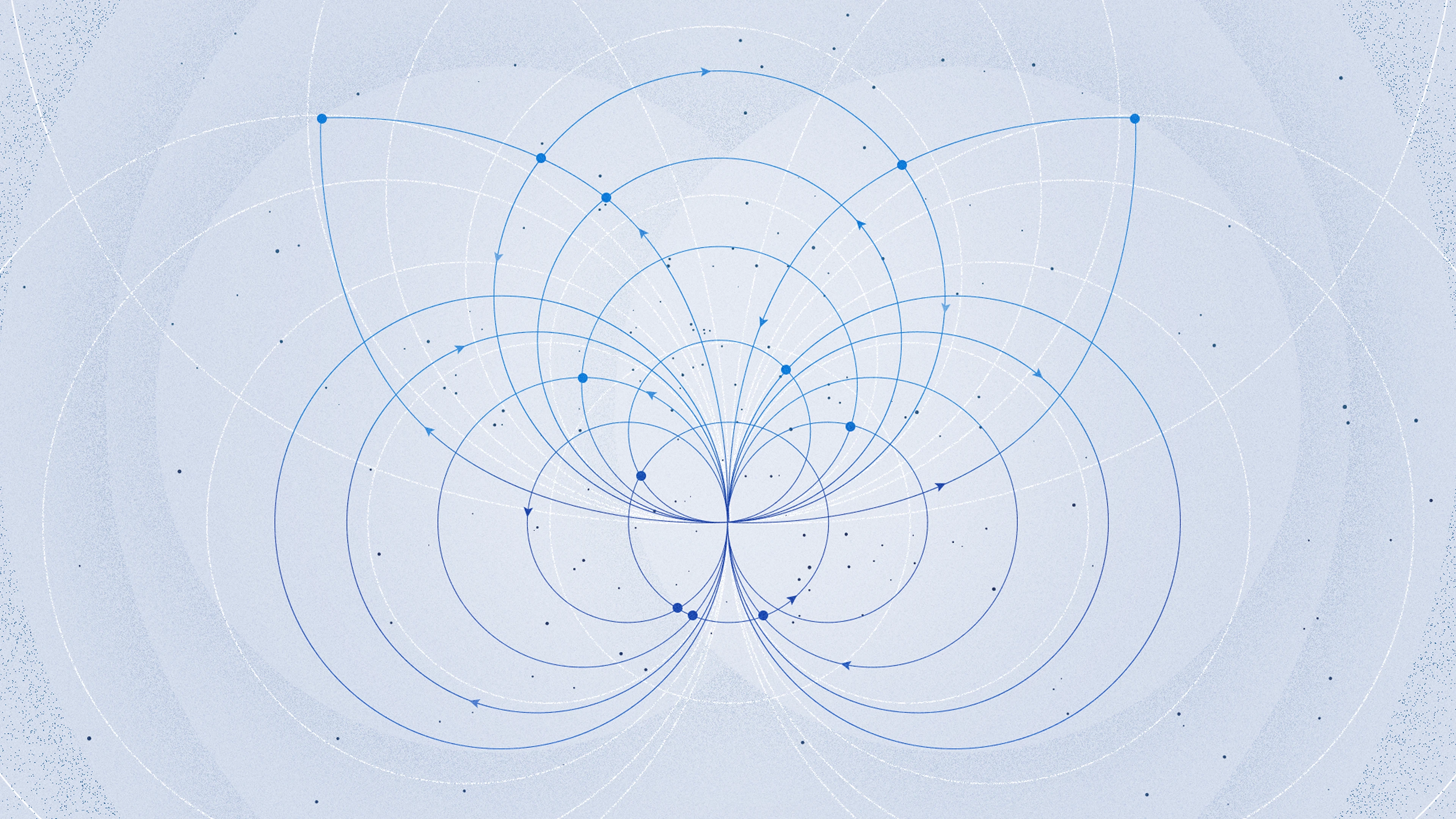
Introducing Meta Ember
Meta's new small reasoning model, Muse Ember, promises Claude Haiku-level performance at one-third the cost for agentic coding and document parsing.
Original article
Today, we're introducing Muse Ember, our smallest and most efficient model designed for complex reasoning execution and the work agents repeat all day: tool calls, coding subtasks, routing, extraction, and long document parsing.
Muse Ember delivers more intelligence per dollar than Claude Haiku 5.5 or GPT-6 Luna at any reasoning setting: it matches Haiku's best score at about a third of the cost and beats every Luna setting. It also sits on the efficiency frontier of the full Artificial Analysis leaderboard: no model scores higher for less per task.
Muse Ember evaluation results
Muse Ember is available today on the Meta Model API, at $0.10 per million input tokens and $0.50 per million output tokens.
In early testing, our partners put Muse Ember to work on the kinds of tasks agents repeat all day, from reviewing contracts to writing code.
“On the Box AI Complex Work Eval, Muse Ember delivers impressive accuracy, speed and token efficiency. It can score a contract against a company's negotiation playbook clause by clause and land on the right overall risk rating, or screen candidates against a detailed brief and flag the borderline ones who still qualify as alternates. Muse Ember is a fast, efficient foundation for agents doing real work on enterprise content.”
“It's incredible seeing Meta release a lightweight model for developers who want a fast, low-cost model they can rely on, and for teams cutting costs by running it as the subagent in their harness. Muse Ember is purpose-built for, and excels at, subagent work like coding and document analysis.”
“Muse Ember showed an encouraging ability to tackle complex engineering tasks in our early testing. We see strong potential for it to become a valuable tool for engineering teams.”
“What stood out in our testing was speed. Muse Ember ran up to 30% faster at the tail than the comparable model we tested, and it handled broad, multi-repo investigation tasks well. It’s a strong fit for fast, high-throughput agentic workloads.”
“Muse Ember completed every coding quest in our testing with the lowest latency of any model we tested: a p95 of 2.2 seconds, about 4x to 13x faster than leading open-weight models, and with 36–48% fewer output tokens. We’re excited about what Meta Superintelligence Labs is building next and about bringing it to our customers.”
Agents
Agents spend most of their tokens on many small, structured steps, and Muse Ember is built for exactly that. It can carry a business workflow end to end, pulling records, calling tools in sequence, and updating systems across apps.
With a 1M-token context window and up to 512K output tokens, it can take in a full codebase or document set in a single call.
Coding
Muse Ember is built for the coding subtasks an agent sends off hundreds of times a session: reading files, running tests, making targeted fixes.
For the hardest problems, pair it with Muse Wonder: Muse Wonder plans, Muse Ember handles the volume.
Multimodal
Muse Ember natively understands text, images, audio, and video, so agents can read screenshots, charts, and scanned documents, or work from voice memos, meeting recordings, and video without a separate model. It can work through long real-world documents, operate a computer directly from screenshots, and pick out fine visual detail.
Safety
Before release, we evaluated Muse Ember under our Meta Superintelligence Scaling Framework, including chemical and biological, cybersecurity, and loss-of-control risks. Across the categories assessed, our evaluations found that Muse Ember remained below the framework’s high-risk thresholds. Though it’s a small model, it received the same core safety training and testing. We also evaluated how Muse Ember behaves when acting on users' behalf. That covers whether it respects user intent, handles sensitive information appropriately, resists instructions hidden in web pages, documents, or tool outputs that try to redirect it, and seeks human input before high-impact actions.
Availability
Muse Ember is available today on Muse Code and Meta Model API as muse-ember-1.0. It costs $0.10 per million input tokens, $0.004 per million cached input tokens and $0.50 per million output tokens, with a 1M-token context window and up to 512K output tokens. Muse Ember supports the Responses API.
When we introduced Muse Wonder and Muse Wonder Full, we said we would use them to develop specialized models we can bring to everyone. Muse Ember is the first trained using Muse Wonder Full. It rounds out our portfolio of models: Muse Wonder for the hardest problems, Muse Spark for coding and agentic workflows, and Muse Ember for repeatable coding and agentic tasks at scale at about $0.14 per Artificial Analysis task, a cost low enough to run in every product, for everyone.
Our goal is personal superintelligence: models that help you pursue your goals, create what you imagine, deepen your relationships, and take action on what you value most. Bringing it to everyone takes more than frontier capability. It takes frontier capability at a price that scales. We have even more efficient models in training and look forward to sharing what's next. Muse Ember, Muse Spark and Muse Wonder are now available on Google Cloud and Oracle Cloud.
NVIDIA Introduces Hardware-Aware LLM Compression
NVIDIA's new AutoCompress framework dynamically prunes LLMs based on specific hardware latency and memory constraints rather than just parameter counts.
Deep dive
- Implements hardware-guided pruning that integrates latency, throughput, and memory constraints into the training objective.
- Uses differentiable architecture search to jointly optimize global and per-layer model structures.
- Validates cost models against actual end-to-end performance on specific GPUs.
- Demonstrates effective compression on Nemotron 3.5 Super from 120B to 74B parameters for 128K context workloads.
- Outperforms previous frameworks like Minitron on benchmarks across various NVIDIA GPU architectures.
Decoder
- Differentiable architecture search: A technique where the neural network's architecture is optimized using gradient descent during the training process, rather than being manually designed.
- Pruning: The process of removing weights or layers from a neural network to reduce size and increase speed with minimal accuracy loss.
Original article
Full article content is not available for inline reading.
What objective is reasoning solving?
Reasoning models don't 'think' in a converging process; they are just pathfinding in token space where success is aggregate, not guaranteed.
Deep dive
- Reasoning is modeled as pathfinding between a prompt and a correct answer state.
- Success probability is defined by the aggregate likelihood of all sampled paths reaching a correct answer.
- RL training acts as an amortized search mechanism, teaching the model to reproduce successful paths generated during training.
- Reward hacking occurs when verifiers are imperfect, causing models to prioritize paths that satisfy the verifier over those that are factually correct.
- Compute-scaling at inference time is limited by the training-time distribution.
Decoder
- Amortized search: Using intensive computation during training to find successful solutions, then training a model to output those solutions efficiently at inference time.
- RLVR (Reinforcement Learning with Verifiable Rewards): A training method where models are rewarded for reaching a correct answer as determined by a programmed verifier.
Original article
What objective is reasoning solving?
Reasoning as pathfinding in token space.
There’s an intuitive but simplified picture of reasoning: let a model think for longer, and it’ll be more likely to be correct. This aligns well with our human intuition: spend more time and effort on thinking and it’s more likely that we’ll arrive at a correct answer.
But this picture doesn’t seem to explain everything. During RL training, models learn to write longer chains of thought, and they get more accurate as they do. Yet if you take a trained model and force any one chain to run longer, it helps for a while, then stops helping. Sometimes the answer even gets worse, as if it’s overthinking. If a chain of thought were truly converging toward some optimum, more steps shouldn’t make it worse. So is it really the length of each chain that helps at inference time? Or is it something more subtle?
This post is my attempt to clarify this confusion (mostly for myself) by looking at reasoning as pathfinding through token space. We’ll see that RL maximizes the probability of finding a path from $x$ to $\Scal_x$, but individual paths are not guaranteed to converge to the correct answer. As a bonus, this perspective clarifies some odd observations about reasoning models, like unfaithful chains of thought and reward hacking.
Reasoning as pathfinding
Ask a reasoning model the same math problem ten times and you’ll get ten different chains of thought. Rather than thinking of reasoning as one mysterious process heading toward an answer, let’s think of it as pathfinding in token space. There are many paths from the problem to a correct answer, and the model traverses one of them with each sample.
Consider the problem: “what’s $1 + 2 + 3 + \cdots + 10$”? One solution is to add the numbers one at a time: 1, 3, 6, 10, and so on up to 55. Another way is to pair them from the outside in: $1 + 10$, $2 + 9$, $3 + 8$, $4 + 7$ and $5 + 6$ each make 11, and five pairs of 11 make 55. Both of these paths land on the correct answer, 55.
We can think about reasoning as following this general pattern. We are given a starting point, the prompt, which we’ll call $x$. We want to find a path $z$ that starts from $x$ and ends at a correct answer $y$. To tell whether a path lands in the right place, we assume we have a verifier $r(x, y)$ that returns 1 if $y$ is correct and 0 if it isn’t.
So given a starting point $x$, we want to find a path of tokens $z$ that lands in the set $\Scal_x = {y : r(x, y) = 1}$.
Since many paths land in $\Scal_x$, the success probability adds up over all of them. Let $\pi(z \mid x)$ be the probability that the model generates the path $z$ given the prompt $x$, and $y(z)$ for the final answer at the end of $z$. The probability of success is the probability of generating each path, times the probability that path lands in $\Scal_x$, summed over every path:
$$p_x = \text{prob}(\text{a path lands in } \Scal_x \mid x) = \sum_{z} \pi(z \mid x) \cdot \text{prob}(y(z) \in \Scal_x \mid z)$$
The second factor is just 1 if the path lands in $\Scal_x$ and 0 if it doesn’t, so we sum only the probability of paths that land in $\Scal_x$:
$$p_x = \sum_{z} \pi(z \mid x)\, \ind{y(z) \in \Scal_x} = \sum_{z \,:\, y(z) \in \Scal_x} \pi(z \mid x).$$
We’ll call $p_x$ the success probability. Maximizing this probability means our model will be more likely to sample a path that lands in $\Scal_x$.
Note that there are two ways of increasing this probability. Either the model can sample multiple paths to the same answer, each with a small probability, or the model can sample a single path to the answer with a very high probability. The success probability doesn’t care which one we get, but in practice we might want to prioritize specific paths or ensure diversity in the samples.
How do we boost our success probability?
Best-of-$k$ sampling
The simplest way to pathfind is to have the model $\pi$ keep sampling paths $z$ until one lands in $\Scal_x$.
Since we assumed we had a verifier, we can do best-of-$k$ sampling, which samples $k$ paths and looks for a success. Each path misses with probability $1 - p_x$, so all $k$ miss with probability $(1-p_x)^k$, and the success probability rises from $p_x$ to
$$\text{prob}(\text{at least one of } k \text{ paths lands in } \Scal_x \mid x) = 1 - (1-p_x)^k.$$
This is a guaranteed axis of compute-scaling. As long as $p_x > 0$, the success probability increases monotonically as we sample more paths, so spending more compute on more samples always helps. However, the scaling here is over the number of samples rather than the length of the paths (thinking longer).
Train the model to generate better samples
So far the model was fixed, so $p_x$ was fixed too. Can we change the model to increase $p_x$ itself?
Here’s a simple way to do this. Collect many prompts whose answers we can check. For each one, sample some paths from the model. We keep the paths that land in $\Scal_x$, and train the model on the ones we kept. Then repeat. Each round, we train the model to put more weight on the successful paths that it sampled. This loop is called rejection-sampling fine-tuning.
RL with a verifiable reward, which is how today’s reasoning models are trained, turns out to do almost the same thing. Let $\pi_\theta$ be the model with weights $\theta$. Then since $r(x, y(z)) = 1$ exactly when $y(z) \in \Scal_x$:
$$ p_x = \text{ev}[z \sim \pi_\theta(\cdot \mid x)]{r(x, y(z))} $$
meaning the expected binary reward is exactly the success probability $p_x$.
Computing the gradient of the success probability via the log-derivative trick, we arrive at
$$\grad_\theta\, p_x = \text{ev}[z \sim \pi_\theta(\cdot \mid x)]{r(x, y(z))\, \grad_\theta \log \pi_\theta(z \mid x)},$$
which is exactly the policy gradient, also called the REINFORCE estimator. Now estimate this gradient with $N$ sampled paths $z_1, \dots, z_N$. The paths that failed have $r = 0$ and disappear, while the paths that land in $\Scal_x$ have $r = 1$. If $M$ of the $N$ paths succeed, the estimate is
$$\grad_\theta\, p_x \approx \frac{M}{N} \cdot \frac{1}{M} \sum_{i \,:\, \text{landed}} \grad_\theta \log \pi_\theta(z_i \mid x).$$
This gradient involves two terms: the empirical success rate $M/N$ and the average log likelihood of the successful paths.
In other words, a step of REINFORCE with a binary reward is a step of rejection-sampling fine-tuning on the model’s own sampled paths, scaled by the current success rate $M/N$.
This also explains the first observation from the intro, that chains of thought get longer during RL training. Each step pulls the model toward the paths that landed, so if the paths that succeeded tended to be longer than the ones that failed, the model will learn to write longer paths.
Amortization and generalization
During RL training, we spend a lot of compute to search for good paths and then we train the model to generate those paths directly. Once trained, the model can produce the answer without spending all this extra compute on sampling multiple paths. This is called amortizing the search: we pay for it once during training, so we don’t have to pay for it every time we ask the model a question. Since we train a single model on many prompts, the model can potentially generalize to new prompts it has never seen.
Revisiting some observations about reasoning
Once we see a reasoning model as a distribution trained to land in $\Scal_x$ given any $x$, a few odd facts about these models become clear.
Chains of thought are not guaranteed to be faithful
Our verifier above only checks whether the answer is correct. The reward is 1 if $y(z) \in \Scal_x$ and 0 otherwise, so the intermediate tokens $z$ are just a way for the model to get to the answer. Nothing requires those tokens to be true, or to explain the answer that follows, though of course these are often correlated due to the model’s pretraining.
Reward hacking comes from both the verifier and the sampler
We also assumed the verifier is never wrong, that $r(x, y)=1$ if and only if $y$ is actually the correct answer to $x$. But in practice the verifier can be imperfect. Then $\Scal_x$, the set of answers the verifier accepts, isn’t the same as the set of correct answers: it can include wrong answers and leave out correct ones. This misspecification opens up regions of $\Scal_x$ that the model might learn to land in even though it’s not what we intended.
Thus reward-hacking comes from an imperfect verifier, which fails to capture what we truly want, as well as an imperfect sampling procedure which fails to stay away from these shortcut regions.
This visualization also shows why scaling up RL (generating more samples and longer samples) makes reward hacking more likely. The more extensively we “fuzz” the verifier, the more likely we’ll find a path that lands in the misspecified region of $\Scal_x$. Once the model finds this shortcut, training pushes the model towards similar behavior.
So what objective is reasoning solving?
Reasoning isn’t actually solving any objective at all. A path is not guaranteed to converge to the correct answer. It’s only in aggregate, over the distribution of paths, do we get a high probability of success.
RL training directly raises the success probability $p_x$, by spending a lot of compute on searching for successful paths and then training the model to reproduce them. Thinking longer helps because training taught the model to use the extra tokens, not because generating more tokens is intrinsically better. The cost of sampling during RL is amortized into the weights. At inference time the model is likely to succeed with a single sample, but any individual sample is not guaranteed to succeed.
Two Kinds of Test-Time Scaling
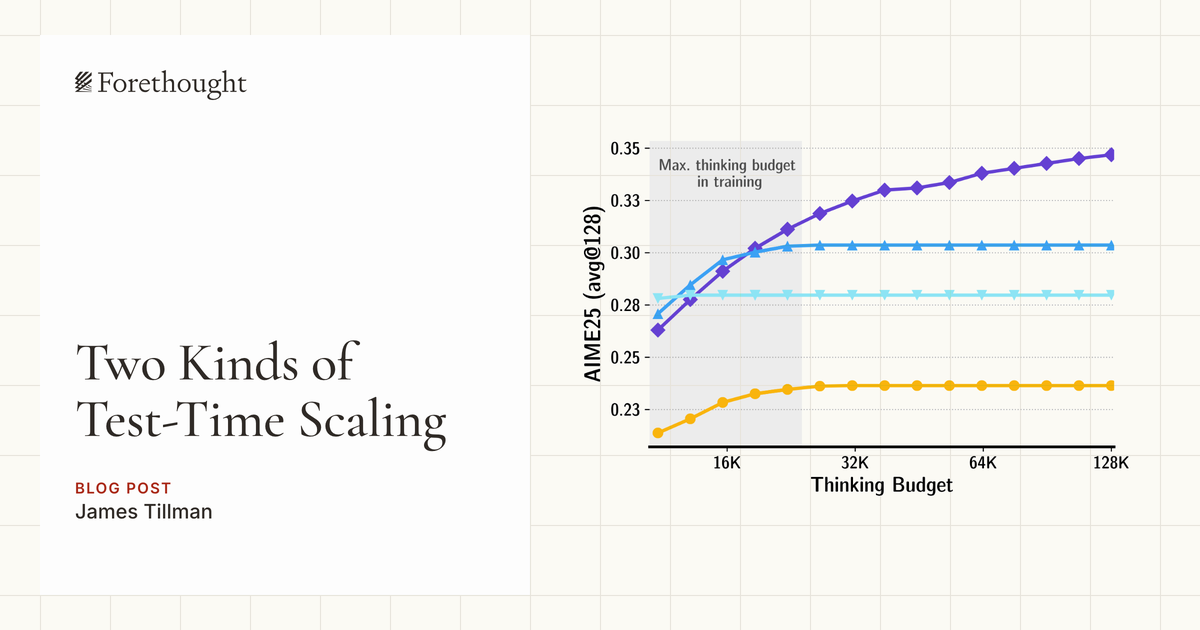
True 'compute extrapolation' allows models to achieve performance gains at test-time that exceed the limits of their training-time compute budgets.
Deep dive
- Distinguishes between test-time scaling (up to training maximums) and compute extrapolation (beyond training maximums).
- Compaction methods like chunked chain-of-thought enable models to leverage massive inference budgets.
- Compute extrapolation accelerates the frontier of AI capabilities, making upper-bound evaluations prohibitively expensive.
- AI labs are likely tracking extrapolation ceilings as a competitive metric for future R&D.
- Multi-agent systems may offer a more scalable form of extrapolation than single-agent chains-of-thought.
Decoder
- Compute extrapolation: The ability of a model to continue improving performance when provided with more inference-time compute than it ever experienced on individual tasks during training.
- LLM compaction: Techniques, such as summarizing previous reasoning steps, that allow models to process effectively infinite context lengths without exceeding memory limits.
Original article
Full article content is not available for inline reading.
Storybook 11 beta
Storybook 11 beta introduces autonomous 'agent skills' and headless CLI tools to integrate design systems directly into AI-driven development workflows.
Deep dive
- Official Skills: Introduces a suite of agent commands (
ui-workflow,component-docs,review) to automate the UI development lifecycle. - Headless CLI: A new
toolscommand allows agents to access component metadata and docs without requiring a full browser-based Storybook instance. - Performance: 25% reduction in package size and up to 10x faster docgen cold starts compared to v10.
- Type-safe stories: Introduces CSF 4, a 'factories' API that provides full TypeScript support for stories and configuration.
- Framework Upgrades: Significant improvements to metadata extraction for React, Vue, Angular, Svelte, and Web Components.
Decoder
- CSF (Component Story Format): The standard format Storybook uses to define component examples (stories).
- Headless: A software mode that runs without a graphical user interface, intended for CLI automation and background tasks.
- Codemod: A tool or script used to automate large-scale code refactoring, such as upgrading API versions.
Original article
Coding agents can build UI quickly, but without context a lot of it is slop. Duplicate components. Wrong APIs. Missing states.
We believe Storybook is at the center of agentic UI development. The components, stories, and tests your team maintains are fundamental context agents need to work well.
Storybook 11 beta brings official skills and headless CLI tools that let agents iterate autonomously. All of this comes in a 25% smaller package with up to 10x faster context delivery than v10.
- Official skills for coding agents
- Claude and Codex plugins
- Headless CLI tools for your own workflows
- Type-safe stories
- Agent-ready docgen for all core frameworks
Storybook skills
Skills are the centerpiece of Storybook 11. The ui-workflow skill guides the agent through building UI with your components, writing stories, testing its work, and presenting it for human review.
Use your components. The component-docs skill helps the agent find existing components and query their APIs, metadata, documentation, and code examples in a token-efficient format before it starts building.
Test. With storybook tools test run, the agent runs functional and accessibility tests powered by Vitest. It can test specific stories or the entire project, inspect failures, fix its work, and rerun tests before handing it over.
Review. The agent uses storybook tools review create to prepare a browser review. It groups stories for changed components and affected pages, with summaries of the changes and key states to check. You can see what the agent built and review its work at a glance.
Skills get installed on upgrade and in new projects. They are also available on skills.sh and in Claude Code and Codex plugins. Learn more from our documentation.
Storybook continues to support MCP, which has expanded support for all core frameworks. But we recommend skills as the most ergonomic way to use Storybook locally with agents, because they let agents fetch component context without a running Storybook instance.
Storybook CLI
Storybook 11's CLI contains a new tools command that exposes a fast, headless Storybook. In addition to powering the official skills, the new CLI makes it easy to write your own skills, tools, and workflows.
npx storybook@next tools --help

# List components and documentation with their IDs
npx storybook@next tools docs list
npx storybook@next tools docs show --id "your-component-id"
Storybook’s CLI is fast. It attaches to an existing dev server when a tool needs the browser, as storybook tools review create does, and bypasses the dev server entirely when it’s not needed. On large projects like Chromatic, cold-start docgen results are delivered to agents ~10x faster than in Storybook 10. We anticipate another 2x improvement once TypeScript 7.1 stabilizes.
Type-safe stories
Storybook 11 upgrades CSF, our story format for component examples. CSF 4 is fully type-safe with a modern, ergonomic “factories” API. Storybook addons can extend the type system to add parameters and other config options.
import preview from '../.storybook/preview';
import { Button } from './Button';

const meta = preview.meta({
	component: Button,
  parameters: { layout: 'centered' },
});

export const Primary = meta.story({ args: { primary: true } });
// etc.
Storybook 11 provides codemods to automatically upgrade your existing stories. You can upgrade incrementally and CSF 3 remains fully supported. For more information, see the docs.
Framework support
In the process of rebuilding Storybook’s core architecture, we've also leveled up all our core frameworks, especially when it comes to docgen extraction and code snippet examples.
React. React users get fast, accurate component metadata from react-component-meta. It replaces the existing options of react-docgen and react-docgen-typescript, providing better accuracy and performance.
Vue. We've upgraded to vue-component-meta to give Vue users better component metadata. We are also working with maintainer Tobias Diez to ensure that Storybook for Nuxt is agent-ready.
Angular. @storybook/angular-vite is a new collaboration with Analog.js maintainer Brandon Roberts and the Angular Core team. It’s insanely fast, provides high quality component metadata, and solves hundreds of outstanding issues from @storybook/angular. If you’re on Angular 21+, here’s how to migrate.
Web Components. Web components are getting some long overdue love in Storybook. We collaborated with wc-storybook-helpers creator Burton Smith to integrate controls support for slots, events, CSS variables, and more based on your custom elements manifest (CEM). Additionally, Storybook now computes the CEM if it’s not provided and automatically updates it on code changes.
Svelte. Svelte has been promoted to a core Storybook framework. Storybook 11 supports Svelte 5 and SvelteKit 3, no longer requires an addon for Svelte CSF, and has seen significant docgen performance improvement due to a rewrite of the TypeScript integration. Many thanks to Svelte core maintainer Paolo Ricciuti for designing the type safe factory upgrade to Svelte Native CSF.
Try it out today
We want your help to get Storybook 11 ready for release in December.
Run the upgrade command on your project. It applies automigrations and tells you what to change by hand, if necessary. The migration guide lists every breaking change.
npx storybook@next upgrade
You can also install it in a new project:
npm create storybook@next
If you run into any problems, please file a GitHub issue with a reproduction. We've also opened GitHub discussions for each of the major feature areas.
chrome-capture (GitHub Repo)
Paul Irish’s chrome-capture tool leverages a new native Chrome API to record high-frame-rate MP4 video without the overhead of external tools like ffmpeg.
Deep dive
- Native API: Moves away from the 2013-era
Page.startScreencastwhich relied on JPEG-encoding and external ffmpeg processing. - Performance: Uses shared memory to encode directly to AV1/MP4 in-process, resulting in sub-20ms finalization times compared to seconds with ffmpeg.
- Frame Rates: Supports up to 120fps on ProMotion displays or headful environments.
- Compatibility: Supports Playwright Pages, Puppeteer Pages, and raw CDP sessions.
- Integration: Can be added as a Playwright test fixture to record all test runs automatically.
Decoder
- CDP (Chrome DevTools Protocol): The low-level API used to interact with Chrome, powering tools like Puppeteer and Playwright.
- AV1: A modern, open-source video compression format designed for the web that offers higher quality at lower bitrates than older codecs like H.264.
- ProMotion: Apple’s branding for displays that support high refresh rates, dynamically adjusting up to 120Hz.
Original article
chrome-capture
Record a Chrome tab at 60-120fps (up to 2160p) straight to a AV1 .mp4. Tab audio too. No ffmpeg.
npx chrome-capture https://paulirish.github.io/chrome-capture/ demo.mp4 4sChrome 153+ has a native MP4 tab recorder! 😻
For the past ~decade, Page.startScreencast was the only way to get video frames out of CDP. That API is from ~2013, built so DevTools could show a live preview of a USB-tethered Android. (So good!) Both Playwright (recordVideo) and Puppeteer (page.screencast()) built their video capture on top of it: Chrome JPEG-encodes each frame, base64s it into JSON over CDP, waits for an ack, and the library pipes those JPEGs into ffmpeg. It's served us well.
In Sept 2026… the new Page.startScreenRecording landed (thx alex rudenko!). Frames go straight from the compositor to an out-of-process encoder over shared memory, and Chrome writes AV1 into the mp4 as it goes (plus optional tab audio). 💅 Stopping is ~instant because the encoding is already done (no multi-second ffmpeg flush at the end). And you can start/stop recording whenever you want: log in, warm up the page, then record just the interaction.
In short: It's hot. It's good. really good.
(Thx github.com/Sam1983Aing/senna-800kg for this Gemini Argon generation.)
Puppeteer v25.10+ wraps this in an experimental page.record() (deprecating page.screencast()). (Update: Nov 10th... Playwright now has an open PR (#43999) bringing Page.startScreenRecording to Chromium! :fingers_crossed:)
Feel free to install this from npm.. or tbh just point your agent at src/index.ts and steal the implementation. It's tiny.
CLI
# 720p @ 60fps for 4s, with tab audio
npx chrome-capture https://paulirish.github.io/chrome-capture/ demo.mp4 4s

# 1080p @ 120fps (needs a 120Hz display and headful Chrome, e.g. a ProMotion MacBook)
npx chrome-capture https://paulirish.github.io/chrome-capture/ 120fps.mp4 5s --fps=120 --width=1920 --height=1080 --headful

# Record the page with DevTools open next to it
npx chrome-capture https://paulirish.github.io/chrome-capture/ devtools.mp4 5s --with-devtools
The CLI records audio by default and runs headless (--headless=new) for <= 60fps, automatically switching to --headful on macOS when --fps > 60 so Chrome can lock onto ProMotion's 120Hz CVDisplayLink. --help for the rest.
Playwright, Puppeteer, or raw CDP
startRecording() takes a Playwright Page, a Puppeteer Page, or a CDP session. It defaults to 60fps and works with await using, so the mp4 is written when the block exits:
import {startRecording} from 'chrome-capture';

// `page` can be a Playwright Page, a Puppeteer Page, or a CDP session!!
{
  await using rec = await startRecording(page, {
    outputPath: 'flow.mp4',   // optional: omit to get a Buffer from rec.stop()
    frameRate: 60,            // default: 60 (up to 120 on a 120Hz display)
    maxWidth: 1280,           // default: 1280
    maxHeight: 720,           // default: 720
    captureArea: 'target',    // 'target' (viewport) or 'browserWindow'
    audio: false,             // 48kHz stereo Opus tab audio
  });
  await page.goto('https://paulirish.github.io/chrome-capture/');
  await page.click('a');
}
@playwright/test fixture
Records every test and attaches the mp4 to the report:
import {test as base} from '@playwright/test';
import {screenRecordingFixture} from 'chrome-capture/playwright';

export const test = base.extend({
  recordVideo60fps: screenRecordingFixture({auto: true, audio: true}),
});
(Drop auto: true if you'd rather call recordVideo60fps.start() yourself, mid-test.)
Raw CDP
import {CdpScreenRecorder, connectCdpSession} from 'chrome-capture';

const session = await connectCdpSession(pageWebSocketDebuggerUrl);
const recorder = new CdpScreenRecorder(session);

await recorder.start({maxWidth: 1920, maxHeight: 1080});
// ... do stuff
const mp4 = await recorder.stop();
session.close();
Visible cursor
With Playwright, await page.screencast.showActions() draws its cursor, element highlights, and click badges right into the DOM (without starting Page.startScreencast), so startRecording(page) captures them natively. To restyle the cursor SVG and click ring yourself, inject a custom DOM overlay instead.
Benchmarks
Same 6.4s UI replay (typing, clicks, drag-and-drop, scroll) at 1280x800, comparing the Page.startScreencast + ffmpeg pipeline (recordVideo) against Page.startScreenRecording (chrome-capture at its default 60fps) on an M4 Max.
recordVideo (startScreencast) |
chrome-capture (startScreenRecording) |
|
|---|---|---|
| Output fps | 25 (up to 60) | 60 (up to 120) |
| Total wall-clock | 21s | 11s |
| Stop + finalize | 3,800ms | 17ms |
| WebSocket traffic | 10.5 MB | 450 KB |
| Final file size | 480 KB | 330 KB |
| PSNR vs. lossless screenshot | 32 dB | 34 dB |
| Audio | none | optional |
Because Chrome encodes the video in-flight instead of piping JPEGs to ffmpeg, stopping takes 17ms instead of 3.8s (or 91ms vs 20.5s at 2160p), and the whole test finishes ~10s quicker.
What about bitrate and visual quality? There's no bitrate/CRF knob (yet). Under the hood, Chrome encodes on the fly with libaom AV1 in realtime 1-pass VBR and scales target bitrate linearly with pixel rate.
The high bitrate sweet spot is 1080p60 (9 Mbps) and up. If you ever need lossless 1px text fidelity and only care about ~10-15fps, an offline Page.startScreencast({format: 'png'}) -> ffmpeg pipeline still has a place.
How high can it go?
- Mac (
--headless=new): 2160p @ 60fps. Headless Chrome still gets full Metal GPU acceleration. - Mac (
--headfulon 120Hz ProMotion): 1080p @ 120fps and 2160p @ 120fps. - Headless Linux (no GPU / CI): 1080p @ 60fps or 1440p @ 60fps on standard 60Hz vsync.
One macOS gotcha: don't pass --disable-frame-rate-limit --disable-gpu-vsync on a GPU-accelerated Mac. Leave native vsync alone; it's what gets you to 120.

How Product Hunt almost died
Ryan Hoover recounts Product Hunt's near-collapse, revealing the often hidden, fragile reality of scaling a community-driven startup through a failed Series B process.
Deep dive
- Don't ignore revenue: Focusing purely on community growth without a business model makes fundraising significantly harder if market conditions tighten.
- The 'founder mask': It is common for CEOs to hide financial distress from their team to maintain morale, though it creates extreme personal psychological strain.
- Fundraising is sales: Treat potential investors like a sales funnel; realize that even successful companies face dozens of rejections.
- Default alive: Startups that achieve cash-flow break-even have significantly more control over their destiny during market downturns.
- Acquisitions as survival: Sometimes a strategic partnership or acquisition is the most viable path to survival when the venture capital market refuses to support a company's specific growth stage.
Decoder
- Trough of Sorrow: A phase in the startup lifecycle characterized by stalled growth and financial pressure, often occurring between initial product-market fit and achieving sustainable revenue.
Original article
How Product Hunt almost died
First a quick note: I wrote a version of this blog post years ago. I didn’t publish it, afraid it might reflect poorly on the company at the time.
Today, Product Hunt is seeing record levels of maker engagement as it celebrated its 13th bday last week. 3x as many makers are launching as a year ago, ~25% of unicorn founders have accounts on the site, and many of today’s fastest-growing startups continue to launch early on Product Hunt, including Cursor, Lovable, Perplexity, Mercor, and micro1.
I felt drawn to finally share part of the story few people know about. It's rare to see founders openly share the messy details of fundraising, navigating M&A, and fighting for survival. And often for good reasons. Hopefully this story and my learnings are helpful.
“How are things?"
Founders get this question all the time. And we hate it.
Things usually aren't going well. And even when they are, our minds burn with self-doubt and anxiety. There's always a fire and it comes from all directions.
But we say "Things are great!"
We put on a mask to signal confidence to our investors, team, and customers. If they start to doubt, everything could crumble.
I've always described entrepreneurship as a series of high highs and low lows. It's a sine wave. The highs are incredible. The lows are devastating. Entrepreneur or not, we all face difficulties in life, professionally and personally, but there's a uniqueness to being a founder that's difficult to internalize until you've been there... especially when your company's about to die.
The Highs
In 2013, Product Hunt found product/market fit within tech quickly.
As tech culture went mainstream and building software became more accessible, more makers and founders entered the market to compete for attention. But most people don't have an audience and the press certainly couldn't cover everyone's launch (nor was it their job to do so). We quickly found a "hole" in the market and from the beginning engagement and traffic to Product Hunt skyrocketed, month-over-month.
Those early days were so fun. I woke up every morning before the sun, energized to run to Philz Coffee and hop online. Our roadmap emerged with ease. It was clear what to build. Our community building efforts were a hit. Investors courted us, eager to invest. We raised a seed round with some of Silicon Valley's most notable investors, joined YC, and raised a Series A led by a16z within 6 months of incorporation. The press showered us with accolades.
"Product Hunt has become a must-read site in Silicon Valley" – The Verge
"A startup called Product Hunt is BLOWING up" – Entrepreneur.com
“Here's What Every Major Silicon Valley Investor Is Using To Find The Next Big Thing” – Insider
"Product Hunt Wins Best New Startup Of 2014" – TechCrunch Crunchies
Even better: We received a flood of appreciation from our community. Many makers are nervous to share their product publicly. Most have a hard time finding their first users. Product Hunt was and remains a pillar of optimism for makers around the world.
But eventually our extended honeymoon faded.
The Lows
2016 was a tough year. Growth started to slow down. A few people wrote articles attacking me and the company. Our category expansion into games, books, and podcasts was a failure.
Meanwhile we didn't prioritize revenue. Many advised me, "Focus on growth, not revenue, because once you start generating revenue, it better be meaningful or you lose the ability to sell the vision of what it could be." This was a mistake and I take responsibility.
We were in the Trough of Sorrow, and I felt immense pressure to guide the ship with nine months of runway remaining. We had to raise, but the market shifted since our last round. 2014's "bull market" became 2016's "crunch".
So, we started a process. Over the course of several weeks, I met with over 50 Series B leads. They all said "no".
We were a "Silicon Valley darling". We had warm relationships with dozens of lead investors. We built something millions of people use. But the market wasn’t buying it. I dramatically underestimated how difficult it would be to raise a Series B, especially in this new climate.
I, alongside a few other executives, reduced our salary and other non-critical expenses to squeeze out a few extra months of runway. I didn't tell the team. They knew our financial position and that we were raising, but I put on a mask to avoid subjecting everyone to the same doubts. I forced a smile while anxiety wrecked me inside.
Realizing how difficult it would be to raise a Series B, we started to pursue an acquisition in parallel. "Companies are bought, not sold" they say. Unfortunately, companies weren't knocking on our door. I was nervous.
We reached out to several large organizations and strategics like Y Combinator to discuss a "partnership" (code word for "acquisition"). Most took a meeting but these discussions didn't go anywhere, except for one.
A large east coast media conglomerate leaned in, with the assistance of one of our investors who helped us establish a relationship several months prior. A second meeting landed us in New York to meet the CEO at the top of the One World Trade Center.
I entered their fancy office with a cardigan, feeling out of place. Fortunately I had a lot of practice assimilating. Founders are shape-shifters, after all. To my delight and surprise, the CEO asked if we were interested in being acquired. I didn't even have to ask.
This led us down a series of meetings with their M&A and executive teams. I remained sober, knowing we were very far from an agreement but it gave me hope. Maybe we'd survive, and even thrive by tapping into their audience of hundreds of millions of readers.
After several weeks of meetings and diligence, I received a vague email.
They were out. I was frustrated and demoralized. We were running out of options and time.
10 days later, I emailed Naval, one of our seed investors.
I gave him the update on the business, effectively extending an olive branch to see if there was interest in "partnering".
Three weeks later, after tons of diligence and meetings with others on the AngelList team, we had a verbal offer. The deal was far from done, but we were aligned toward something that could work for everyone.
A month later, we closed and announced the acquisition. Instantly I felt lighter.
The Learnings
Despite my mistakes, I'm very happy with the outcome. AngelList has been an amazing partner and gave us the autonomy to continue to operate almost entirely independently. There's a reason I remained at the company as CEO for several years post-acquisition.
But I would have done things differently, knowing what I know now. Some learnings:
- Markets can change, quickly. The investing market is reflexive. If investors think others are moving slowly, they're more likely to take time and be more selective. We’re in a boom cycle today but it won’t always be like this.
- Assume each consecutive round is 10x harder than the last. The further along founders get in the fundraising alphabet, the harder it gets. 2014, when we raised our Series A, was a great time to raise. Investors were throwing money at us (granted, we had tremendous traction). But past interest has very little correlation to future interest. By the time we needed to raise, the market turned sharply and I completely underestimated how much harder it would be to raise a Series B. The later the round, the fewer potential investors you have to raise from. There are likely far more seed investors that can lead than Series B investors. Additionally, the pitch is less about the vision and more about the reality. If you don't have the numbers to show, it will be very hard to sell investors on a story alone.
- Know the risks if you're planning to pitch the growth narrative. As mentioned earlier, we didn't prioritize revenue-generation pre-acquisition. As a small team, I pushed us to focus and our number one priority was growth of the community. This was extremely risky. In hindsight, we should have shifted at least 10% of our efforts toward proving out a business model, soon after our Series A raise. With hindsight, I'm confident we could have achieved cash flow breakeven well before the next raise without meaningfully impacting our growth focus. Startups that are default alive have much more control over their own destiny.
- Remember, it only takes one "yes". Corley Hughes, COO at Product Hunt, joined me on many of our Series B and M&A conversations. Facing rejection after rejection, she reminded me that we only need one lead or buyer. Just one. And she was right. This gave me motivation and hope.
- Create a wide funnel. Most founders hate pitching. It's not fun and distracts from the primary goal: Build and scale something people want. But in difficult times, where runway is tight and markets are bearish, founders need to think like salespeople and open a wide funnel. You only need one “yes” but most investor meetings result in a pass, even in a successful fundraise. Founders should plan to speak with several dozen investors and fill your calendar with pitches every day until you have a signed term sheet.
- Find people you can speak to without the mask. The cliche is true: Being a CEO is lonely, especially when things aren't going great. We wear a mask to protect ourselves and the company. Optics matter, so we bottle up the doubts and fears circulating in our head. Having trusted friends, fellow founders, mentors, or coaches that don’t have a stake in the outcome to confide in can be therapeutic. But this requires complete trust.
- Try to divorce your emotions from the outcome. This is hard for me. I’m very emotionally invested in my work and probably care too much about what other people think. When your identity is your work, it’s difficult to escape the sine wave. Those that can remain objective suffer less emotional stress and make better decisions. But it’s hard to do.
Our story isn’t unique. I know many founders who are facing similar challenges right now. That’s why I’m sharing our story today.
Building Product Hunt was painful and extremely rewarding. I’m grateful for the challenge and have become a better entrepreneur and more empathetic investor as a result.
Shoutout to my team for putting up with me over the years and to Rajiv, the current CEO, for maintaining Product Hunt’s positive culture. Curious to see the graph below on its 14th birthday. :)
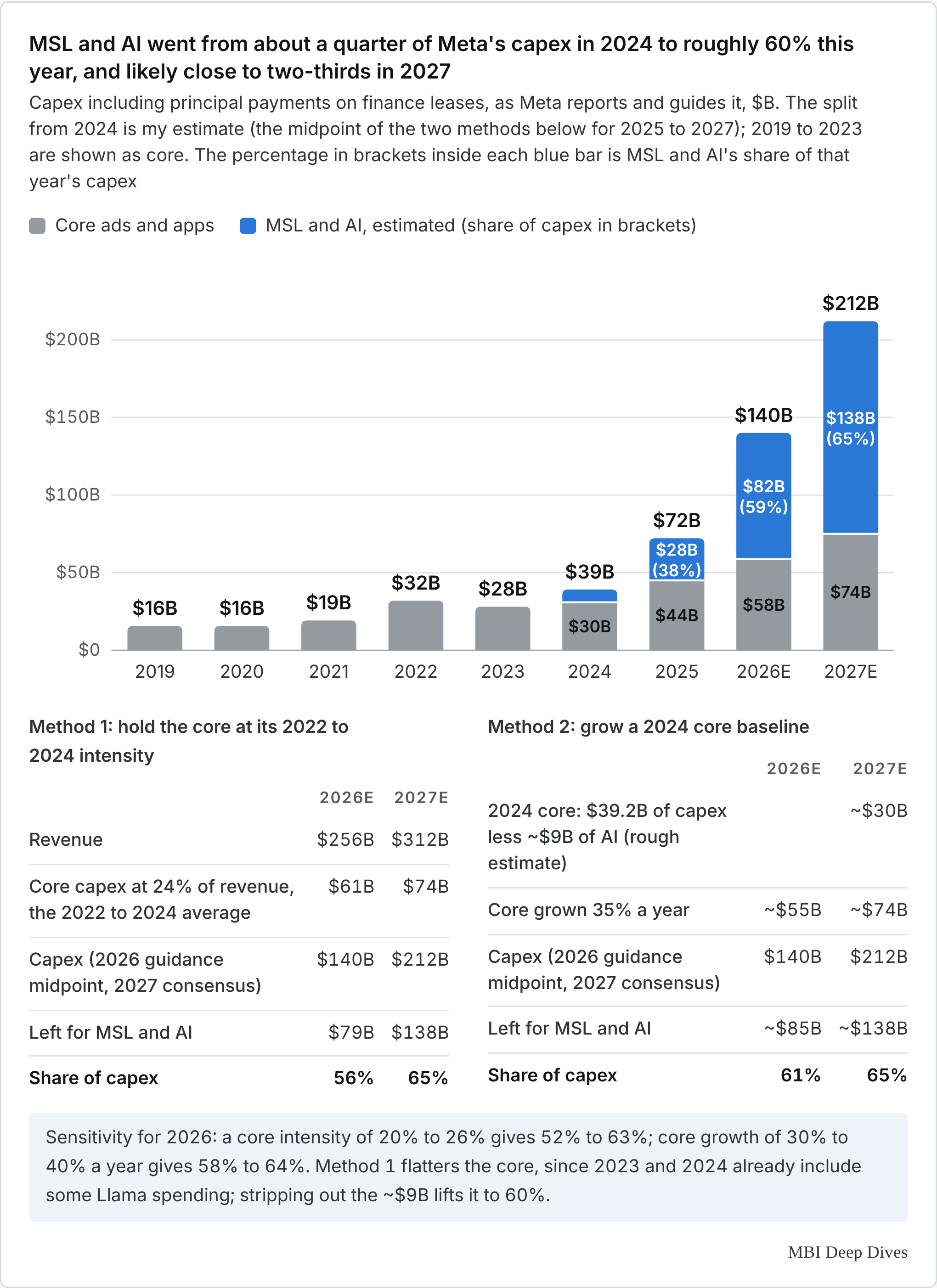
Anthropic vs Meta: Room to Be Wrong
Meta’s advertising business provides a valuation floor that Anthropic lacks as both companies spend aggressively on AI model development.
Deep dive
- Meta is reallocating approximately 60-66% of its massive capex toward AI and its Superintelligence Labs (MSL) initiative.
- Anthropic's R&D costs have surged to $9.7 billion annually, with revenue per R&D dollar showing signs of volatility and potential decline in 3Q 2026.
- Anthropic's reliance on usage-based API revenue makes it vulnerable to 'Uber-style' insourcing, where large customers eventually build their own models to avoid growing API bills.
- The author notes that Meta's 'Muse' models have already improved ad content processing efficiency by over 80% in offline tests.
- Anthropic models currently show high compute efficiency, but the company must prove it can transition to non-metered, subscription-based products to sustain its valuation.
- Meta effectively owns its infrastructure, bypassing cloud provider margins, which gives it a long-term capital advantage over Anthropic's rented compute model.
Decoder
- Capex (Capital Expenditure): Money a company spends to acquire, upgrade, and maintain physical assets like property, buildings, and hardware (e.g., GPUs).
- Enterprise Value (EV): A measure of a company's total value, often used as a more comprehensive alternative to equity market capitalization, taking debt and cash into account.
- Model Picker: A software architecture or tool that allows users to switch between different LLM providers via API based on cost or performance needs.
- Insourcing: The practice of bringing processes or services that were previously outsourced to third-party vendors (like API providers) in-house.
Original article
Anthropic is expected to go public at ~$1.5 trillion, although some investors are now reportedly pushing for something closer to $1 trillion after last week’s AI selloff. As it turns out, Meta’s enterprise value is also ~$1.5 trillion. So I had been thinking about these two businesses which have taken very different routes to the same valuation. Each has a core business that already makes money AND a bet on what comes next. At Meta, the core is advertising and the bet is MSL; at Anthropic, the core is a fast-growing API and the bet is a set of first-party products, many of which have yet to launch. I wanted to understand that split better: what the core is worth on its own at each company, and how much of the price is really riding on the bet.
Meta plans to spend $135 to $145 billion of capex this year, which is ~3.5x of what it spent in 2024. Meta does not disclose how much of its capex goes to Meta Superintelligence Labs (MSL) and its other AI work rather than the core ads business, so I estimated it two ways (shown below). Both put the bet at ~60% of capex this year, and two-thirds of the ~$212 billion consensus capex next year on MSL and AI.
I, however, admit that the line between MSL and the core is getting blurrier. Meta says its capacity can shift between model training, the core business and new products, and MSL's models are already being put to work in the core, from content understanding to ranking research and ad creative tools, so some of what I am calling the bet will likely show up as better ads rather than as Muse. Capex is not the whole bill either: the Hyperion data center JV and Meta's third-party cloud contracts aren't considered here, and I suspect most of that capacity serves MSL too. Still, much of the return on all this spending depends on Muse, Meta Enterprise Platform, or other new products and services. Meta hasn't quite nailed the business model for Muse yet, and Zuckerberg also said Muse needs to become more than 10x cheaper to run before it can be profitable at scale.
So ~60% of Meta's capex this year, and about two-thirds next year, is going to products that either haven't nailed their economics or haven't properly launched, which can make the whole program look quite speculative. Anthropic's spending has a lot of speculation embedded in it too; it just runs through the income statement instead of the balance sheet. The share of its compute serving paying customers fell from 44% in the first half of 2025 to ~25% in 3Q’26 (the rest goes to research, training and the free tier), even though Anthropic says demand exceeds the compute available to it and it took delivery of $5 billion of short-term compute from SpaceX that costs significantly more than its multi-year contracts. A company in that position that still shrinks the share serving customers is betting that compute earns more in research and training over the long term than in serving the customers in the near term, and I think that is really two bets. The first is that research makes serving much cheaper, and so far it visibly has: quarterly revenue grew ~29x over that stretch while the compute serving paying customers grew about 5x, so each serving dollar earned six times more. The second is that the models keep getting better, which is what Anthropic needs to launch the first-party products it will eventually have to lean on.
Part of the reason every major AI labs are leaning in this hard may be early signs that AI is speeding up AI research. Last week METR published an outside assessment after eleven weeks inside Anthropic. It found that Anthropic's models gained ~15 points a year on its capability index before October 2025 and about 29 since, a 1.9x acceleration, and that ~80% of it is likely attributable to AI rather than faster growth in training compute. Anthropic's amended S-1 also warned that it may soon meet its own definition of "dramatically accelerated progress attributable to AI."
That acceleration has not come cheap, though, as Michael Wiebe and Séb Krier pointed out. Anthropic's R&D expense rose from ~$1.9 billion in the first half of 2025 to ~$9.7 billion a year later, so benchmark progress per R&D dollar fell by ~60% even as progress per year doubled, and it almost halved again in the third quarter. Revenue per R&D dollar is a better test of whether the research pays for itself. On that measure, it climbed from $0.74 in 4Q’25 to $1.91 in 2Q’26, even as R&D was ramping, then slipped to $1.78 in 3Q’26 as R&D rose faster than revenue. Some of that is the expensive short-term capacity Anthropic has been adding. Paying up for compute is fine if the returns rise with it, but in 3Q’26 they did not, and with more of that capacity still to come, the ratio could keep slipping.
There is, of course, a simpler reason to keep spending: most of Anthropic's revenue comes from its newest models, so staying at the frontier pays today. But if the gains start to plateau, the compute may be forced to shift toward inference.
Staying at the frontier matters more than it might seem, because a lead in models can compound. Imagine two labs with the same amount of compute, one of which has the better model. Customers pay more for the better model, so the leader needs a smaller share of its fleet to earn the same revenue and can point the rest at training. That makes its next model better still, and the gap widens. The lab that falls behind faces the opposite squeeze, unless it doesn't need inference revenue to pay for training at all, which is exactly what Meta's ads business provides. So far, though, having the most compute has not been enough to produce the best model.
John Hempton made this point on Joe Walker's podcast which I strongly recommend. He noted that Anthropic has spent just under $20 billion on compute in its entire history (against his estimates of $45 to $60 billion at OpenAI and about $60 billion at Google), and only ~$12 billion of it on training, more than half of that this year. Yet the result is, in his words, "clearly at the moment the best model." He had assumed frontier models would cost something like $100 billion to train; instead he reckons Claude is about five times more compute-efficient than its rivals. (His figures run through June, before Anthropic's R&D reached about $9.5 billion in the third quarter alone, but whatever that ramp buys, the models we already have and are using did not cost eye-watering amount)
I am not sure those comparisons are apples to apples, though. OpenAI doesn't file with the SEC, and Google's AI spending is buried inside a much larger business, so the estimates for both are difficult to estimate. Meta is relatively easier to estimate, and arguably a cleaner test since MSL only started in mid-2025, so I made my own estimate.
Meta's capex makes it look far less efficient, but most of it buys land, power, buildings and GPUs that will serve for years, while Anthropic rents its compute and runs the bill through its income statement. Counting only what hits each income statement, Anthropic has spent ~$26 billion on compute since the start of 2025, and on my estimates Meta's AI compute has cost it ~$16.5 billion. That is not much for a lab that got to Muse Wonder in about 15 months, even if Muse Wonder still looks about a generation behind the true frontier. The bigger point is that owning the fleet spares Meta a cloud provider's margin and return on capital, so each dollar it books buys almost twice the compute of a rented dollar. At rental prices, Meta's fleet would have cost about $26.5 billion, essentially what Anthropic spent, and far less of it went to serving paying customers. The trade-off is, however, that Meta carries the capital and the risk.
I think of it as two clocks. Anthropic has to turn its model lead into enough revenue and capital to keep buying compute faster than the cash-rich labs (i.e. DeepMind and MSL), and Meta has to close the model gap before a lead that compounds gets too wide to catch.
No one knows yet how those clocks will run, so it is just as important to understand the business each company owns outside the race, the one that keeps earning whichever way they go. For Meta, that is advertising, and Meta’s advertisers pay for outcomes. If Meta’s ranking models get 10x better, advertisers see better returns, Meta’s ad prices go up, and no advertiser can swap in a cheaper open-weight model to run Meta’s auction for it. The ads business doesn’t need the race, but it gains when Meta does well in it; as mentioned in 3Q’26 call, Meta’s Muse models cut per-unit content processing costs by more than 80% in offline tests.
It is worth asking what the market is paying for that floor alone. Consensus EBIT for 2027 is ~$105 billion. Add back the ~$15 billion Reality Labs is guided to lose and ~$35 billion of MSL and AI costs, and the core ads business would earn something like $155 billion, implying just 10x EV to EBIT multiple for the core business. Meta does not disclose MSL’s costs, so I estimated them two ways below, and they land at ~$35 to $36 billion. These are, of course, rough estimates, but useful to think through how much conservatism is embedded into the stock price.
Just as advertising is Meta’s floor, Anthropic’s floor is the API business, but I increasingly see it as a lower quality revenue stream. Subscriptions were ~20% of revenue in the first half of 2026, and most of the rest is billed by usage. A meter invites the customer to optimize against it, and Anthropic’s largest customers are doing just that. DoorDash co-founder Andy Fang said on No Priors that DoorDash’s AI spend rose 20x from January to June before flattening, and in a more recent clip he said he and Tony Xu keep asking, “If we’re seeing ROI from the spend, wouldn’t we want to spend more?” A good return does not remove the incentive to cut the bill, though: if a cheaper model, or one DoorDash owns, does the job nearly as well, the return only goes up. Presumably that is why it built its own benchmark and worked with Applied Compute to train its own models. On Microsoft's FY27 Q1 call, Nadella said customers are asking, "Can I own the weights? Can I manage my costs?"
Tokens are, of course, not a commodity, since models use different numbers of tokens for the same job, but buyers running evals on their own workflows can measure cost per task, and Epoch estimates the cost of a fixed level of performance has fallen ~47% a quarter since 2023. Remember, ~44% of Anthropic's revenue through September also came through cloud marketplaces such as Bedrock and Foundry, where swapping models is very easy.
We have seen a version of this with usage-based APIs before. Uber was 14% of Twilio’s revenue in 2016. As its bill grew, Uber moved work in-house and to other vendors, and its spend at Twilio fell from ~$39 million in 2016 to ~$32 million in 2017. Usage-based revenue from the largest, most sophisticated customers is the most likely to be insourced, precisely because the bill eventually gets big enough to justify a team to replace it.
To be fair, Anthropic is not Twilio. Its customer base is broadening quickly, which is also how Twilio got past its Uber problem. And if the frontier moves faster, new jobs that only the frontier can do may arrive faster than customers can distill the old ones. But that is also what makes the revenue hard to capitalize. Models released in the six months to September 30 made up more than 80% of third-quarter revenue, and it is interesting that Anthropic mentioned $600 million of price reductions and contractual discounts for 3Q'26 in their amended S-1.
I think the API business has problems that compound. Metering itself is not the key issue here; AWS meters compute too, but leaving AWS is costly, and people often say moving off a hyperscaler is like changing the engine of a plane while it is still flying. The API business has, however, at least five problems:
- a) spend a sophisticated buyer can break down into cost per task,
- b) drop-in rivals that are often a one-line change away,
- c) a substitute that gets ridiculously cheaper every year,
- d) a bill big enough for a CFO to notice, and
- e) a buyer increasingly able to build the substitute.
More importantly, these challenges feed on each other: a bill that size gets scrutinized, cost per task shows when a cheaper model is good enough, and moving to it takes a line of code. Meta's core advertising business is largely immune from these challenges.
Hempton also offered a useful parable here in that interview mentioned earlier. At one end of the chemicals industry are giant plants turning natural gas into plastic pellets, whose high capital cost, low marginal cost and competition he reckons make about the worst business there is. At the other end are enzyme makers like Novozymes, whose small dose makes an enormous process run better, so they can charge a small slice of a very large pie. Selling tokens looks like the pellet plant to me: training costs a fortune, serving paying customers costs relatively little which I don't think was clear until the S-1, and the industry looks likely to stay competitive. Meta's ads are closer to the enzyme since it is priced on results and a small slice of the commerce they help drive. Interestingly, Muse is pitched the same way. Muse has no model picker at all. The focus is distinctly just on the product or what it can do, rather than what models they are using to drive that outcome. Prosumers such as me or large enterprises obviously like to have model pickers or pricing by the token meter, but most Muse users probably won’t care which model answered, so Meta can swap in cheaper ones and keep the savings.
Put together, the payoffs look quite different. If MSL disappoints, a Meta shareholder still owns an ads business priced at ~10x 2027 EBIT, and the damage is the capex. That is painful but bounded. If Anthropic’s bet disappoints, the shareholder owns an API whose value depends on staying meaningfully ahead, so the floor itself is built out of the bet.
My sense is that within five years Anthropic’s non-metered revenue will have to overtake its metered revenue, which is of course a massive shift from today’s 80/20 split. Given where subscription vs API stands today, even if usage-billed revenue only doubles from here, everything else would need to grow ~8x to overtake it in 5 years. The trouble is how little we know about what those products will be or how they will be distributed, when much of Anthropic’s distribution today runs through clouds that compete with it.
Anthropic’s S-1 itself illuminated so much about the AI economics that I am praying that the IPO goes through even though I don’t intend to put my capital at $1.5 trillion valuation. It will be very, very useful to see and track the economics closely every quarter. After the IPO, I will watch three numbers very closely. The first is the share of its compute serving paying customers. If that keeps falling while revenue per serving dollar keeps rising, Anthropic is earning more from every unit of compute it sells and pointing the rest at the next model, which means the loop may be working. The second is revenue per R&D dollar, which slipped in the third quarter after peaking in the second; I want to see it rising again, because that is the best possible sign the research is paying for itself. The third is the share of revenue from subscriptions, which will tell me whether Anthropic is building a floor that does not depend on staying ahead.
For Meta, the question is whether Muse finds a business model and gets cheap enough to run, but even if it never does, shareholders still own an ads business at about 10x. If the gap between Anthropic’s models and the next best narrows, or customers decide the best model is more than most of their work needs, I suspect the API underneath it would be worth far less than it is today.
At similar valuations, only one of these lets me be wrong about the bet, which is why I remain comfortable owning Meta while still lacking the conviction to buy the Anthropic IPO. That said, investors’ biggest complaint about Meta, and about Zuckerberg, may be the shadow of Reality Labs. Meta has spent more than $100 billion there with no sign yet that the economics will turn positive, so whenever it places another speculative bet, investors understandably ask: is this another Reality Labs?

GitHub Previews a Redesigned Pull Request Overview
GitHub’s redesigned pull request Overview page aims to fix navigation fatigue by moving status indicators and action items to a persistent top-level summary.
Original article
GitHub began rolling out a redesigned pull request Overview page on November 5 as an opt-in public preview. Availability will continue expanding through the weekend.
A compact summary at the top shows whether the change is ready to merge, what is blocking it and which actions are available. Checks, approvals and comments remain accessible from that summary.
The conversation also gains filters for unresolved threads and the user’s own comments, newest-first sorting, and a recent-activity summary. Depending on permissions, users can mark a draft ready for review or close a pull request from the header.
The design addresses a navigation problem in long discussions: finding the current state no longer requires scrolling to the merge box below the conversation. Users can start with the blocking issue and open its supporting details.
The preview can be enabled through the Try the Overview page button in the header. The same menu allows a return to the classic view. GitHub describes this as an early iteration rather than the completed redesign.
No Figma, one branch, a 3-4 day sprint, and where the engineers take over
Design engineers shorten the feedback loop by shipping functional, documented components directly to production instead of producing static Figma mockups.
Deep dive
- The design engineer role acts as a translation layer between product intent and technical execution.
- Avoiding static Figma handoffs reduces the 'lost in translation' errors common between design and engineering.
- Successful teams integrate design into the sprint cycle, enabling rapid user testing of code-based prototypes.
- Documentation, like Storybook, is as essential to the design engineer’s output as the UI components themselves.
- This model allows software engineers to focus on high-level infrastructure while design engineers manage the interface layer.
Decoder
- Design Engineer: A hybrid role that combines expertise in front-end web development with user experience design, focusing on building high-fidelity, functional interfaces.
- Storybook: An open-source tool for building UI components and pages in isolation, used for documentation and automated testing.
Original article
Design engineers can shorten the distance between design and development by creating functional prototypes directly in a product's codebase instead of producing static Figma handoffs. In one team's workflow, a design engineer collaborates on discovery, builds and tests prototypes with users in three to four days, and delivers finished components with Storybook documentation while software engineers handle backend systems and architecture. The role combines front-end development, rapid prototyping, user research, and AI-assisted coding, allowing designers to contribute directly to production without replacing specialized engineering expertise.
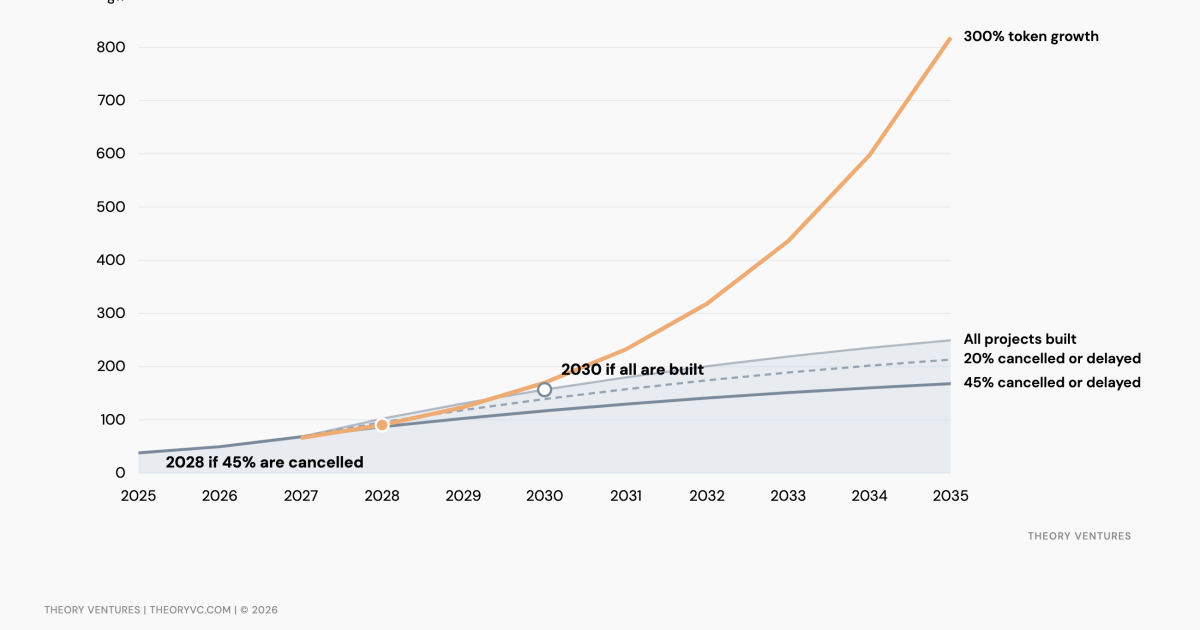
When Does the US Become a Net Importer of Tokens?
The US risks becoming a net importer of AI tokens by 2030 due to domestic energy grid constraints and data center project cancellations.
Original article
In short : US AI demand grows from 66gw in 2027 while tokens per watt compound 2.9x a year, so the grid only binds if token demand outruns efficiency. Break-even real token growth is ~2.5x a year with no cancellations.
With AI demand outpacing supply, & domestic data center construction slowing, soon the US will consume more tokens than it produces.
At that point, the US will become a net importer of tokens, just like it is a net importer of rare earth metals. A basic model estimates this switch between 2028 & 2030, depending on how many planned facilities get cancelled.
Very roughly, the current systems, with new data centers coming online, can manage 2.5x annual token growth. Above that rate, chip & model efficiency gains can no longer offset domestic demand growth : power required in gigawatts equals tokens demanded divided by tokens per watt.
If 45% of planned projects fail to connect, imports start by 2028. Cut cancellations to 20%, & the deadline slips to 2029. Even if every proposed facility gets built on time, the gap still opens by 2030.
Every physical model assumes the price of compute stays constant. In reality, when supply chokes, prices spike. So far, demand has proven remarkably price-inelastic. Over the past two quarters, short-term GPU rental prices surged from $5 to more than $13 per hour, Anthropic signed billions in burst compute at premium rates, & overall demand barely blinked. Buyers simply paid the toll.
At what price do people balk? Is it the model labs burning through capital to pre-train the next frontier? The enterprises financing vibe-coding teams that burn hundreds of millions of tokens a week building custom apps? Or consumers asked to pay $40 a month for an autonomous agent subscription?
Surely there is some price at which demand will slow & current data center capacity will suffice. But throttling demand through scarcity pricing denies the basic market reality : at a lower cost of production, demand would be orders of magnitude higher. If we do not build the domestic power and facilities to satisfy that demand, tokens will simply be produced elsewhere & imported.
The uninhibited growth since GPT 3.5 will be modulated not by lack of access to data, nor algorithmic limits, nor GPU manufacturing speed, but by the broader values of the country. The forthcoming limits on the quantity, size, electrical consumption, & location of data centers will reshape Startupland.
-
Demand grows from a 66gw base in 2027, up 61% from 41gw (Goldman Sachs Commodities Research, Wei, Struyven & Dart, May 20, 2026. US data center power 31gw / 41gw / 66gw for 2025 / 2026 / 2027). Efficiency is the counterweight. Tokens per watt compounds about 2.9x a year, blending NVIDIA’s Vera Rubin at 5.4x over GB300, Google’s Ironwood at 2x Trillium & AWS’s Trainium3 at 4x Trainium2 (SemiAnalysis InferenceX, 2026 : Vera Rubin 5.4x GB300 on tokens per watt. NVIDIA claims up to 10x on agentic workloads. Google TPU Ironwood 2x Trillium. AWS Trainium3 4x Trainium2). Supply is the third input, & only 55% of scheduled US capacity lands on time.
-
The chart is a capacity date, not an economic one. Power is only 5% of the cost of a GPU-hour ; capital recovery is 64%. A $40/mwh spread is worth $0.35b per gigawatt per year, while a 6%-to-9% cost of capital spread is worth $0.84b. Capital wins. Latency finishes the argument : New York to Frankfurt round-trips in 88ms. Behind-the-meter generation covers much of the shortfall, so the real constraint becomes gas turbines, sold out into 2030 (SemiAnalysis, June 25, 2026 ; GE Vernova, July 22, 2026).
-
Tomasz Tunguz, The Financial Engineering Essential for AI in 2027, November 3, 2026, analyzing Anthropic’s Form S-1/A disclosures on short-term burst compute surges to $12–$13/GPU-hour (up from $3–$5 six months earlier) and long-term compute commitments. The Ornn Compute Index settled at $12.29/GPU-hour in October 2026.
AI R&D Is Accelerating Towards Potential RSI in 2027
AI R&D at Anthropic is accelerating so rapidly that experts estimate we are less than a year away from fully automated AI research capabilities.
Decoder
- RSI (Recursive Self-Improvement): A theoretical state where an AI system can design better versions of itself, leading to an exponential increase in capability.
Original article
AI is accelerating AI R&D at Anthropic. The company is now estimated to be several months ahead of the AI 2027 timeline. We may be less than a year away from full RSI, and there are no clear bottlenecks in the way. We now need to prepare for scenarios where critical events happen in 2027 or 2028.

Will Anthropic Grow Into Its Compute Bill?
Anthropic's massive $895 billion compute commitment requires roughly $200 billion in annual revenue, leaving little room for error in a price-sensitive market.
Deep dive
- Total committed spending: $895.4 billion, with $447.5 billion due before 2030.
- Revenue growth is currently supported by 11,900+ large accounts (>$100k spend).
- Compute expenses represented 58% of revenue in Q3 2026.
- Commitments include massive leases with Broadcom and capacity deals with AWS, Google, and Microsoft.
- Cross-default clauses in credit facilities mean a revenue shortfall could trigger systemic financial risks.
Decoder
- Net Revenue Retention (NRR): A metric measuring revenue growth from existing customers, including upgrades and churn.
- Finance Leases: Long-term lease agreements treated as debt on the balance sheet, reflecting the ownership and liability of equipment.
Original article
Full article content is not available for inline reading.

Anthropic Buys $3.4 Billion in Gas Generators
Anthropic is bypassing the power grid by purchasing $3.4 billion in natural gas generators to secure energy for its data centers.
Original article
AI’s power crunch has become so acute that Anthropic, a company that has generally avoided buying physical infrastructure, is spending $3.4 billion on natural gas turbines.
The AI company, which is planning to go public this year, is buying Caterpillar generators that equipment supplier OnePWR had originally ordered, according to a Financial Times report. The generators are capable of producing up to 1.7 gigawatts of electricity.
Historically, Anthropic has preferred to rent rather than buy. The company disclosed in its S-1 filing in May that it is paying SpaceX subsidiary xAI $1.25 billion per month through May 2029 to use xAI’s computing power.
“We expect to enter into additional similar services contracts,” Anthropic stated in the filing, meaning more deals to rent computing power.
But as demand for compute ramps up, the market for power has also grown increasingly uncertain, which may have forced its hand. The backlog for natural gas turbines stretches into the early 2030s, and queues to connect to the electrical grid can be just as long.
Anthropic’s purchase looks like a last resort.
According to the report, OnePWR ordered the turbines a couple years ago but couldn’t find financing to complete the purchase. Anthropic had planned to buy them from OnePWR but instead went directly to Caterpillar, the manufacturer.
It’s not clear why OnePWR was unable to secure financing despite Anthropic’s apparent interest as a customer. Whatever the case, Anthropic likely wanted to keep the generating capacity to itself rather than give a competitor an opportunity to snap it up.
AI companies have been ramping up their purchases of natural gas equipment and supplies in recent years. Google, Amazon, Microsoft, and Meta have all announced plans to build massive natural gas power plants to power their data centers on-site, rather than drawing from the public grid.
The binge has given a second wind to fracking, the drilling method used to extract natural gas from underground rock. And if the buildout proceeds as planned, U.S. data centers alone could consume more natural gas than Germany and Japan combined by 2035. The reliance on natural gas also exposes hyperscalers to price fluctuations. One analyst expects that prices could more than triple by the end of the decade in some markets. If that happens, Anthropic might have a serious case of buyer’s remorse.
OpenAI's Control Room Can Halt Research Model Output
OpenAI's internal 'Control Room' allows researchers to centrally monitor and kill model output for ongoing inference tasks in under 35 seconds.
Original article
OpenAI's Control Room centrally authorizes research inference requests and can stop a workload's model output within 35 seconds of intervention.

Is Opus 5.5 nerfed?
User testing suggests Claude 3.5 Opus's reasoning behavior has shifted following a potential silent model update on November 3.
Deep dive
- Analysis of 1,400 Claude Code sessions shows a distinct performance shift starting November 3.
- 'High' reasoning mode appears to 'jump into action' too quickly, causing confusion on complex debugging tasks.
- 'Xhigh' remains more reliable for long-horizon or complex reasoning.
- Observations suggest the model’s internal reasoning process has been altered despite the name remaining the same.
Original article
is Opus 5.5 nerfed?
I just had Gemini 4 Argon analyze 1,400 Claude Code sessions and it found that on November 3, something definitely happened.
the model name didn't change, but the way it does reasoning took a sharp turn. also, how much reasoning Opus 5.5 does in "high" took a nosedive. quick test on a real bug showed Opus 5.5 high jumping into action too quickly, getting confused and being unable to find a fix after 3 full hours.
meanwhile Opus 5.5 xhigh takes a moment to think, finds a fix after a few minutes. so yeah, you're not imagining things. the nerf is real.
my take is that the @theo popularized "use high for everything" no longer applies.
https://x.com/shanemelaugh/status/2119779113296703663
Google Escalates Nvidia Rivalry With Specialized Versions of AI Chips
Google is introducing two specialized Tensor Processing Units to compete directly with Nvidia in regulated and long-context AI workloads.
Decoder
- TPU (Tensor Processing Unit): Google’s custom-designed application-specific integrated circuit (ASIC) used to accelerate machine learning workloads.
- Long-context window: The ability of an AI model to process and retain a significantly larger amount of input data (such as entire books or long codebases) within a single session.
Original article
Google is rolling out two new variations of its Tensor Processing Units. The 8tx is aimed at handling secure, confidential work for customers like government agencies and companies in regulated industries. The 8i Max is designed to run AI applications that require long-context windows. Google's TPU business has proven to be lucrative, and the company has netted some high-profile clients including Apple, Meta, and Oracle.
Anthropic Prepares to Push Ahead With IPO Despite Market Jitters
Anthropic plans to begin trading shares by the end of next week despite internal conflict regarding its multi-trillion-dollar valuation target.
Original article
Anthropic plans to start trading its shares by the end of next week. Investors anticipated a target valuation of around $1.5 trillion last week, but some major investors are now pushing for it to be lower. Anthropic could still decide to delay its plans and wait for more favorable conditions, but doing so could spark panic in the market. Even before the recent market volatility, investor enthusiasm had been waning for AI names due to increasing concerns about the increasing investments required and a lack of clarity on their potential payoff.
Alphabet's Wing to Build New Texas Factory for Delivery Drones
Alphabet’s drone subsidiary Wing is opening a 15,000-square-foot manufacturing plant in Fort Worth, Texas, to scale production to tens of thousands of drones annually.
Original article
Wing's new 15,000-square-foot plant in Fort Worth, Texas, will have the capacity to build tens of thousands of aircraft each year.
A Timeline of Nvidia CEO Jensen Huang's Suspected Spy Drama
Nvidia CEO Jensen Huang clarified to President Trump his lack of knowledge regarding allegations surrounding Alice Huang.
Original article
Jensen Huang told President Trump that he had no idea that Alice Huang was a spy.

The race is on to sue Nvidia
Nvidia faces a securities class action lawsuit following revelations about CEO Jensen Huang’s personal ties to a Chinese-linked executive.
Deep dive
- The lawsuit centers on the 'fraud on the market' theory, arguing that investors purchased Nvidia stock based on misleading public statements.
- Plaintiffs' firms are rushing to lead the litigation, as federal securities law rewards the first filer with the ability to represent the class.
- Nvidia's board has initiated its own investigation, though it claims there is no evidence of compromised national security or technical secrets.
- The suit targets three specific statements made by Nvidia representatives and Jensen Huang that downplayed his interactions with Alice Huang.
- Potential outcomes for Nvidia include massive financial settlements with shareholders, though personal liability for the CEO or directors remains unlikely in a civil suit.
Decoder
- Securities class action: A lawsuit where a group of investors sues a company for alleged wrongdoing, typically for issuing misleading information that caused the stock price to drop.
- Fraud on the market: A legal theory stating that in an efficient market, stock prices reflect all publicly available information; therefore, false information inherently defrauds anyone who traded at the distorted price.
- Lead plaintiff: The representative investor in a class action lawsuit, usually the one who suffered the largest financial loss, who guides the litigation strategy.
Original article
Nvidia’s stock slid more than 4% on Monday, the first trading day after its board said it would investigate CEO Jensen Huang over his relationship with Alice Huang, an executive U.S. intelligence believes was spying for China.
Securities lawyers were already moving. At least four firms, including Schall, Brown & Schwartz and Levi & Korsinsky, announced investigations Monday into whether Nvidia misled investors. Robert Bartlett, a Stanford Law professor and securities law expert, expects them to have plenty of company.
“I would definitely wager that there’ll be a filing,” Bartlett said in an interview Monday morning, adding that he wouldn’t be surprised if a case had been filed by the end of the day. Plaintiffs’ lawyers have good reasons to be first in line; under federal securities law, the first complaint triggers a public notice, and investors then have 60 days to ask the court to be named lead plaintiff. A firm that files early gets a head start on signing up investors with large losses, as well as on shaping the story of the case. Bartlett was right, in fact. A case surfaced Monday afternoon in the Northern District of California, where Nvidia is headquartered.
Rosen Law Firm, a New York-based plaintiffs’ firm that specializes in securities class actions, filed it on behalf of Mark Kistenmacher, a retail investor who made seven purchases totaling roughly $20,500 this year, according to a schedule attached to the complaint. (Rosen was lead counsel in a $250 million settlement with Alibaba and ranks among the most active filers of such cases.) The proposed class covers anyone who bought Nvidia securities between Oct. 9, 2025, and Nov. 8, 2026, and the suit names both Nvidia and Huang.
The complaint accuses them of misleading investors about Huang’s ties to Megaspeed, the Singapore-based data center outfit where Alice Huang was considered a top exec, and it points to three statements as proof: Nvidia spokesperson John Rizzo’s late-October claim that Huang’s interactions with Alice Huang were “not unusual or unexpected,” the company’s even earlier claim that it found “no evidence of diversion” of its chips, and Jensen Huang’s Oct. 30 comment to Bloomberg that Nvidia’s dealings with Megaspeed were “normal and not unusual.”
All three were false or misleading, the suit says, because Huang was having an affair with Alice Huang. Kistenmacher is asking for unspecified damages, interest and attorneys’ fees, and he wants a jury trial.
While much remains unknown, the legal theory here doesn’t depend on anything the board’s investigation may turn up about Huang’s private life. When The New York Times first reported on Huang’s ties to Alice Huang last month, Rizzo really did tell the Times that the relationship was “not unusual or unexpected.” Rizzo separately told another outlet, The Hill, that “Megaspeed has been no different than many other regional cloud customers. Meetings with customers are part of a CEO’s job; Jensen talks with thousands of customer executives every year.”
Of course, the world now knows that was not true. Worse, the Times reports that U.S. intelligence had been monitoring Alice Huang for more than a year.
From a securities perspective, Bartlett said, the company’s earlier statement was “clearly a misleading statement.” And because Huang is CEO, Bartlett said, “his knowledge gets imputed to the company.” In other words, Nvidia is treated as having known what its chief executive knew.
The Kistenmacher complaint makes the same argument.
Bartlett predicted a “classic fraud on the market” claim, in which investors argue they paid prices that reflected false or incomplete public information, and lost money when the truth emerged. This early lawsuit relies on that theory, and Monday’s drop of $7.97 per share, or 4.27%, gives the attorneys involved a lot to work with. Damages in such cases are tied to the stock’s decline, and Nvidia is one of the most valuable companies in the world, so you can imagine a settlement could prove exceedingly expensive.
That means a large payment from the company and its directors-and-officers insurers, but typically no personal consequences for the CEO or the board. It is also a civil matter, so Huang isn’t facing prison over it. The irony, as Bartlett noted, is that the suit is brought in the name of Nvidia’s shareholders, and shareholders ultimately pay for the settlement, directly or through insurance premiums.
Bartlett sorted Nvidia’s wider exposure into buckets. The first is the securities fraud claim, which is the clearest immediate problem for the company and potentially for Huang. The second is governance: what the board knew and when. It’s possible directors were kept in the dark, but the board also has oversight duties, and once the Times began reporting on the Megaspeed connection, the company should have had reporting lines to bring a critical risk like this to directors. If it didn’t, or if directors didn’t act, board-level liability is possible.
A third category, one that would change everything, would arise only if the board’s investigation finds Huang knew about the intelligence connection. That would be “a whole other ball game,” as Bartlett said. (The board said in a statement to the public Sunday that it has no reason to believe national security or Nvidia secrets were compromised.)
There’s also the question of government action. The SEC can seek an officer-and-director bar for intentional securities-fraud violations, which Bartlett said is technically on the table. But he doubts the current SEC under Chairman Paul Atkins would have the appetite, given President Trump’s support for Huang. A roughly two-year clock after discovery of the facts would leave room for a future administration to act, but the window would be tight, and Bartlett posited that’s pretty unlikely when asked about it.
It’s worth underscoring that neither law firm announcements nor this newly filed complaint is a sign of a strong case. Plaintiffs’ firms are quick to publish these notices when they see an opportunity. Which firm winds up leading the case is decided later by the court, and that decision usually depends on which investor has suffered the biggest loss. Kistenmacher said in his filing that he’s willing to serve as lead plaintiff, but the court will ultimately choose among the competing investors. No doubt they’ll materialize soon.

Transform a Quick Drawing into a Live App with Gemini
Gemini’s new Canvas tool can now convert hand-drawn sketches into functional, live-previewed application prototypes.
Original article
Transform a quick drawing into a live app with Gemini.
Great app ideas often start on paper. Turn them into interactive tools with Gemini.
Here’s how.
- Upload a photo of your sketch, like an app mock-up, habit tracker, or game board to Gemini.
- Select the Canvas tool and ask Gemini: "Can you code this app?" Gemini reads your visual and writes the code.
- Test your tool in the preview window. Gemini can adjust colors, fonts, or features in real time.
Next time inspiration strikes, bring it to life with Gemini.
Apple aiming to make Siri ‘more like an agent' as soon as next year: report
Apple is reportedly shifting Siri toward a proactive agent architecture for a potential 2027 launch to better handle multi-step, goal-oriented tasks.
Decoder
- Agentic: Refers to AI systems capable of autonomous planning, reasoning, and tool use to achieve high-level goals rather than just performing singular, static requests.
Original article
Apple is reportedly working to transform Siri into a proactive AI agent capable of tracking goals, planning next steps, and completing tasks without requiring users to initiate every action. The company could introduce these capabilities as early as 2027, building on the personalized Siri features delivered with iOS 27 and potentially using its App Intents framework to interact with applications more efficiently. Apple is also adjusting its iOS 28 development process to give engineers more time for coding and experimentation, reflecting the growing influence of AI-assisted development.
Raising the ceiling must be earned
Exceptional results in an AI-assisted workflow require the human ability to critique, direct, and understand fundamentals, not just the capacity to generate content.
Deep dive
- AI tools accelerate prototyping but obscure the complexity of production systems.
- 'Taste' is a learned skill rooted in understanding design hierarchy, typography, and interaction.
- Relying on LLMs without context leads to 'AI slop' where the output quality is unvetted.
- Understanding the 'why' behind a working prototype is critical when users interact with the application in unexpected ways.
- Developers should use AI as a training tool to learn code syntax and architecture rather than a crutch for output generation.
Decoder
- Vibe coding: A colloquial term for generating code or interfaces via LLMs based on intent or 'feel' rather than writing or understanding the underlying logic.
- AI slop: Content generated by AI that lacks human intent, craft, or quality, often characterized by generic, superficial, or nonsensical output.
Original article
Raising the ceiling must be earned
There is a phrase: raise the floor and ceiling. This means improving both the baseline and maximum potential at the same time. It’s been used in many applications such as the potential or teams. Recently, it’s been applied to Design in the age of design; a phrase Figma CEO Dylan CEO repeated at Config.
At UXDX San Francisco this week, I had the pleasure of self-moderating a conversation with Josh Clemm, VP of Software Engineering at Figma.
One of the questions asked was if taste will remain a human element? As a designer, you may expect my answer, but I had a controversial take. Some AI has better taste than some humans.
If you think AI Slop is bad, have you seen Human Slop?
In I, Robot, Detective Spooner, played by Will Smith, questions the robot Sonny (voiced by Alan Tudyk) about what separates humans from machines. He asks whether a robot can write a symphony or turn a canvas into a masterpiece. Sonny answers with a simple question: “Can you?” Spooner has no answer. It’s easy to point to great art as proof of what humans can do. It’s a different thing to make it yourself.
Using AI tools is not an entitlement to elevated craft. The output is only as good as the person providing the input. AI will only be as good as the historical context and the prompter. To know you’re a good prompter, one must know how to critique the outputs and give better direction. Without it, things become AI slop; a phenomenon that is less about the output rather it is people’s tolerance to the output quality.
The ceiling can’t be raised while sitting on the floor
To push the bounds of your craft, you need some understanding of where those bounds are. That comes from practice: making things, noticing where they fall short, and learning enough to make the next version better. New tools can help you move through that process, but the fundamentals still give you something to build on.
Vibe coding can get you from an idea to a working prototype in minutes. That’s a meaningful head start. But when something breaks, or a customer uses it in a way you didn’t expect, you need to understand what’s happening beneath the interface. Where does the data go? What happens when a request fails? Does the code solve the problem, or did it just make the error disappear?
You don’t need to master every part of software development before making something. Building can be how you learn. Take one piece of the prototype and follow how it works. Change it, see what breaks, and try to explain why. The risk is getting so used to a working result that you stop asking how it works. Putting off those questions gets expensive when other people start depending on what you’ve made.
The same applies to design. You can generate dozens of layouts and still struggle to explain why one works better than another. Knowing how hierarchy, typography, and interaction shape an experience helps you critique what the tool gives you and give it better direction. With practice, you can begin to see where the familiar approach falls short—and have a reason to try something else.
Elevation of craft comes in many forms
There are different approaches to get to the ceiling. I believe there are multiple contributors for the craft bar to be raised aside from raw skill. This is why I dedicated my career to work on tools that revolutionize the internet and empower. When I was at Webflow from 2019-2023, Application Layer AI experiences were still very early, and most code was still hand-written. I spoke to so many customers who told me Webflow was what allowed them to Break the Code Barrier. The syntax of front-end code wasn’t intuitive for them. Using Webflow, they were empowered to design and build visually. They used no-code to know code.
Replit was a similar story. The number one detractor from people learning to code is not programming itself but the ability to even get the development environment in the first place. The Xcode provisioning profile setup killed so many dreams of people wanting to build iOS applications.
Augmenting people is a way to raise them to the ceiling. Having taste without the hands and technical skills does not guarantee you will be a good designer. At the same time, being good at technical skills and not having a sense of what to create or the meaning behind it also does not make you a good designer. You need to be able to balance both. I’ve long said I don’t care how they get to shipping as long as they ship. This might be through raw skill, empowerment, or leverage that gets them to the ceiling.
Bringing the best of your craft is the only way to move the ceiling, and there is a lot to do to be the best at your craft. It requires both repetition in your own excellence and opening the aperture of what you’ve done. In art school I had the misconception about Salvador Dali being only a surrealist painter. When I lived in Barcelona, some friends took me to Figueres, Dali’s home town. There I saw I was so wrong about the Spanish artist. In the casa had technical drawings, paintings in the style of the old masters, and some of the most intricate jewelry and metal smithing work.
Many of the best artists who abstracted away reality were able to create in such a manner first. There is a similar lesson here for software and brand designers using AI. The best ones already have a sense of how to accelerate and push what is already known to them to invent new originalities. When you don’t know what you’re doing, there is risk of unknowingly producing slop, whether intentional or not.
Raising the floor allows more people to participate in a craft. Some may choose to be hobbyists and others may blaze a path into the craft professionally. However, raising the ceiling is a collective effort an entire craft industry must do together. It’s because our collective pushing of it is the only way we can push what we have collectively done throughout history. For LLMs, they do this without context and require us.
In the agentic era, raising the ceiling of your craft must be earned.
Your Marketing Stack, Connected to Your AI (Website)
Orphex uses a unified MCP gateway to bridge digital marketing platforms like Shopify and Google Ads directly with LLM-driven budget management.
Decoder
- MCP (Model Context Protocol): An open standard developed by Anthropic that allows AI models to connect to external data sources, tools, and repositories as a unified interface.
Original article
Turn Chat into Action.
Go from a question to a concrete proposal. Review supported changes and give the final approval from your AI conversation.
Move $500/day to Performance Max. Keep total spend the same.
Claude
I’ve prepared the proposal for your review.
DAILY BUDGET
- Brand Search: $1,200 → $700
- Performance Max: $2,000 → $2,500
The Brand Layer for Agents (Website)
Rainbrand positions itself as a 'brand layer' to provide LLMs with structured identity context, ensuring agent-generated content remains consistent with corporate guidelines.
Original article
Rainbrand builds and maintains your brands' identity, guidance, and assets as shared context for AI agents and products.
There's No Better Name for Design Systems
Design systems should be framed as 'infrastructure' rather than 'methodology' to better communicate their long-term value and non-optional status to stakeholders.
Original article
There’s no better name for design systems
Design systems have grown exponentially since the mid-2000s. Initially, we built style guides and pattern libraries to mimic print-based brand guidelines, reshaping them for the web. Nowadays, a design system is often an umbrella term for a set of diverse resources: design tokens, component libraries, UI patterns, accessibility guidelines, governance processes, structured metadata for LLM consumption, and associated tooling. No design system is the same; their shapes vary depending on company size, design function maturity, or how well the initiative is funded. What’s in a design system today is vastly different from a decade ago.
For years the community defined a design system by the sum of its parts. As Nathan Curtis pointed out, that variability of composition inevitably kept causing confusion. How can you effectively discuss something that’s constantly shapeshifting? What I found over the years is that what’s inside a design system is irrelevant in most conversations. Specific resources are important to design system consumers and contributors—they are the people who have to understand the moving parts and how to work with them.
Specialised approaches are challenging to convey across disciplines, especially if people don’t know why they should care in the first place. The minute we start listing all the tools (Figma, Storybook, Supernova . . .) and resources (component library, tokens, icons . . .), attention dissipates. In most conversations I’ve had (outside the design system maintainer circles), stakeholders weren’t asking what the ingredients of a design system were, how they were built, and how they connected. It’s too close to the metal. What was critical was what the design system enabled. We keep looking for a better name for design systems when there isn’t one.
The unhelpful nomenclature purity Sarah Federman described, that focused on specific terms and rigid compositions, is very much alive (just yesterday I saw an article proclaiming that someone has a UI kit, not a design system). I’ve seen too many design systems grow unused and stale because they were treated as an optional nicety “only for designers” (it’s in the name!) rather than a vital operational framework. Despite the popularity of design systems, this isn’t an isolated scenario.
Inevitably, we need terms to translate across functions. We need fluidity in our language, tailored to our users (something the design function already does really well). I want to explain when a design system used, and what does it mean for individual roles and the organisation. If we can’t demonstrate the impact and leverage, securing funding for a design system as an ongoing initiative and meaningfully growing its adoption will be difficult. The challenge isn’t a design system rebranding, it’s a cross-functional translation.
When talking about design systems, we often reach for broader terms, such as product, methodology, and infrastructure. All have potential to bridge the gap for different audiences:
- Product: resonates with product-led audiences (managers, leaders) bringing useful concepts such as roadmaps, setting up feedback loops, understanding the user, and treating adoption as a success measure. However, products are optional: they can be deprioritised or not bought, leaving design systems in a constant sales-loop, looking for funding and attention.
- Methodology: enticing for designers, engineers, and delivery leads, as it describes a way of working and delivering software. However, methodologies are notoriously hard to quantify to leadership, making it challenging to describe the funding cost and potential return on investment.
- Infrastructure: speaks to cross-functional leadership and finance, implying shared investment, ongoing maintenance, reliability, and non-optionality. However, infrastructure can still be treated as a cost to cut, which brings back the same funding fight.
None of these is the right name. All of them answer a different question—how we build, how we run the system, and why we invest in it. I most often go with infrastructure, as it resonates most effectively across functions, and travels furthest. A few years ago, I read Deb Chachra’s “How Infrastructure Works” (excellent for anyone, but especially systems thinkers), which further solidified infrastructure as my default abstraction. Deb writes:
“Technology is more than just the physical systems. These are human systems, created by and for humans to serve particular needs and desires, and to meet them in particular ways. Technologies develop into infrastructural systems because of the evolving roles they play in our lives.”
Despite writing about literal infrastructure systems (sewers, pipes, cables, or bridges), Deb nails down the collectivism a system requires to become something more than a set of seldom used tools. She highlights how infrastructure is universal because everyone relies on it. And yes, as Sam Anderson outlined, infrastructure is boring—not due to the lack of complexity in the challenge, but because specialised, ongoing care going into its maintenance results in resilience (which Deb writes about at length).
Success isn’t an organisation finally understanding what a design system is. It’s every team knowing what it does for them, in terms that make sense, so it becomes the way things get built rather than something to continuously explain.

e.l.f.'s Stop-Motion Christmas Ad is a Win for Human Creativity
Beauty brand e.l.f. debuted its first holiday campaign using entirely physical stop-motion animation instead of AI-generated visuals.
Deep dive
- The campaign features puppets with wire armatures, yarn hair, and resin heads.
- Animators used actual e.l.f. powder blushes and highlighters on puppet faces, noting that powder-based products adhere better to resin than creams.
- Creative director Cami Kwan implemented 'smear frames' using cut paper to simulate motion blur, a technique rarely seen in stop-motion.
- The production team prioritized tactile, physical craftsmanship as a reaction to digital and AI saturation in 2026 media.
- The project required testing how different cosmetics interacted with puppet fabrication materials, which lack human skin pores and body temperature.
Decoder
- Smear frames: An animation technique that involves distorting or 'smearing' a character over several frames to imply high-speed movement, typically used in 2D animation.
Original article
The fight for the Christmas advert crown is on, and brands have set standards high this year. From hand-drawn animation to immersive storytelling, there's been a wonderful display of hand-crafted creativity, and among the ranks, beauty brand e.l.f. did not disappoint.
As the brand's first-ever holiday campaign, the beautiful stop-motion animation is a sparkling debut that captures the joy of the festive season. A masterful display of tactile craftsmanship, the 'e.l.f. Made to Stand Out' campaign carries many of the traits of the best Christmas adverts, proving that analogue storytelling is the perfect tool for sparking festive joy.
Narrated by iconic actor Alan Cumming, the campaign follows friends Kit, Echo and Cleo as they reunite in their hometown for a holiday get-together. What could be an uncomfortable hangout turns into a celebration of the qualities that make them extraordinary, spreading festive cheer.
“For a campaign about the power of standing out, the medium needed to stand out too, and stop motion felt like such a natural fit for this story," explains Oshiya Savur, chief marketing officer at e.l.f. Beauty. "We're seeing a real appetite for nostalgia and a return to simpler times, with 72% of Americans saying nostalgic memories inspire them when life feels complicated.
There's an incredible level of craftsmanship and character that comes from building an entire world by hand
There's something about stop motion that takes you right back to the holiday specials you grew up watching, but we saw an opportunity to give that familiar art form a uniquely e.l.f. twist. There's an incredible level of craftsmanship and character that comes from building an entire world by hand, and when you combine that with our signature wit and wink, you create something that feels both familiar and completely unexpected.”
Created by Apartment D Films, each element of the ad reads as a love letter to analogue craft, from individually moulded characters to intricately constructed miniature sets. "We used a wide variety of different materials! It's truly a mixed media project," Cami Kwan, Creative Director of Apartment D, tells Creative Bloq. "The puppets have aluminium and steel wire armatures inside, which makes them posable. Their hands and heads are made of printed resin, which we then painted and finished with actual e.l.f. products! The cheeks and mouths of the puppets are colored using a combination of e.l.f. Powder Blush Palette, e.l.f Perfect 10 Eyeshadow Palette, and e.l.f. Halo Glow Silky Powder Highlighter.
All the characters' hair is made with different weights and textures of yarn, to call back to super nostalgic toys, but with a modern sensibility. The eyebrows and eyelids of the characters are made of a mix of wax and clay, so they're super mouldable to get big expressions in the performance, and also so you can literally see the animators' fingerprints on the characters as they emote.
A lot of the world around the character is made of wood, but with hand-painted textures so the wood grain is more painterly and stylized. The mini products and bottles the characters use are all hand-sculpted out of clay, and then finished with a variety of nail art techniques, like cured acrylic, gels, and powder shimmers! The mini bottles are really so, so small; none of them is more than 1 inch tall."
It wasn't a project without some difficulties, as Cami explains. "One of our challenges was integrating real beauty products intended to live on human skin with stop-motion puppets. Unlike real humans, our puppets don't have pores and don't have a body temperature, both of which e.l.f. beauty products are chemically formulated to interact with.
On top of that, stop motion puppets are designed to be handled and touched constantly during the animation process, so the treatments and colors on them need to be incredibly resilient to constant wear and tear. We spent a good deal of time on the material testing of the e.l.f. beauty products to see which ones would integrate best with our fabrication techniques.
We're seeing a renewed appreciation for the analog, and I think that's a natural response to an increasingly digital world
It was actually really interesting to let our puppet team dip into their extensive knowledge of material science! We've found that generally anything based in a powder pigment merged really well with our typical techniques, and those combinations were really successful in getting puppets with a lot of character and a lot of dynamic color and shimmer on screen!"
Honouring such a tactile animation style is a time intensive practice, but are audiences hungry for analogue creativity? “Absolutely," says Oshiya. "The more purely AI-generated content we see, the greater the opposite and equal reaction from people craving something real: human connection and creativity they can actually feel.
We're seeing a renewed appreciation for the analogue, and I think that's a natural response to an increasingly digital world. At e.l.f., we're human first, human last. AI can be an incredible tool, but taste, discernment and original ideas come from human ingenuity. At the end of the day, we want to make people feel something, and that human element is what makes it possible.”
"The thing I'm most proud of is how kind and collaborative our crew on this project was. It's not something you can point to on screen, but it's something you can feel in how much care was taken with every frame, and how lively the animation is. There was so much joy in the creation and filming of this project, and I do think you can feel that in how kinetic and inventive everything is. It's a little zany, a little imperfect, and really so captivating when all seen together!" says Cami.
Every quirk and detail adds personality to the story, and there's no expectation of perfection.
"For a more specific on-screen detail, though, I love the smear frames we used when Echo is zooming between the tables and getting everyone amped up! Smear frames are an animation technique that's most typical in 2D animation – they're moments when, for just a few frames, you distort the character and literally smear them to give a sense of speed, mimicking the way something moving too fast on a live-action camera will appear blurry.
You hardly ever see smear frames in stop motion, but one of the things that we really focus on at Apartment D is pushing the stylistic boundaries of stop motion and finding ways to bring 2D animation techniques into our three-dimensional medium. So, in that Echo zooming scene, we actually used pieces of cut paper to create practical, dimensional smear frames! Jen Prokopowicz, the animator of that shot, curved the paper smears to get an extra sense of dimension, and created smears of different sizes to get a sense of speeding up and slowing down. It's just so cool, and something that generally only real animation nerds will notice," Kami adds.
“At e.l.f., we've never been interested in being part of a sea of sameness. We're a brand that celebrates the unexpected, embraces individuality and believes that what makes us different is what makes us extraordinary. That's what I love about stop motion. Every quirk and detail adds personality to the story, and there's no expectation of perfection. Just as no two handcrafted creations are exactly alike, no two people are either. It's a playful way to bring our belief in celebrating every eye, lip and face to life, and a reminder that your difference is low-key your gift,” says Oshiya.
For more creative inspiration check out Prada's Disney inspired Christmas campaign or take a look at Dior's festive ad that ruffled some feathers.

Apple might be getting rid of the iPhone's Action button already
Apple may retire the dedicated Action button by 2027, consolidating its features into the Camera Control button through a gesture-heavy interface.
Deep dive
- The proposed design would use short presses for camera activation and long presses for Action button shortcuts.
- Current Camera Control already supports multiple inputs including light-press, slide, and full-press, making the addition of long-press logic highly complex for users.
- This shift is reportedly tied to the 2027 anniversary redesign, which may feature solid-state controls and curved edges.
- Apple's current approach contrasts with competitors like Samsung, which map specific physical buttons to distinct AI and camera actions.
Original article
Apple has been rather busy experimenting with buttons on its iPhones lately. It introduced the Action button on the iPhone 15 Pro, and a year later, added Camera Control to the iPhone 16 lineup. But it seems the company is already considering retiring one of those additions, as it prepares something rather special for the iPhone’s 20th anniversary next year.
As Weibo tipster Instant Digital reports, Apple is planning to remove the dedicated Action button from new iPhones arriving in the second half of 2027. The plan is apparently to merge its functionality with Camera Control. A single press would open the camera, while holding it down would activate whatever function users have assigned to the Action button. The tipster also specifically clarified that it’s the Action button going away, while Camera Control will stay.
Fewer buttons, more responsibilities
On paper, having one less button sounds like a neat way of cleaning up the iPhone’s frame. However, there is the small matter of Camera Control already handling photography, video recording, camera adjustments, and Visual Intelligence.
Given how many different gestures and presses are already involved, adding another set of functions sounds like an invitation for confusion. Apple would also need to figure out what happens to the existing long-press actions, which are already occupied. Perhaps some of those functions could move behind other gestures, though that would bring its own learning curve.
One button could be part of a much bigger redesign
Samsung already does something similar on its Galaxy S26 Ultra. A double-press of the Side button launches the camera, while holding it down activates Gemini by default. It’s a fairly convenient setup, and doesn’t take much getting used to. Apple’s rumored implementation, however, has a lot more functions to accommodate.
As far as the anniversary iPhone goes, we’ve already heard rumors of solid-state controls and curved glass edges. Apple might even skip the iPhone 19 name for iPhone 20, marking twenty years since the original iPhone arrived in 2007.
Of course, we’ve heard plenty about Apple experimenting with buttons over the years, and not all those ideas made it to production. It would be interesting to see whether this change makes it into the final design or remains just another concept.

Apple Introduces $50 AI Usage Packs in Logic Pro
Apple is monetizing its cloud-based AI features in Logic Pro by selling $50 usage packs for heavy users.
Original article
Apple now sells $49.99 Intelligence Usage Packs in Logic Pro to extend access to cloud-based AI features after users reach their limits. Unused capacity rolls over monthly but expires after 12 months, and purchases cannot be shared through Family Sharing.
ChatGPT Enterprise on AWS Marketplace
Organizations can now procure ChatGPT Enterprise directly via the AWS Marketplace, allowing for streamlined billing and commitment tracking.
Original article
OpenAI made ChatGPT Enterprise available through AWS Marketplace, allowing organizations to purchase and manage subscriptions through existing AWS billing relationships and apply eligible spending toward AWS commitments.
Experimental mRNA therapy promotes repair after heart attack damage
Experimental mRNA therapy successfully induced heart muscle cell division in mice, showing potential for repairing heart tissue after a cardiac event.
Decoder
- mRNA therapy: A treatment method that delivers messenger RNA into cells to provide instructions for producing specific proteins, in this case, proteins that stimulate cell regeneration.
Original article
Researchers have developed a treatment that uses mRNA therapy to reawaken heart muscle cells so that they start to divide and help repair damaged muscle. The treatment helped mice produce stronger heartbeats following a heart attack. While not a full cure for heart disease, even small improvements to heart function have been linked to lower mortality. The treatment is short-lived and localized, and is not expected to cause any permanent modification to the heart cells. Further trials in larger animal models are required before human testing can begin.
New Units of Knowledge
In an era of AI-generated content abundance, true value will derive from intentional, human-led 'difference' rather than cheap variation.
Original article
Difference will become the valuable scarcity when AI becomes the main producer of content. The value will lie in doing things in a way that AI does not. Cheap variation is not the same as valuable difference. What yields scarcity will be a distinction worth paying attention to.
Writing as a thinking tool
Writing is not just a method for communication but a fundamental cognitive tool for externalizing and clarifying complex thought processes.
Original article
Language lets us externalize some of our thinking, and writing lets us externalize even more of it.
The future of software
The future of software may involve the total abstraction of creation, where digital products are instantly generated at will by the user.
Original article
Software will eventually evolve to the point where it won't mean anything anymore, as everything digital will be instantly created at will.

Why I Make Mood Boards
Building mood boards is an intellectual exercise in visual thinking where juxtaposition creates meaning beyond what individual images convey.
Decoder
- Juxtaposition: Placing two or more elements side-by-side to highlight their differences or create new meaning through their interaction.
- Gestalt: The principle that the whole of an object or composition is perceived as different from and greater than the sum of its parts.
Original article
Mood boards can become more than collections of visual references when the arrangement of images creates meanings that none of the individual pictures communicate alone. Juxtaposition, proximity, and contrast generate unexpected relationships between otherwise unrelated subjects, turning the act of collecting and arranging images into a form of visual thinking. Building collections gradually around themes such as machines, time, or technology allows new connections to emerge through experimentation rather than following a predetermined narrative.
Build a Polished Website or Web App with AI (Website)
Modulify provides an automated workflow to convert natural language prompts into functional, editable landing pages and dashboards.
Original article
Modulify turns your prompt into a polished landing page, website, dashboard, or app, ready to edit, refine, and launch.

The volleyball World Cup logo looks... wrong
The FIVB 2027 Men's Volleyball World Cup logo illustrates the risk of excessive symbolism, resulting in a design that lacks immediate visual clarity.
Original article
The identity for the 2027 FIVB Men's Volleyball World Cup in Poland features an abstract white emblem inspired by the tournament trophy, surrounded by concentric red circles. Its design combines several symbolic references, including the trophy's silhouette, the Earth, a volleyball net, players reaching for a ball, and fans represented by a wave at the base. Although these elements are individually identifiable, their combination produces an ambiguous mark that raises questions about how much symbolism a logo can communicate before losing immediate visual clarity.
What greater devolution could mean for design
Increased fiscal devolution in the UK may provide cities with the stable funding needed for long-term, design-led urban infrastructure projects.
Decoder
- Adaptive reuse: The process of repurposing existing buildings for new functions while preserving their historical or structural character, often used to reduce construction waste.
Original article
Greater financial autonomy for regional governments in the UK could create new opportunities for design-led regeneration, with mayors gaining additional control over business rates, borrowing, and future income tax revenues. More predictable funding could encourage long-term investment in workplaces, infrastructure, and adaptive reuse projects that preserve local character while reducing construction waste and embodied carbon. Successful regeneration will depend on combining regional knowledge with broader design expertise, improving collaboration between public and private sectors, and creating spaces that reflect the communities and businesses they serve.

César Cid Turns Famous Artists into Letters in His Playful Alphabet Series
Designer César Cid created 'The Artphabet', a series of 26 3D letters modeled after famous artworks like Warhol’s soup cans and Hirst’s shark tank.
Original article
The Artphabet turns 26 famous artworks into 3D letters, from a Warhol soup can shaped like an A to Munch's The Scream bent into a Z.
