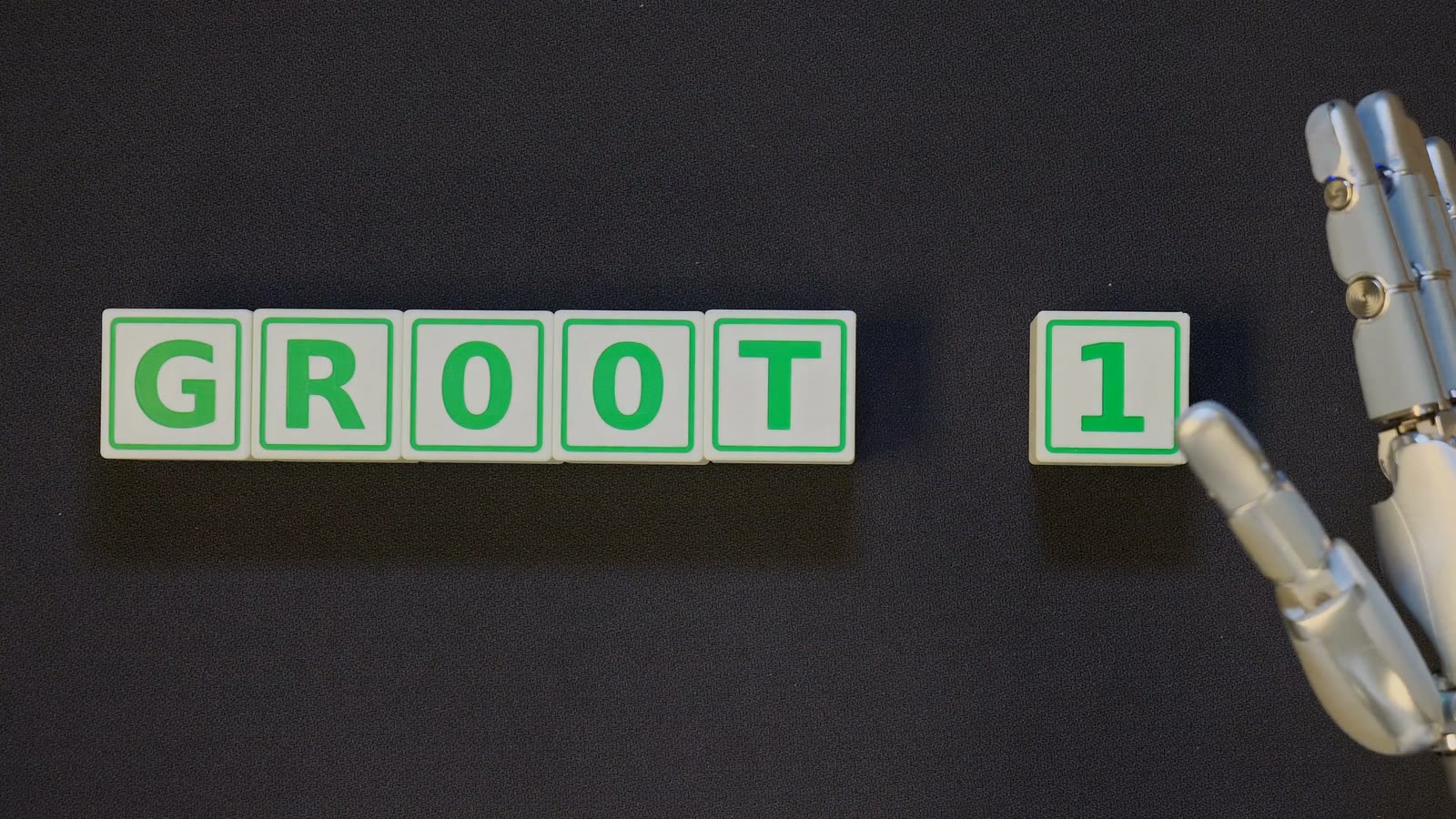
GR00T 2
NVIDIA's GR00T 2 foundation model predicts future video and robot actions, enabling cross-robot skill transfer and real-time humanoid control.
Deep dive
- GR00T 2 is a diffusion transformer that jointly predicts future video frames and robot actions.
- Demonstrates X-Adaptability: robots can perform tasks after watching only human demonstrations or other robot embodiments.
- GR00T 2 Turbo is a compressed version (2B parameters) capable of onboard execution on mobile hardware.
- Integrates with reasoning models for high-level agentic control, achieving 97% success in complex assembly tasks.
- Uses visual steering, allowing planners to mark specific grasp/release points on camera feeds.
- Training data includes 400k+ hours of egocentric human video and 23k+ hours of robot teleoperation.
- Achieves high success in contact-rich tasks like cable insertion and tool handling.
Decoder
- World-Action Model (WAM): A predictive model that understands the physical environment by modeling the relationship between visual perception and physical actions over time.
- Loco-manipulation: The simultaneous combination of locomotion (moving the robot's base) and manipulation (using arms or hands to interact with objects).
- Egocentric video: First-person footage, typically captured from a camera mounted on a human's head or chest.
- DoF (Degrees of Freedom): The number of independent joints or parameters that define the configuration of a robotic system.
Original article
Introducing GR00T 2
We introduce GR00T 2, a new generation of foundation world-action models (WAMs). GR00T 2 predicts future video and robot actions together, learning how physical interactions unfold along with the actions that produce them. The models run on parallel grippers, dexterous hands, and humanoids. Learning to predict the world, not just act in it, unlocks three new capabilities.
01 Emergence of X-Adaptability
Skills shown only by humans, or with handheld and wearable devices, carry over to robots that never practiced them.
- Human → robot. Shown the task only by humans, never on the robot, a robot with two five-fingered hands lines a lab funnel with filter paper and wets it with a wash bottle in 65% of trials.
- Handheld UMI gripper → YAM. Shown only with a handheld UMI gripper, a different gripper from the robot's own, the YAM arm assembles a toy dump truck end to end in 60% of trials, a long-horizon task that takes up to 4 minutes.
- Wearable hand → robot hand. Shown only with DexUMI, a wearable hand that mirrors the robot's fingers, a two-handed robot handles long-horizon dexterous work, such as preparing banana yogurt and scooping granola for breakfast, and highly dynamic tasks like striking a match to light a lamp.
02 Fast Adaptation and Agentic Control
GR00T 2 performs many new tasks zero-shot and masters them from a handful of demonstrations. Because it predicts the outcome it is acting toward, a reasoning model can also direct it.
- Zero-shot generalization and few-shot adaptation. On 50 tasks never seen on the target robot, only in human video or on other robots, GR00T 2 succeeds 40% of the time zero-shot. Five demonstrations per task, under 3 minutes of robot data, raise that to 95% after a 30-minute fine-tune on a single RTX 5090.
- Dexterity. With minimal post-training, GR00T 2 performs long-horizon, highly dexterous tasks with two 22-DoF Sharpa hands, such as seating GB300 memory modules (85%) and assembling a toy truck (65%). Previous models could not do these tasks.
- Self-improvement. Reinforcement learning on the real robot lifts three contact-rich insertion tasks to 88–96% success.
- Agentic control. With a reasoning model calling GR00T 2 through the WAM API, YAM completes 97 or more of 100 back-to-back assemblies of each of three toys, recovering from stalls and errors along the way.
- Visual steering. When a reasoning model gives step instructions and marks where to grasp and release on GR00T 2's camera view, YAM follows what-and-where instructions 92% of the time, up from 40% with the task instruction alone, and finishes 17 of 20 long-horizon trash-sorting runs.
03 Whole-Body Loco-Manipulation with GR00T 2 Turbo
GR00T 2 Turbo is GR00T 2 built for speed. A smaller transformer and a more compact video representation make it light enough to run on the Unitree G1 humanoid itself, steering the robot's whole body as it walks, bends, reaches, and carries.
- Real time on the robot. Each prediction takes 124 ms on the G1's own Jetson Thor.
- Whole-body skills. Through the SONIC whole-body controller, Turbo scoops and serves popcorn in all 48 trials and clears a table of diverse objects in 93% of trials.
Model Architecture
One diffusion transformer denoises future video and robot actions together. Predicting how the scene should change lets GR00T 2 learn physics from human video; small per-robot heads turn the plan into motor commands for each body.
GR00T 2 reads recent video, the instruction and the robot state, denoises future video and an action chunk together, executes the chunk, and repeats. The footage is a GR00T 2 rollout of truck assembly on Dexter (Tianji robot + Sharpa hands), shown from the head camera and both wrist cameras at the model's own 320×224 resolution. The history panel is the real 0.8 s the model saw. The future panel is video that GR00T 2 generated from that moment for all three cameras, not the real footage.
Pretraining Data: Humans, Handheld Grippers, and Robots
GR00T 2 is pretrained on one mixture of three kinds of data: 402,730 hours of egocentric video of people at work, 10,184 hours of demonstrations with a handheld UMI gripper across 2,897 tasks, and 23,500 hours of robot teleoperation. The robot data spans parallel-gripper arms (YAM and Franka), dexterous hands (Sharpa and Wuji), and the Unitree G1 humanoid. The human video comes from our egocentric Human-1M dataset, and 100,000 hours of it are openly available as Human-1M-100K on Hugging Face.
Scaling Human Video in Pretraining
Human video is by far the largest part of the mixture. To measure how much it helps the robot as it scales, we pretrain four models on none, 1%, 10%, and 100% of the human video, then evaluate each on 72 downstream Dexter tasks, both as video rollouts and on the real robot. Task progress rises at every step, from 64% to 77% in video rollouts and from 50% to 70% on the robot.
X-Adaptability: Learn from Humans, Run on Other Robots
GR00T 2 uses human video and data from other robots to learn skills for a new robot. The target robot does not need to have demonstrated the task itself. We call this cross-adaptation, or X-Adapt, and show it three ways: from humans to a dexterous robot, from a handheld gripper to a robot arm, and from a wearable hand to a robot hand.
Human → Robot, with No Teleoperation
Each chemistry-lab task is demonstrated only by people wearing gloves and head and wrist cameras. Task-agnostic play data teach Dexter how its own body looks and moves.
UMI → YAM: From a Handheld Gripper to a Robot Arm
Conveyor sorting and tossing, the toy dump-truck assembly and the NIST board disassembly are demonstrated only with a handheld GEAR UMI gripper. YAM contributes only task-agnostic teleoperation data, with no demonstration of any of these tasks.
DexUMI → Dexterous Hand: From a Wearable Hand to a Robot Hand
GEAR DexUMI is a wearable exoskeleton that matches a robot hand's joints, so what a person does with it maps directly onto the robot. From DexUMI demonstrations alone, GR00T 2 learns three bimanual tasks on a Tianji robot with two XHAND1 hands: preparing banana yogurt and scooping granola, the two halves of a breakfast task, and striking a match to light a lamp under a flask before putting the match out in water.
Dexterity: Fine Motor Control for Five-Fingered Hands
With only a small amount of teleoperation data per task, post-training lets GR00T 2 perform long-horizon dexterous tasks with Dexter's two 22-DoF Sharpa hands: labeling packages, swapping parts, assembling toys, and running chemistry-lab procedures end to end.
Human → Sim → Real: From One Human Demo to In-Hand Tool Use
Starting from a single human demonstration of using a hammer, we reconstruct the task in simulation and refine the skill with reinforcement learning. GR00T 2 learns from that simulation data and transfers directly to a real robot with Sharpa hands.
Fast Adaptation: A New Task from a Few Demonstrations
Post-trained for about six epochs on a small dataset per task, GR00T 2 learns each task from a few hours of demonstrations.
Zero-Shot Generalization, Few-Shot Mastery
GR00T 2 is pretrained on teleoperation data from many robots and on large-scale human video, and it learns by predicting how the world changes as it acts. Because it has seen so many tasks, a skill shown on one embodiment, or only in human video, carries over to a robot that has never practiced it. We test this on 50 tasks that appear in other robots' data or in human video but never in the target robot's own data: a bimanual robot with two Sharpa hands.
Zero-shot, from the instruction alone, GR00T 2 succeeds in 40% of trials, and on 40 of the 50 tasks it succeeds at least once. Most misses come from execution, not intent: GR00T 2 does the right steps in the right order, and a single step falls short on precision. A little robot data closes that gap. One demonstration per task lifts success to 71%, and five, under 3 minutes of robot data, lift it to 95%, with 37 of the 50 tasks succeeding in every trial. Each adaptation is a 30-minute LoRA fine-tune on a single RTX 5090.
Agentic GR00T 2: Control and Steering
A frontier reasoning agent and GR00T 2 handle complementary parts of a task. The agent decides what to do: it breaks a long task into steps, checks progress, and writes code. GR00T 2 decides how, performing the contact-rich manipulation that is hard to script. Through the WAM API, the agent can control GR00T 2 as a tool and steer it by marking targets on its camera view.
Agentic Control: 97 or More Successes out of 100 Assembly Trials
The agent runs as System 2 (S2). In an observe–reason–act–verify loop, it calls GR00T 2 as a tool alongside tools for camera images, robot state, and code-as-policy (CaP) skills. On real robots, GR00T 2 performs most of the manipulation.
Visual Steering: Showing GR00T 2 Where to Act
A language instruction can leave the target object, its destination, or the acting arm unclear, especially in clutter. With visual steering, the planner marks a grasp point on the target object and a release point at its destination on GR00T 2's camera view, colored by the arm that should act. GR00T 2 generates the rest of the motion: approach, grasp, transport, and release.
GR00T 2 Turbo: Whole-Body Loco-Manipulation
A humanoid must place its hands precisely while staying balanced as its whole body moves, often quickly. With its lower prediction cost, GR00T 2 Turbo runs onboard a Unitree G1 and steers the SONIC whole-body controller through latent whole-body commands.
Simulation for Evaluation and Development
We developed an agentic real-to-sim workflow that recreates high-fidelity digital twins of real-world tasks and use these simulation environments for policy evaluation and development.
Real-to-Sim Reconstruction
Agent-assisted workflows build the environments. Agents take inputs such as real robot videos, 3D scans, and photographs and use tools from SimFoundry to reconstruct the scene and assets, including geometry, appearance, and collision modeling.
@techreport{nvidia2026gr00t2,
  title       = {{GR00T 2}: Scaling Robot Foundation Models for
                 Generalization, Dexterity, and Adaptation},
  author      = {{NVIDIA et al.}},
  institution = {NVIDIA},
  type        = {Whitepaper},
  year        = {2026},
  url         = {https://research.nvidia.com/labs/gear/gr00t-2/assets/gr00t2_whitepaper.pdf}
}Fresh dev news, AI-digested daily. Never miss a trend at devoured.fyi