Apple's Claris Testing 'Harbor' App for Local AI on Macs
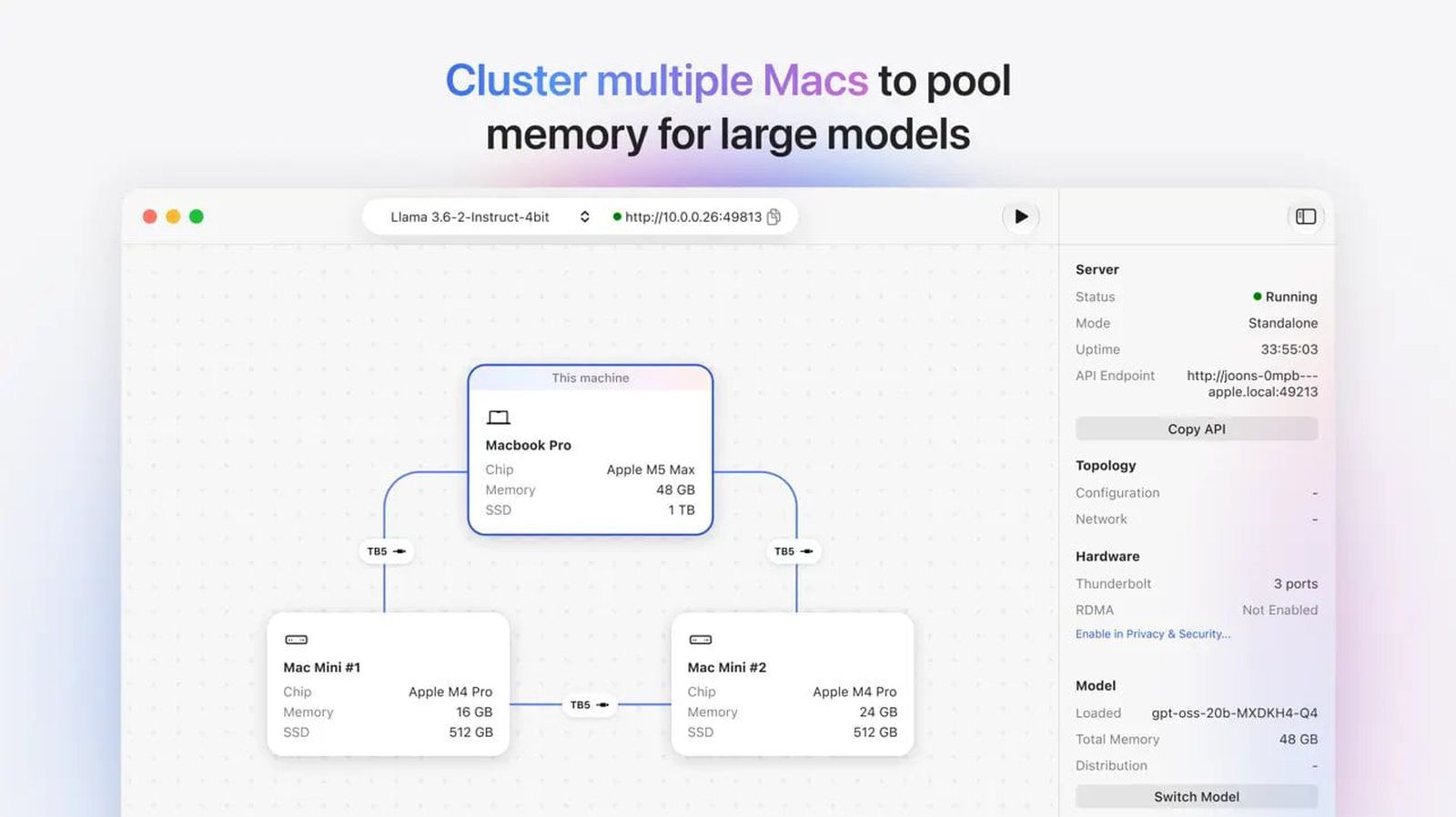
Apple's Claris subsidiary is testing a new app called Harbor that enables local AI model clustering across multiple Macs via Thunderbolt 5.
Decoder
- RDMA (Remote Direct Memory Access): A networking technique that allows data to move between the main memory of two computers without involving either operating system, reducing latency and CPU overhead.
- Unified Memory: A memory architecture where the CPU and GPU share the same memory pool, common in Apple Silicon, which simplifies data handling for large AI models.
Original article
Apple's Claris Testing 'Harbor' App for Local AI on Macs
Apple's Claris subsidiary is testing an app called Harbor, which turns Apple silicon Macs into a private AI server.
Harbor works with a single Apple silicon Mac, but it also supports connecting multiple Mac computers over Thunderbolt 5 to pool unified memory for larger models. Apple added RDMA over Thunderbolt 5 with macOS Tahoe 26.2, making clustering faster.
Harbor detects devices connected over Thunderbolt 5 and lets users browse for, download, and load open-weight models. It's described as an easy-to-use app with no manual configuration required.
Harbor turns your Mac into a private AI inference server. Run open-weight models locally on Apple silicon—your data never leaves your hardware, and nothing reaches the cloud. Connect multiple Mac computers over Thunderbolt 5 to pool unified memory, enabling large models and higher concurrency than a single computer can handle alone.
Set up in minutes, not hours. Harbor automatically detects your devices over Thunderbolt 5 to form a cluster. Plug in, start, and you're running—no manual configuration, no command line, no infrastructure expertise required.
Download and run models directly. Browse, download, and load open-weight models from within the app. Harbor handles model management so you can focus on the work, not the setup.
Cluster for scale. Connect two or more Thunderbolt 5-capable Mac computers and Harbor pools their unified memory into a single inference resource. Run models that exceed any single computer's capacity, or serve more concurrent requests across your cluster.
Harbor is in early access and is not publicly available. There was an App Store listing, but it has now been removed.
Claris is known for its database platform FileMaker, which is aimed at businesses, so it isn't clear how Apple will market the Harbor app or whether it will be free. The sign-up page for Harbor asks for a company name, which suggests more of a business focus.
There are already well-known, free alternatives for Mac users who want to run a local AI server. Exo is an open-source tool for clustering Macs, and LM Studio is available for single-Mac use, but Apple's Harbor app appears to combine LM Studio's simple interface with clustering.
Fresh dev news, AI-digested daily. Never miss a trend at devoured.fyi