Who Captures the Most Margin in AI?
Analysis of the AI value chain reveals that applications, neoclouds, and inference vendors capture over 90% of gross profit, with heavy vertical integration ongoing.
Deep dive
- The AI stack consists of: Power, Data Center, Neocloud, Inference, and Applications.
- Compute costs are rising, with CoreWeave contracts shifting significantly in pricing per megawatt.
- Gross profit is highly concentrated in the top three layers of the stack.
- Vertical integration (e.g., CoreWeave acquiring Weights & Biases) is the current strategy to protect margins from volatility.
Decoder
- Neocloud: Specialized cloud providers, such as CoreWeave or Nebius, that focus specifically on providing GPU-intensive infrastructure rather than general-purpose cloud services like AWS.
- $/w/yr: A unit of measurement that normalizes different pricing models (kWh, monthly rent, GPU-hour, task-based) into an annual dollar value per utilized watt of power.
Original article
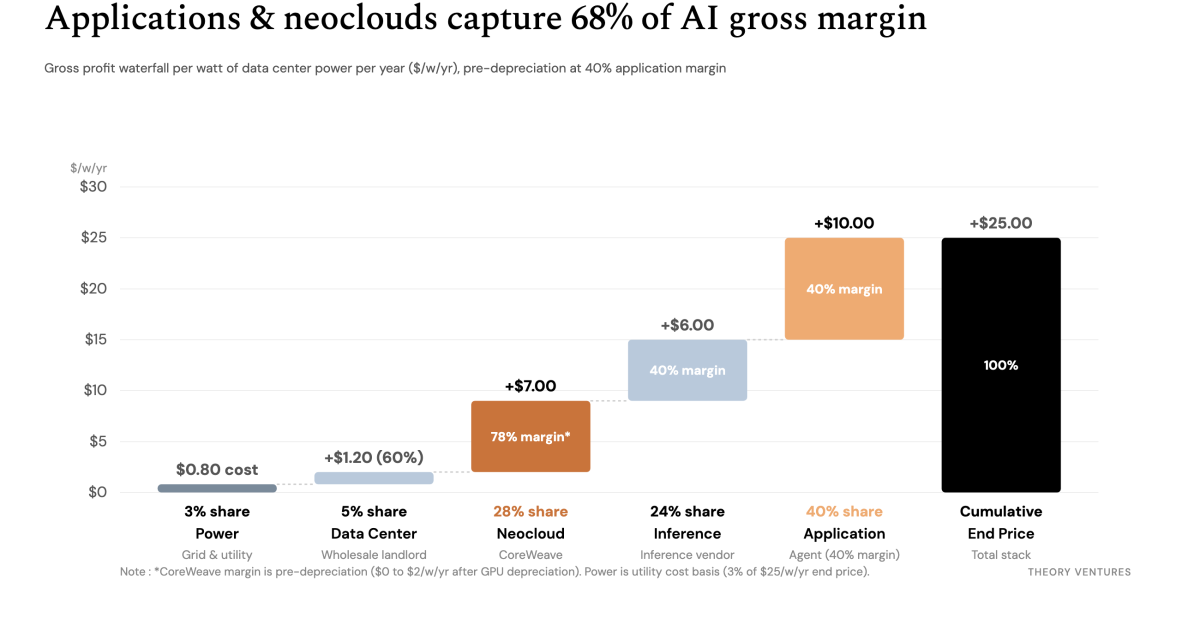
In short : Public disclosures from CoreWeave, Anthropic & wholesale data center landlords piece together the AI gross profit value chain in dollars per watt per year. At a 40% application margin, applications (40%), neoclouds (28%) & inference vendors (24%) capture 92% of total gross profit before GPU depreciation.
Who captures the most margin in the AI value chain? Public filings now let us trace the dollars from the power plant to the agent.
Five layers make up the chain :
- Power plant : produces the electricity.
- Data center operator : builds the building, connects the power & provides a shell.
- Neocloud : buys the GPUs & manages them.
- Inference vendor : runs the software to power AI.
- AI application : sells software to a customer.
Each layer bills in a different unit : utilities sell kilowatt-hours, neoclouds rent GPU-hours (an hour of a GPU’s time) & applications price completed tasks. Normalizing every step to dollars per watt per year ($/w/yr) puts the whole stack on one scale.
At a 40% application gross margin, the total gross profit pool divides from left to right as :
- Power : 3%
- Data center : 5%
- Neocloud : 28% (before GPU depreciation)
- Inference : 24%
- Application : 40%
Three implications follow from the chain :
1. Rising compute prices will test who holds pricing power. From Anthropic to CoreWeave, compute prices are climbing. Anthropic’s Form S-1/A discloses short-term burst compute reaching $13 per GPU-hour. On CoreWeave’s Q3 earnings call, CEO Michael Intrator confirmed the shift in contract rates :
“Selling capacity at more than $40m per megawatt annually while pricing for new infrastructure on four & five year contracts is moving to $20m to $25m per megawatt.”
At $20m to $25m per megawatt ($20 to $25/w/yr), new multi-year compute contracts price at more than double CoreWeave’s $9/w/yr blended fleet today. If the application can charge the end user more because of its effectiveness, higher compute costs cascade through. Otherwise, neoclouds, inference providers & applications fight over a fixed pool.
2. Different applications will command varying pricing power as a function of their ROI. An AI that saves 30% does not command the same pricing power as one that saves 70%. Techniques like small models, fine-tuning & routing will help sustain margins. Unlike the SaaS era, different vertical software markets will support varying gross profit pools.
3. Vertical integration is already consolidating margin. Companies across the stack are absorbing neighboring layers to capture adjacent margin. CoreWeave acquired Weights & Biases ($1.03b), OpenPipe, Marimo & Monolith AI ($185m) to move up into training, evaluation & enterprise workflows. Nebius has spent more than $1b in 2026 acquiring four companies across search, model optimization, cold-start scaling & orchestration to build its Token Factory. Owning multiple layers lets an integrated provider absorb price swings that squeeze standalone vendors.
No layer in AI is static. As market power shifts from one layer to the next, though, understanding these shifts will explain where competition is fiercest & where M&A will concentrate.
Fresh dev news, AI-digested daily. Never miss a trend at devoured.fyi