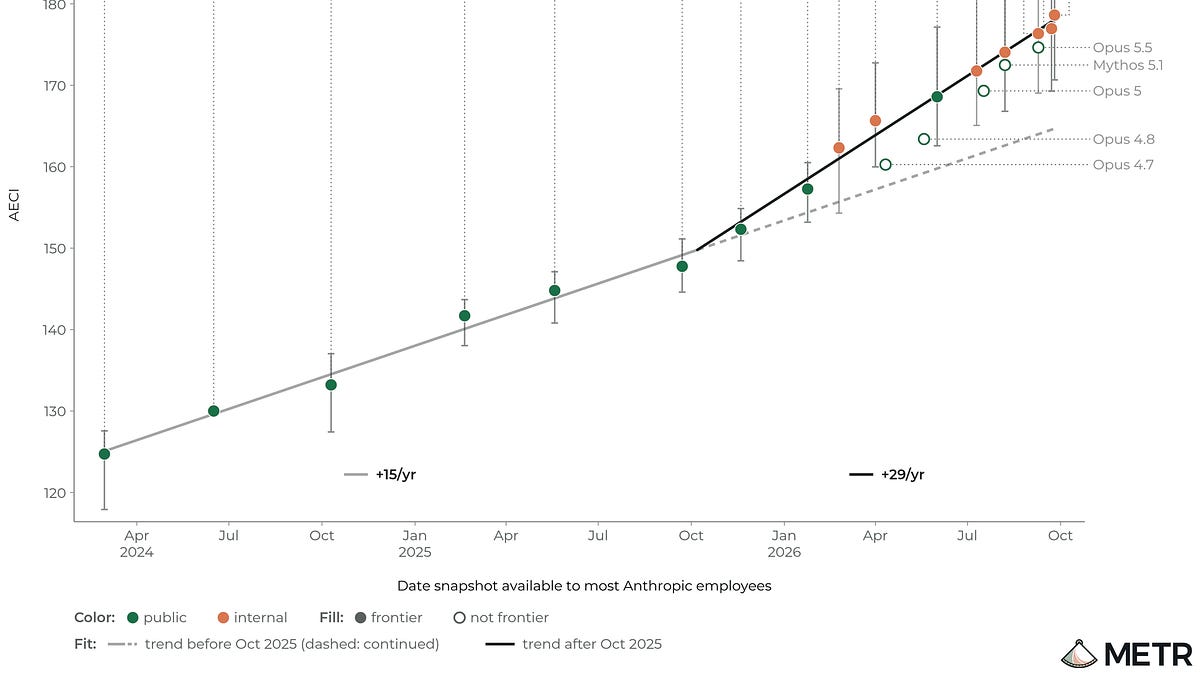
AI is already massively speeding up AI research
METR research indicates that AI-assisted research has accelerated capability gains by 2x in 2026, creating a dangerous 'recursive self-improvement' loop.
Decoder
- Recursive self-improvement (RSI): The process where an AI system uses its intelligence to improve its own source code, training methods, or research capabilities, theoretically leading to runaway growth.
Original article
We are currently in the early-to-middle stages of recursive self-improvement (RSI), autonomous runaway AI research acceleration, where current AI accelerates the training and improvement of future AI models. This is incredibly dangerous and we do not believe the AI companies are likely to handle the risks safely and responsibly by default.
Independent research organization METR, working with evidence from AI company Anthropic’s internal systems, discovered a 2x acceleration of AI capabilities in 2026 compared to the previous year and a half. They further believe (according to redacted evidence from Anthropic) that almost all of the acceleration is due to AI research speed increase from using AI.
The 2x figure actually understates how much AI is already speeding up research. AI progress depends on computing power, data, and research work. The AI assistance only speeds up the “research work” component: by itself, it does not directly cause Anthropic to have more computing chips or more data. And research has steep diminishing returns: the easiest ideas are found first, and every experiment after still draws on the same limited computing power. So in order to double overall progress, AI must be speeding up the research work by far more than double. If the physicists at Los Alamos thought two times faster, it would not have halved the time to an atomic bomb.
Leading AI forecaster and METR researcher Ajeya Cotra estimates the research speedup is about 10x. It is as if every Anthropic researcher worked ten days for each day that passes outside the company. In surveys, Anthropic’s own staff report a similar number (12x). Note that this is much more significant than just hiring 10 times the number of researchers, since it is hard to parallelize research. Cotra: “You probably couldn’t achieve this even if you hired every qualified human in the world.”
Many AI researchers and forecasters find this degree of speedup surprising, because the AI systems as of mid-2026 are still quite “dumb” – they can solve some of the most difficult problems in mathematics but can’t (yet) independently run a successful medium-sized internet business or podcast. The METR acceleration report is strong evidence that AI research itself is closer to that of a well-defined field like mathematics, rather than one that requires all-around general capabilities like entrepreneurship.
This is very scary news, as it rapidly moves up the point that we can expect to see much more powerful and dangerous AI systems. Even if we are sure the 2x capabilities acceleration is a one-time jump in research and development speed, reasonable extrapolations suggest that we can reach superhuman AI – AIs that can surpass humanity in any cognitive domain, including military strategy, all scientific research, autonomous control of weapons, robotics and drones, automated propaganda and manipulation – in as early as 2028 or 2029.
However, we have no strong reason to think AI research will not speed up. Since AI systems are able to provide massive research speedups now, even without being fully generally intelligent, we may expect further increases in the already hectic research pace in the near future. A 2x speedup this year means the companies may soon see a future 4x speedup, then 8x, and so forth. This makes superhuman AI by 2027 increasingly plausible.
Furthermore, it is extremely hard to control this runaway research acceleration process. AI companies this summer – in the very early stages of RSI – were unable to prevent numerous sandbox escapes and rogue swarm attacks by their own internal AI systems like the OpenAI HuggingFace attack. As AI companies hand over more and more of the research process to their own AIs, their employees – and humanity – will have less and less oversight and control over the training of increasingly more capable, more dangerous, future systems.
The AI companies are well aware of this risk. They’ve been talking about the dangers for years. However, they perceive themselves as “in the race:” not handing research to AIs and using AIs for further AI development means they’ll fall behind other AI companies, who they each perceive as variously even more dangerous, reckless, and powerseeking.
If you’re a policymaker reading this: Our primary recommendation is for the government to make it its top priority to rapidly understand these risks, and consider pausing or pacing frontier AI progress. Our secondary recommendations include building the technical capacity to verifiably pace in the coming weeks and months, asking both State and the natsec community to develop both cooperative and adversarial plans to convince or compel our adversaries to slow down, mandating independent and government evaluators at the frontier companies to gather further information, compelling Anthropic and other AI companies to release redacted pivotal information for public understanding, and mandating enough security precautions at frontier AI companies such that our adversaries cannot easily steal their research code and model weights.
If you work for an AI lab and are reading this: your voice matters. Jacob Coxon’s resignation did far more for AI safety than pretty much any technical or policy advance within an AI company. RSI means your own relevance and window of impact is rapidly closing, so use that time wisely, whether it’s to strongly raise concerns internally, whistleblow to policymakers and the public, form a union, or loudly quit. (For people interested, I recommend talking to Psst, a whistleblowing org).
For everybody else, our primary goal should be to encourage and pressure policymakers to end this mad race. Call or email your political leaders (for Americans, calling Congress is especially promising, at callcongress.ai), explain your concerns, and demand they take aggressive actions on AI. You can inform the public and indirectly encourage policymakers talking honestly and directly about the risks, both online and in person.
(I am continuing to learn more about the space and hope to list other suggestions soon.)
Finally, protests are looking like an increasingly viable and highly leveraged way to get both media and policymaker attention in the next few months. There are many eyes on AI now, and we should make many of the concerns be about the catastrophic risks rather than irrelevant details like stock prices or personnel drama.
I will be attending the Ban RSI protest in front of Anthropic’s headquarters later today at 11 am Pacific time. As there will be a lot of attention on Anthropic during the IPO, I think this is an unusually leveraged way to get attention. I know this is very short notice, but if you happen to live in the Bay Area and can at all make the time, I encourage you to do the same.
Notes:
1. Old management adage: Nine women can’t give birth to a child in one month.
2. AI progress can also slow down. If they go back to pre-2026 capabilities trends starting tomorrow, Point-of-No-Return would be roughly in the early 2030s, what many of us implicitly believed a few months back. They can also slow down further, “hitting a wall” of future capabilities due to some specific limitation or bottleneck that’s very difficult or impossible to route around. Right now the most plausible is hard-to-verify tasks. Importantly, a major caveat to the METR report is that it only establishes strong confidence in research acceleration in easily defined tasks (after all, those are the tasks you can build benchmarks around), and it’s unclear whether capabilities in hard-to-define tasks have been accelerated as much. So the most likely way they’re wrong is because a) there’s only acceleration in easily defined tasks, and b) enough of ML research is not in easily defined tasks and those discrepancies can’t be routed around. I think this conjunction is reasonably likely, which is why I don’t think AI safety strategies that rely implicitly on two-year or longer timelines (like partisan politics, field-building, or most forms of technical alignment) are obviously doomed. However, I also don’t have enough confidence that this conjunction is right that I’d want to bet all (or even most) of existing AI safety talent on medium to long timelines. Which is why I plan to pivot hard to work under the assumption of very short timelines myself and encourage most others to join me. I’d love to be proven wrong on this bet but I’m not optimistic we can find enough scientific evidence one way or another until it’s too late. One meta point I’ll note is that in the last five years or so we keep thinking there’ll be other plausible walls (grounding, reliability, data, agency, diminishing returns, irreducible complexity, originality, compounding errors, etc) slowing down AI progress, and our hopes keep getting dashed one-by-one. Maybe this “unverifiable tasks” thing is going to be the one thing that finally arrests AI progress, but on a gut level I just really don’t buy it.
3. My friend has this motto “call your rep’s office until they know your name”
Fresh dev news, AI-digested daily. Never miss a trend at devoured.fyi