DEVOURED
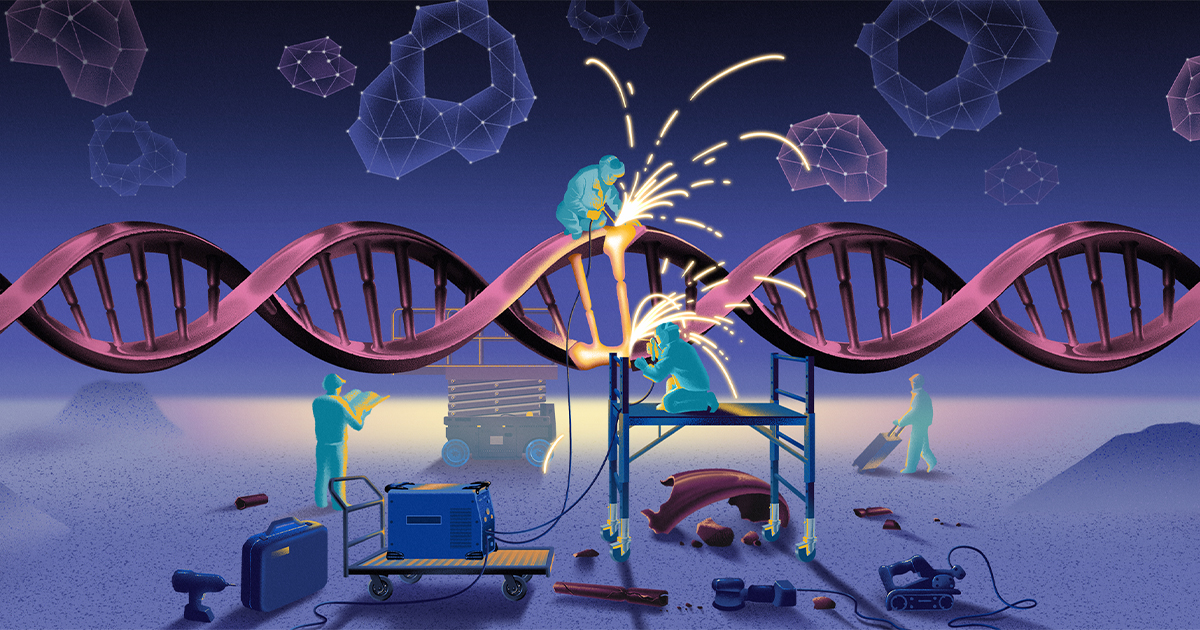
The Incredible, Elegant DNA Repair System Makes Gene Editing Work
Gene editing technologies rely on the cell's native DNA repair machinery, which evolved alongside life itself to fix thousands of damage events daily.
What: Cells use two primary mechanisms for repairing double-strand DNA breaks: nonhomologous end joining (common but prone to mutation) and homologous recombination (accurate but limited to cell division). Modern tools like CRISPR-Cas and base editing use these pathways to precisely insert or modify genes.
Why it matters: Understanding these biological repair pathways is foundational for researchers trying to improve the safety and precision of gene-editing therapies.
Deep dive
- Cells experience up to 100,000 DNA damage events daily from metabolism and environmental factors.
- DNA repair is essential for stable genetic information.
- Nonhomologous end joining sticks broken ends back together, often causing mutations.
- Homologous recombination uses sister chromatids as templates for precise repair.
- Gene editing works by inducing controlled DNA breaks to trigger these repair pathways.
- Base editing is an newer, potentially safer method that changes single bases without breaking the DNA strand.
- Recent research shows base editing currently lacks the precision required for human embryonic use.
Decoder
- Nonhomologous end joining: A cellular repair mechanism that trims and joins broken DNA ends, often resulting in small mutations.
- Homologous recombination: A high-fidelity DNA repair pathway that uses a matching sequence (like a sister chromatid) to repair a damaged strand without losing information.
- Base editing: An advanced gene-editing technique that targets and modifies individual nucleotide bases (A, T, C, G) without needing to sever both strands of the DNA molecule.
Original article
Full article content is not available for inline reading.
Explore all 40 articles in today's digest
Fresh dev news, AI-digested daily. Never miss a trend at devoured.fyi