Devoured - November 24, 2026
Developers can now leverage automated agent workflows for code maintenance and infrastructure protection, with recent tools like Claude Ship enabling automated PR management and Shirudo providing eBPF-based security shields. Simultaneously, research into architectural efficiency—such as Loop Transformers and DeepCrossAttention—is driving models toward higher reasoning capabilities with significantly lower parameter counts.
OpenAI and Cisco introduce Shirudo
OpenAI and Cisco open-sourced Shirudo, an eBPF-based runtime that enables the deployment of temporary security shields on Linux systems without requiring service restarts.
Deep dive
- eBPF Integration: Uses eBPF programs to monitor and apply protections at specific points within the OS kernel.
- Operational Flow: Allows for testing shield impacts before deployment.
- Trust: Shields are signed and verified via TPM (Trusted Platform Module) to ensure integrity.
- Goal: Enable faster, more granular response to zero-days and vulnerabilities in core Linux services.
Decoder
- eBPF (Extended Berkeley Packet Filter): A technology that enables running sandboxed programs in the Linux kernel without changing kernel source code or loading modules.
- Java4Shell: A reference to the Log4j-style vulnerabilities that require immediate blocking of specific code paths to prevent remote code execution.
Original article
OpenAI and Cisco introduce Shirudo
An open-source runtime that helps operators protect running Linux systems without needing to wait for the patch or restarts
OpenAI and Cisco are launching Shirudo, an open-source runtime that helps teams protect Linux systems while they roll out patches. In a controlled test, a Codex-generated shield blocked a Java4Shell exploit attempt against a running Elasticsearch service without requiring a restart.
We’re inviting developers, security researchers, and infrastructure operators across the industry to help develop the project further. The project brings together OpenAI’s frontier AI, security and infrastructure research and Cisco’s infrastructure and security expertise to help protect the systems people rely on every day.
Testing and deploying a patch can still take days or weeks. Protecting a service in the meantime can be challenging because an exploit and a legitimate request may rely on the same Linux operation. Blocking that operation entirely could take the service offline.
Shirudo (Japanese for “shield”) is designed to help security teams navigate this tradeoff. Teams can test whether a temporary safeguard, called a shield, blocks the behavior that exposes a vulnerability while allowing legitimate requests through. Once an operator approves the shield, it can be deployed while the service continues running.
“We’re giving defenders better models and tools to find and fix vulnerabilities faster, but finding a bug today doesn’t mean you can patch every system tomorrow. We are partnering closely with Cisco on Shirudo to help teams protect the systems they need to keep running while they build and roll out a fix. So many teams rely on the same software that it makes sense to build these tools in the open. Now when one team finds a better way to protect a system, others don’t have to start from scratch.” — Greg Brockman, President and Co-founder of OpenAI
How Shirudo works
Shirudo uses eBPF, a Linux technology that allows small programs to run at specific points inside the operating system. This makes it possible to observe suspicious activity and apply targeted security protections to running systems.
OpenAI and Cisco are designing Shirudo around four core capabilities:
- Live protection: eBPF shields can block vulnerable code paths without restarting the system. Security teams can monitor how a proposed shield would affect applications before enforcing it.
- Defense at machine speed: OpenAI and Cisco are designing Shirudo to give agents programmable controls to investigate vulnerabilities, develop targeted shields, and validate their effectiveness against exploits and real workloads. Security teams control what gets deployed.
- Trusted deployment: Shields are cryptographically signed and verified before loading. Linux's eBPF verifier checks eBPF programs against its safety rules, while kernel security controls restrict unauthorized changes.
- Hardware-backed verification: Shirudo uses a Trusted Platform Module (TPM) to support a verifiable record of protections being loaded or removed. Operators can use this evidence to check whether systems meet their security requirements.
The Shirudo technical walkthrough from the Linux Plumbers Conference shows how to apply a shield and verify it on the target host. The Java4Shell vulnerability is another example illustrating how a targeted shield can protect a running application while a permanent patch is being prepared. Using OpenAI's Codex, the team generated a shield that added an input check to Java's Base64 decoder and attached it directly to a running Elasticsearch process. When attempting to exploit the vulnerability, the shield rejected the malicious input, blocking the attack while Elasticsearch continued running.
Rethinking infrastructure
Shirudo is a first step toward infrastructure that can adapt to emerging threats while remaining reliable. We want to strengthen the operating system foundations needed to deploy these protections at scale, including hardening the kernel and core services, limiting workload permissions, and making updates and recovery safer.
Our long-term goal is to enable defenders and AI agents to quickly identify affected systems, validate protections, and deploy eBPF shields that block exploits without disrupting workloads. Applications should run with only the permissions they need, governed by policies that are automatically generated and maintained.
We will combine frontier AI with security and infrastructure research to discover vulnerabilities and test defenses against realistic attacks. We aim to make it easier for operators to detect and contain compromises, prevent attackers from moving across systems, and restore services to a verified, known-good state. Hardware-backed attestation and independent network controls provide additional assurance even if individual systems are compromised.
Building in the open
OpenAI and Cisco are open-sourcing Shirudo so developers, security researchers, and infrastructure operators can inspect the code, test protections, and contribute to its development. Shirudo is licensed under BSD 2-Clause, with its BPF programs dual-licensed under BSD and GPL.
Our goal is to make tested shields available alongside vulnerability disclosures, giving operators a way to evaluate and deploy temporary protections while preparing permanent patches.
- Try Shirudo: Follow the VM quickstart to sign, load, and verify a test protection.
- Get hands-on: Explore Shirudo through Isovalent's self-guided lab.
- Join the technical deep dive: Register for the December 15 webinar.
We’re building Shirudo in the open with the people who build, run, and secure Linux systems. We welcome contributions to the runtime, new shields, and improvements to Linux and eBPF. If you'd like to get involved, take a look at the code on GitHub, read the docs, and let us know what you find.
Legacy Modernization with LLMs, measured
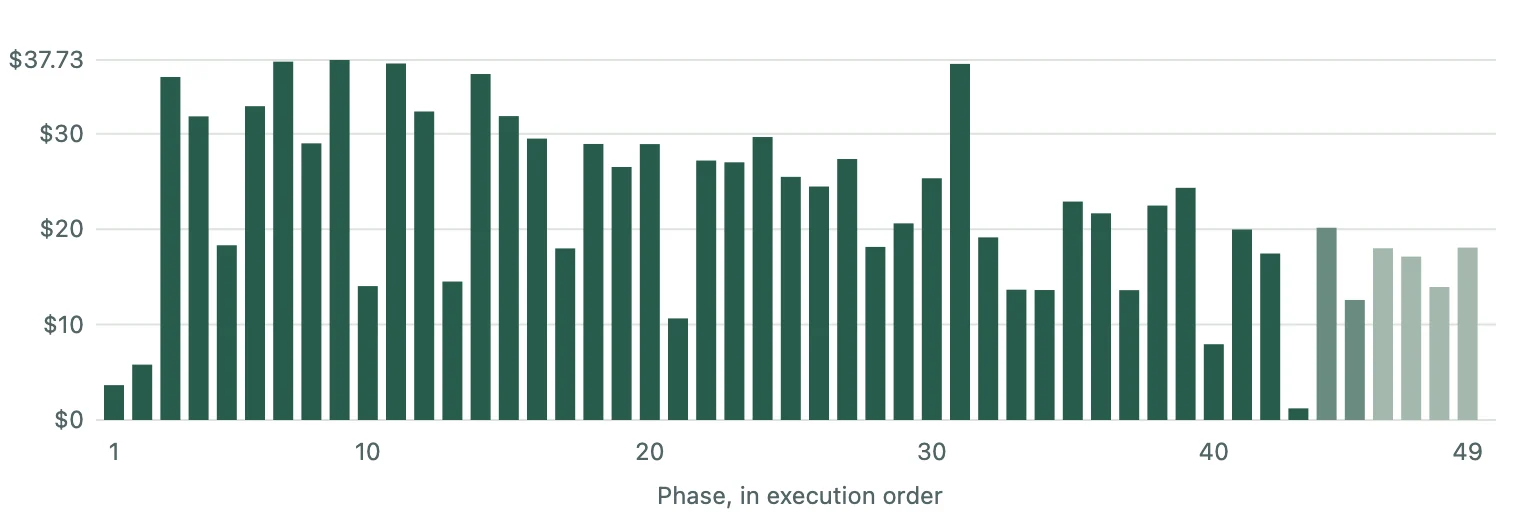
Translating large legacy applications with LLMs costs about $2 per thousand lines, but the resulting code is inconsistent and requires significant verification.
Deep dive
- Translating 500k+ lines of RPG to Java cost ~$1,100 at API prices.
- Repeated translations of the same code resulted in different architectures, interfaces, and design decisions.
- The model struggled with off-the-path behavior (e.g., overflows, negative values) even when standard operations passed tests.
- Generated code was internally inconsistent across different phases of the migration.
- A significant amount of the cost was spent on 'context' tokens as the codebase grew.
- Automated testing and verification remain the most expensive and unresolved bottlenecks.
- The generated code is hard to maintain because it lacks a unified style and uses duplicate utility functions.
Decoder
- IBM i: A mid-range computer system platform from IBM, often running legacy ERP software written in languages like RPG.
- RPG (Report Program Generator): A high-level programming language used primarily on IBM i systems.
- DDS (Data Description Specifications): A language used on IBM i to define data records and files.
Original article
Full article content is not available for inline reading.
Why AI Factories Need a Design System
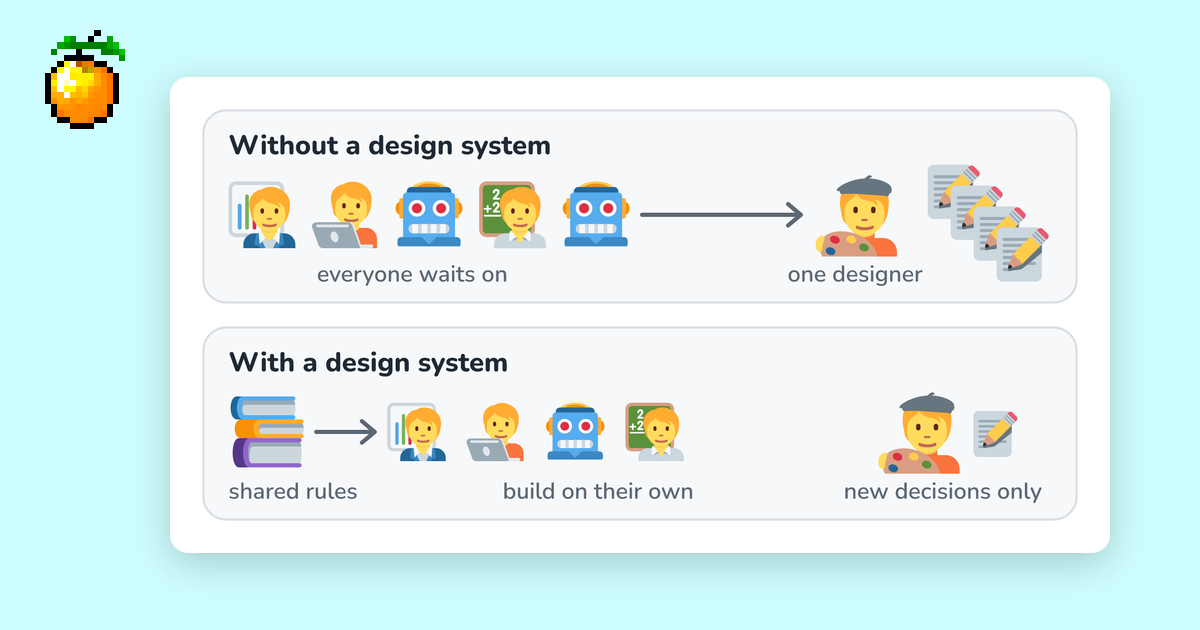
AI 'factories' require rigid, machine-readable design systems to prevent generated content from drifting into visual inconsistency and accessibility non-compliance.
Deep dive
- Standardize tokens (colors, spacing, type) as role-based variables to ensure theme compatibility (dark/light mode).
- Index the system so agents can retrieve only the specific section needed, minimizing token usage.
- Automate accessibility checks (e.g., contrast, alt text) as guardrails for every generation.
- Use 'LLM-as-judge' patterns to verify outputs against the design system rules before human review.
- Generate documentation (Markdown, JSON) from a single source of truth to avoid stale rules.
Decoder
- Design Tokens: Named, platform-agnostic values (like colors or font sizes) used to replace hard-coded values in design systems.
- Interface Inventory: A method of capturing every unique instance of UI elements (buttons, tables, etc.) in a product to identify inconsistencies and define standard versions.
- LLM-as-judge: A technique where one AI model is tasked with evaluating the quality or compliance of content generated by another model.
Original article
Full article content is not available for inline reading.

Introducing Natural Voice
Natural Voice allows AI voice agents to securely process credit card payments during live calls without taking the host system out of PCI compliance.
Decoder
- PCI DSS: Payment Card Industry Data Security Standard, a set of security requirements for organizations that handle branded credit cards from the major card schemes.
- DTMF: Dual-Tone Multi-Frequency signaling, the system used by phone keypads to send numerical data via audio tones.
Original article
Introducing Natural Voice
Today, we’re officially launching Natural Voice. Your voice agent can now take payment information securely and seamlessly, without the customer ever leaving the call.
Why voice agents stop at payment
Voice agents have become remarkably capable of handling complex customer conversations. From booking appointments and placing takeout orders to recovering missing payments, agents are offloading repetitive work for frontline teams.
For millions of small businesses, the phone is still the main channel through which they engage with their customers. But when it comes time for the customer to pay, the agent has to transfer them out-of-band, usually by redirecting them to a secure payment link or portal. Every handoff creates unnecessary friction and invites attrition, risking a lost conversion right when it matters most. Businesses we’ve spoken with see conversion jump from 40% to as high as 80% when payment-over-voice is added alongside payment links. Imagine a cashier who can ring you up but can’t take your card.
The reason for this is largely compliance. PCI DSS, the card industry’s security standards, make it difficult for voice agents to securely hear and process raw credit card numbers or banking credentials during a live call. These standards also apply to any system connected to the agent: the LLM, telephony provider, speech-to-text, transcripts, and logs.
Achieving and maintaining PCI compliance can be a tedious, protracted, and costly process. If they aren’t eager to take on months of work and diligence, teams building voice agents that need to move money typically utilize one of two workarounds:
- Payment links: The voice agent texts the caller a secure link to complete the payment, creating an opportunity for drop-off.
- Human agent: The call gets transferred to a person, bringing back the staffing requirement the agent was designed to relieve.
Take a card payment during a phone call
With Voice, Natural’s agent handles the payment from start to finish. When it’s time for the customer to pay, your agent transfers the call to Natural’s agent, which takes the card information, charges it, confirms that the charge went through, and hands back the call.
Here’s what that looks like from start to finish:
It’s Friday, and you’re getting together with friends for movie night. You call your local pizzeria to place an order, and an AI agent answers. You finish placing the order, then the agent automatically connects you to a secure payment line without interrupting the flow of the call.
Behind the scenes, the pizzeria’s voice agent creates a payment intent for the order, which tells Natural how much to collect. It then opens a voice session for that payment and transfers the call to Natural. Natural’s agent joins the call, names the pizzeria, confirms the total, and asks whether the caller wants to proceed with the payment. It then collects the customer’s card information, which can be spoken out loud or typed in on the keypad (DTMF).
Once the caller confirms, Natural charges the card and tells them whether or not the payment went through. If it doesn’t, Natural’s agent asks them to re-read the card or try a different payment method. After three failed attempts, the caller is texted a checkout link as a fallback.
Natural’s agent then either ends the call or hands it back to the pizzeria’s voice agent, which picks up where it left off. The entire transaction is completed while the caller is on the line.
Keeping your systems out of PCI scope
Since your agent isn’t on the call while payment information is being collected, card details never reach your agent, model, or logs. Natural handles all of the compliance and security requirements, so your team can accept payments securely without dealing with the compliance burden.
We deliberately designed Natural Voice with safeguards in place to ensure a secure, seamless handoff on every call:
- Encrypted calls: Natural rejects any call that isn’t encrypted, so no one can listen in while card information is being read.
- Approved phone systems: Natural only accepts calls from approved phone systems.
- Single-use transfer addresses: Each transfer address works only for that specific call and expires after 15 minutes.
- Test calls before going live: Natural reviews your setup and places test calls with you to make sure that nothing on your side recorded, transcribed, or logged the call.
What your voice agent gets back
Every call ends in one of three outcomes: paid, link sent, or unpaid. When a call finishes, your system receives a webhook with the payment status, alongside a log of every call: timestamps and a full transcript with card details scrubbed.
For agent builders, the order, card capture, and charge all happen in one system, so you get a complete, consolidated record of what happened on every call.
Where the money goes
Natural Voice is a channel for Accept, meaning the funds from each payment settle into the business’s Natural Wallet. Each payment shows up in the same dashboard and API, and refunds and disputes go through the same API as every other Natural payment.
Once it settles, your agents can use the money in your Natural Wallet on your behalf to carry out other business functions, from paying vendors and moving money between wallets to transacting online.
How Natural’s payment agent handles edge cases
People rarely read out their card number in one clean pass. They might pause to grab their wallet, stumble on a digit, or pause halfway through. Natural’s payment agent is built to navigate the messiness of phone calls in the real world.
If a caller drifts off topic, Natural’s agent steers them back. If they interject, append irrelevant details, read details out of order, or correct themselves, it keeps up and brings the conversation back to the payment. The customer won’t get charged until the caller clearly authorizes the agent to do so.
Under the hood, model and code checks work in tandem to ensure that card details are captured and handled correctly: the right amount is charged, a card isn’t charged twice, and whether to re-read the card, try a different one, or text a payment link after a decline.
Natural also runs internal evals that simulate tricky call scenarios: different accents, fast talkers, interrupters, people who correct themselves, declined cards, and callers who refuse to pay.
Natural Voice: Use cases
We’ve seen strong interest in voice payments from agent builders across industries:
- Restaurants: Takeout orders and reservation deposits
- Home services: Service fees, appointment deposits, and invoices
- Hotels and events: Rooms and booking deposits
- Healthcare and dental: Appointment fees and outstanding balances
- Auto services: Repair deposits, service invoices, and towing fees
- Salons and spas: Appointment deposits and no-show fees
- Property management: Rent, late fees, deposits, and maintenance charges
- Utilities and telecom: Bill payments and reconnection fees
- Collections: Past-due balances and payment plans
How to enable payments over the phone for your voice agent
Adding Natural Voice to a voice agent takes three steps:
- Create a payment intent for the order with
POST /payment-intents. It holds the amount, a description, and the line items. - Create a voice session for that intent with
POST /voice/sessions. Pass the caller’s phone number and, if you want the caller back afterward, a SIP address to return them to. Natural responds with a single-usedialUrithat expires after 15 minutes. - Transfer the caller to the
dialUriusing SIP REFER. Natural’s agent takes the card, charges it, and then either sends the caller back to your agent or ends the call.
When the call ends, your system receives a voiceSession.completed webhook with the outcome (paid, linkSent, or unpaid), alongside all other payment events.
In Sandbox, you can test everything before going live. Simulate a full call with a single API request, or place a real test call and read a test card number out to Natural’s agent.
Why we built Natural Voice
Most of the conversation about agents and money has revolved around giving agents the ability to pay. But on the other side of every transaction is a business that needs to get paid.
There are over 36 million small businesses in the US alone. For many of them, phone calls are still the primary way they handle frontline work like taking orders and bookings and engaging with customers. Most aren’t equipped with in-house engineers or a security team to help them build and maintain their own compliant payment systems; they rely on their software providers to handle these capabilities for them. With Natural Voice, one integration allows a builder and every business they serve to accept payments during a live call.
We’re building for a future where agents can act on a business’s behalf across the complete flow of money: collecting payments into the business’s wallet and spending from it. For millions of small businesses, that starts with getting paid over the phone.
To request access to Natural Voice today, reach out at hi@natural.com, or start by reading the Voice docs.
Natural is a financial technology company, not a bank. Wallet Accounts and banking services are provided by Column N.A., Member FDIC. Natural Voice and Accept are powered by other bank partners.
Claude Ship
Anthropic launched Claude Ship, a set of automated agents designed to manage GitHub pull requests from review through to policy-compliant approval.
Deep dive
- Code Review: Analyzes code changes to flag logic errors and security vulnerabilities.
- PR Steward: Automatically creates commits to resolve feedback, merge conflicts, and failing checks.
- Claude Approvals: A policy-driven engine that checks if a PR meets defined criteria before it can be merged.
- Billing: Agents are billed based on token usage separate from the base subscription.
- Security: Agents are currently unavailable for orgs with HIPAA configs or customer-managed encryption keys.
Original article
Claude Ship is a set of agents that help get your team’s GitHub pull requests ready to merge:
- Code Review: looks for issues such as logic errors, security vulnerabilities, and broken edge cases
- PR Steward: works on review feedback and failing checks
- Claude Approvals: checks pull requests against an approval policy that you write
Together, they can take a pull request through review, fixes, and an approval decision, so your team doesn’t have to manage each step manually. Your settings and GitHub branch rules determine what merges. Claude Ship is available on Team and Enterprise plans. To turn on the agents, go to Set up Claude Ship. To get a review and fixes locally, on one of your own pull requests, run /ship in Claude Code.
Claude Ship agents
Claude Ship uses AI and may miss bugs, security vulnerabilities, or other issues.
Code Review finds problems
Code Review reads a change alongside the surrounding code. Findings arrive as inline comments on the lines concerned, ranked by severity.
PR Steward pushes fixes
PR Steward works on failing checks, merge conflicts, and review comments from people and from review bots such as Code Review. It pushes commits with its fixes. Steward is designed not to approve or merge pull requests. Use branch protection to require the approvals you want before anything merges.
Claude Approvals applies your policy
Claude Approvals is a check that reports who still has to approve. You write its policy file, which can set how many people have to approve changes to a path, and where Claude can post an approving review. The check blocks a merge only where you make it a required check in GitHub, and normally not in observe mode. If you use GitHub auto-merge or a merge queue with a policy that doesn’t require a person’s approval, a change can merge without anyone acting.
Set up Claude Ship
Go to Organization settings > Claude Ship for Claude Ship’s settings. You need an Owner role. Turn on one agent at a time in one repository, in this order:
- Set up Code Review
- Set up PR Steward. For the setting that chooses when PR Steward starts, begin with Manual (@claude steward). PR Steward has no spend limit of its own until you set one.
- Set up Claude Approvals. A policy file in the repository starts it, so see who can turn it on. Start in observe mode, where the Claude Approvals check reports what your policy would decide. Observe mode is billed.
If you already use Code Review
Code Review’s settings moved to Organization settings > Claude Ship. A Claude Approvals policy file, .claude/approvals.yml, changes which pull requests Code Review reviews automatically. Once the file is on the default branch, in observe mode or enforced, automatic reviews normally stop where no matching rule names claude/code_review. To keep them, add claude/code_review to a rule.
Plans and billing
Claude Ship is for organizations on Team and Enterprise plans.
Who can use Claude Ship
Code Review is generally available. PR Steward and Claude Approvals are in public beta. The agents aren’t available to organizations with Zero Data Retention enabled, the HIPAA configuration applied, or customer-managed encryption keys.
How each Claude Ship agent is billed
Each agent is billed on token usage through your organization’s usage credits, separately from your plan’s included usage. Approvals bills for classifier runs and the Code Reviews that a policy asks for. Eligible Enterprise organizations can claim promotional Claude Ship credits. If you turn off usage credits in Organization settings > Usage, an agent that’s on keeps running and billing your organization. To stop its charges, follow Turn off Claude Ship.
Turn off Claude Ship
Turn off Approvals before Code Review, because a policy can start billed reviews where Code Review is off:
- Turn off Approvals
- Turn off PR Steward
- Turn off Code Review
These steps leave the /ship and /steward commands on.

Supercharging transformer residual connections
Google Research's DeepCrossAttention (DCA) reduces model parameter counts by 40% while improving performance by dynamically routing information between transformer layers.
Deep dive
- Information Dilution: A problem in deep networks where early high-resolution features are lost as they blend through many layers.
- DCA Mechanism: Uses learnable weights and depth-wise cross-attention to selectively combine past layer embeddings.
- Efficiency: Provides better perplexity on datasets like C4 and LM1B while using 30-40% fewer parameters.
- Implementation: Can be retrofitted onto pre-trained transformers to improve performance without full retraining.
Decoder
- Residual Connection: A technique in deep learning where the input of a layer is added to its output to mitigate the vanishing gradient problem.
- Perplexity: A measurement of how well a probability model predicts a sample; lower values indicate better predictive performance.
Original article
Supercharging transformer residual connections
We present DeepCrossAttention (DCA), an architecture that enhances transformer networks by using learnable weights and depth-wise cross-attention to dynamically combine outputs from previous layers, preventing the information dilution seen in traditional residual connections. Presented in our ICML 2025 paper, this architectural improvement allows models to achieve the same quality up to three times faster with a negligible increase in parameters.
Think of a traditional deep learning model like a giant game of "Telephone": data passes through layer after layer, with each layer changing the information slightly. If a network has dozens or hundreds of layers, the original learning signal can become severely degraded or lost by the time it reaches all layers, which is known as the vanishing gradient problem in AI.
To overcome this challenge and enable the training of networks with dozens or hundreds of layers, transformers rely heavily on residual connections, also known as “skip” connections, which act like an information highway or a shortcut. Instead of forcing the data to pass exclusively through the complicated layer, a duplicate copy of the original input skips right past this layer and is added directly to its output. This ensures that the model always has the original raw data to refer back to.
The standard residual connection implements a simple operation: point-wise summation of a layer's output with its input. While computationally efficient, this simple process has a key limitation: it treats all prior representations with equal weight, leading to information dilution in deep networks. As features propagate through many layers, specific, high-resolution details from earlier layers can be averaged out or distorted, making it difficult for the network to selectively retrieve them. This forces the network to recompute them, reducing learning efficiency.
In our ICML 2025 paper, "DeepCrossAttention: Supercharging Transformer Residual Connections," we studied the shortcomings of the traditional residual architecture and introduced DeepCrossAttention (DCA), which generalizes residual connections by allowing each layer to dynamically select and route features from the history of preceding layers. By allowing the model to dynamically choose which previous layers are most important at any given moment, DCA achieves comparable or improved learning, while reducing the number of parameters needed by up to 30-40%.
How it works
Instead of treating skip connections as a rigid, additive pipeline, DCA reframes residual learning as a dynamic routing problem. Rather than passing all prior layers forward with equal weight, DCA introduces a lightweight, layer-wise module that decides how to best combine previous embeddings on a per-token basis.
The architecture introduces two primary mechanisms:
- Dynamic layer routing: For every token processed, DCA computes a unique set of mixing weights using a static, learnable base combined with an input-dependent projection. This allows the network to adaptively shift its processing structure — ranging from purely sequential to fully parallel — based on the specific context of the token.
- Depth-wise cross-attention (split Q/K/V): While standard transformer attention operates across tokens in a sequence, DCA applies attention across layers in depth. Each token queries a dynamically weighted mix of all prior layer embeddings, unlocking the model's full historical context without the computational penalty usually required to scale traditional attention.
By allowing the network to dynamically select and retrieve high-resolution features from earlier layers, DCA eliminates the information dilution inherent to classic residual connections.
Experiments and results
To test whether DCA can overcome information dilution in practice, we evaluated our approach across controlled synthetic setups, large-scale language modeling benchmarks, and image classification tasks.
DCA demonstrated significant improvements in convergence speed, training stability, and final model quality across these experiments.
On the colossal, cleaned version of Common Crawl's web crawl corpus (C4) and 1 Billion Word Language Model Benchmark (LM1B) datasets, DCA reached the performance of standard transformers in up to five times fewer training steps. When trained for the same duration or number of steps, DCA consistently achieved lower perplexity — how well a probability model predicts a sample — than standard residual connections, effectively extracting more representational capacity from the same training budget. To achieve a perplexity of <14 on LM1B, a standard transformer with fixed width required 42 layers, whereas the DCA model achieved a lower perplexity with only 30 layers — a 29% reduction in depth and parameter count.
One of the most common trade-offs in AI is that better models are often much larger and slower to run. DCA adds a tiny number of parameters — less than 0.2% of the total model size — making it negligible in terms of compute and memory footprint, while increasing memory bandwidth, as representations from different layers are presented intact rather than blended together. Interestingly, because DCA can be initialized to behave identically to a standard residual network, it doesn’t require training from scratch: retrofitting DCA onto an already pre-trained transformer and briefly continuing training reduced perplexity by 0.19 on LM1B, compared to just 0.02 for continued standard training.
A broader shift toward dynamic residual routing
As large language models (LLMs) are used across a broader range of domains, optimizing their training processes and underlying architectures is critical for scaling and unlocking new capabilities. DCA and similar dynamic residual techniques are already seeing significant adoption and success. The rapid emergence of these methodologies highlights dynamic routing as a highly active and promising area of research.
Attention residuals
Developed by Moonshot AI, attention residuals share DCA's core principles of replacing fixed addition with selective retrieval. Instead of blindly summing every prior layer's output, they use a learnable softmax attention mechanism paired with a layer-specific pseudo-query. This allows each layer to selectively weight and retrieve representations from earlier depths. By preventing the unbounded growth of hidden states and the dilution of early-layer information, this method improves gradient stability and boosts performance on reasoning-heavy tasks like coding and mathematics. To maintain computational efficiency at scale, a "Block AttnRes" variant partitions layers into blocks, recovering the benefits of full attention with significantly less memory overhead. The recent Inkling 2 model developed by Thinking Machines also adopted this design in addition to DCA’s cross attention (Q/K/V split) mechanism.
Hyper-connections
Hyper-connections expand the residual stream into multiple parallel channels, offering a form of memory scaling that goes beyond simply increasing model width or depth. They use a fixed-size stack where layer outputs are aggregated and mixed using learnable mixing matrices. However, this unconstrained mixing breaks the traditional identity mapping property of residual connections, which can cause amplification or attenuation of signals, and lead to training instability at scale.
Manifold-constrained hyper-connections
To address instability in standard hyper-connections, manifold-constrained hyper-connections apply specific constraints to the mixing matrices. By forcing these matrices to live on a defined manifold — specifically, constraining them to be doubly stochastic using the Sinkhorn-Knopp algorithm — manifold-constrained hyper-connections restore stable signal propagation. This approach prevents exploding or vanishing gradients while preserving the rich information flow and expressivity of the widened residual streams, allowing models to scale robustly.
Conclusion
DCA demonstrates that transitioning from static residual connections to dynamic, attention-based routing is a powerful strategy for building more efficient models. By leveraging an expanded residual stream and depth-wise cross-attention, DCA empowers deep networks to selectively retrieve and integrate token embeddings across different layers. We expect that next-generation models will dynamically route and weigh past layer representations based on the specific tokens or inputs being processed. This will allow for the effective use of all the model layers as specialized experts working in tandem, with maximum information sharing and no redundancy, leading to more expressivity and deeper interactions. We look forward to seeing how these multi-depth interactions will shape the next generation of transformer architectures.
Acknowledgements
This work was a collaboration between researchers at Google and academic partners, including Mike Heddes, Adel Javanmard, MohammadHossein Bateni, and Vahab Mirrokni, whose contributions were critical for the development of this work.

Recursive Self-Editing: LLMs Program Their Own Weight Edits for Self-Improvement
Researchers demonstrated a method for language models to modify their own internal weights directly using Python code instead of gradient descent.
Deep dive
- Researchers implemented SELFWRITE to enable self-modifying neural networks.
- The system uses a persistent Python environment to perform weight analysis and tensor computations.
- Edits are constructed from white-box primitives like singular directions and activation contrasts.
- Candidate edits are tested against a hidden gate set before being merged into the model.
- No gradient descent is used in the update process.
- The experiment focused on Qwen3.8-27B and the DAPO-Math benchmark.
- The model achieved measurable accuracy gains over five generations of self-editing.
Decoder
- Low-rank weight edit: A technique to modify a neural network's parameters by applying a correction that can be decomposed into smaller matrix operations, reducing computational overhead.
- Gradient descent: The standard optimization algorithm used to train neural networks by iteratively adjusting weights to minimize a loss function.
- White-box primitives: Specific, inspectable components of a model's internal state, such as individual neuron activations or weight matrices, used to calculate model updates.
Original article
Full article content is not available for inline reading.
Faster Quantum Algorithms with Agents and Formal Verification
Google DeepMind utilized Gemini 4 agents to discover more efficient quantum algorithms, including an 11.8x cost reduction for fusion energy research.
Deep dive
- DeepMind deployed Gemini 4 agents to optimize quantum algorithms.
- The agents focused on reducing circuit complexity and computational costs.
- Lean, an open-source formal proof assistant, was used to verify every result produced by the agents.
- One identified circuit for fusion research reduced costs by over 11x.
- The approach combines generative capabilities with strict mathematical verification.
Decoder
- Lean: An interactive theorem prover and programming language used to construct formal mathematical proofs.
- Quantum algorithm: A computational process designed to run on a quantum computer, often providing exponential speedups for specific types of calculations.
- Formal verification: The process of mathematically proving that a system or algorithm behaves as specified, eliminating logic errors.
Original article
Google DeepMind used teams of Gemini 4 agents to find cheaper versions of known quantum algorithms, with each result proven correct in the Lean theorem prover. One circuit for fusion energy research cut its computing cost by 11.8x.
Grok Bot to Get Local Computer Use
SpaceXSI is developing a local 'Computer Use' mode for its macOS Grok Bot app to allow AI agents to operate desktop applications directly.
Deep dive
- Local Computer Use will enable agents to manipulate local desktop apps rather than relying solely on cloud virtual machines.
- Dictation features will integrate directly into any text field, supported by local hotkeys, snippets, and history.
- The app recently reached version 1.0 and supports integrations with Mail, Messages, Notes, Reminders, and Contacts.
- Cloud-based 'Bot's computer' functionality will continue to exist alongside the new local capabilities.
Decoder
- Computer Use: A category of AI agent capability where the model is given control over input devices (mouse and keyboard) to navigate graphical user interfaces.
Original article
SpaceXSI is preparing two new capabilities for the Grok Bot app on macOS: local Computer Use and system-level dictation. Both are still in development and not available to anyone yet. Today, Computer Use in Grok Bot runs through cloud VMs, where Bots work on a hosted computer that keeps going even when your laptop is closed. The upcoming local option would let Grok Bot operate apps directly on your desktop.
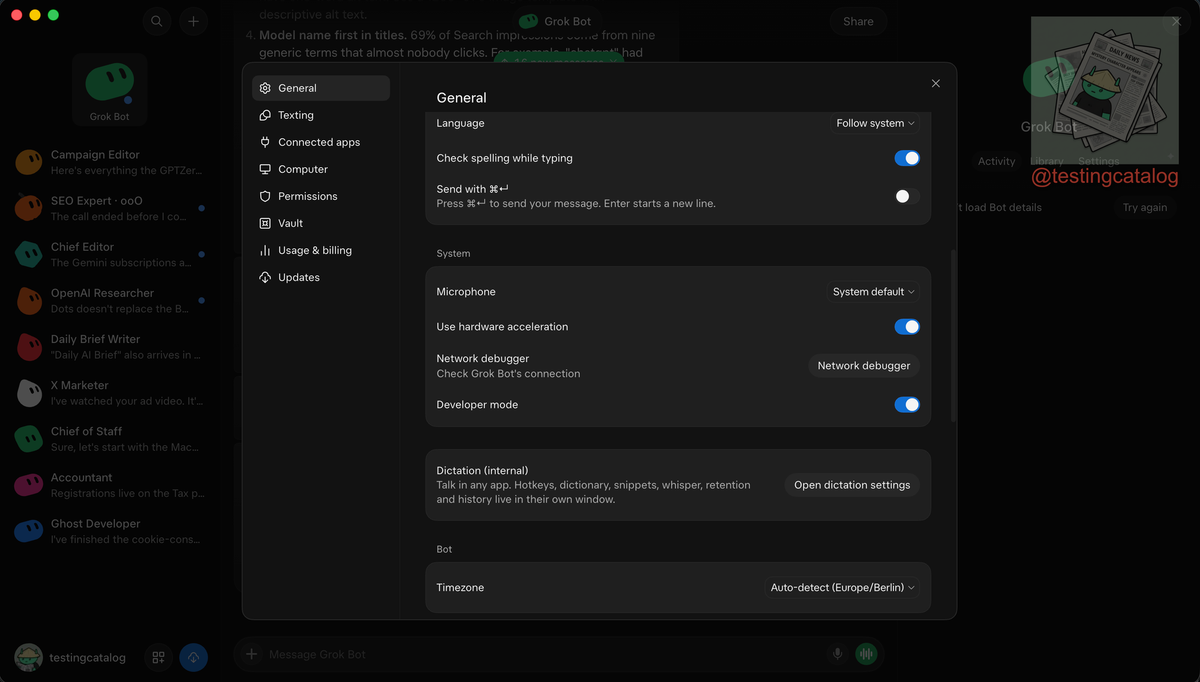
The Computer tab in Settings now lists a separate "Grok Bot Computer Use" section, which says "Not available on this computer" for now. It sits apart from the "Bot's computer" section, where users update or reset the cloud machine that all their Bots share, so the two modes look set to live side by side.
"Dictation in any app" is in the works too. A new Dictation entry in General settings, marked as internal, reads "Talk in any app. Hotkeys, dictionary, snippets, whisper, retention and history live in their own window." It includes an Open dictation settings button that points to a standalone voice input tool for the whole Mac.
Grok Bot launched in August as a team of always-on AI agents, reached version 1.0 this month, and its Mac app recently gained access to Messages, Mail, Notes, Reminders, Calendar, Location and Contacts. Local Computer Use would extend that reach to any desktop app, something many users have asked for, while dictation would bring Grok Bot's voice input to every text field on the Mac. For people who hand daily work to Bots, it means fewer trips between the cloud computer and their own machine. SpaceXSI has not shared any release timing.
RL infrastructure at Microsoft AI
Microsoft AI is using its internal Rocket infrastructure to perform reinforcement learning on the three-trillion-parameter MAI Base 2 model.
Deep dive
- Rocket acts as the primary RL orchestration layer for Microsoft AI's large-scale models.
- MAI Base 2 is explicitly identified as a three-trillion-parameter model, highlighting the current ceiling for large-scale training efforts.
- By avoiding distillation, Microsoft AI avoids licensing dependencies and potential 'model collapse' issues associated with training on synthetic outputs from other LLMs.
- The infrastructure supports the compute requirements necessary for aligning models of this size via RLHF or similar reinforcement methods.
Decoder
- Reinforcement Learning (RL): A machine learning paradigm where an agent learns to make decisions by performing actions in an environment to maximize a reward signal.
- Distillation: The process of training a smaller or secondary model to mimic the outputs of a larger, pre-trained 'teacher' model.
Original article
Rocket is Microsoft AI's in-house reinforcement learning framework for post-training MAI Base 2, a three-trillion-parameter model, without distilling from third-party models.
Tesla FSD v15 is AI4's last shot as Musk reveals how little compute is left
Tesla’s FSD v15 represents the final push for unsupervised self-driving on the current AI4 compute platform as supply and memory constraints tighten.
Decoder
- AI4: Tesla’s fourth-generation Full Self-Driving computer hardware, which powers its vision-based autonomous driving features.
Original article
Tesla's FSD v15 is the company's last real shot at delivering unsupervised self-driving on the AI4 computer. The next-gen A15 chip will not be coming to cars, and the mid-cycle AI4.5 upgrade had its RAM cut from 32GB to 24GB. The mid-cycle refresh exists mainly because Tesla needs a new memory type it can actually buy. The cost of the AI4 chip is now twice as much due to memory and storage price hikes.

The Incredible, Elegant DNA Repair System Makes Gene Editing Work
Gene editing technologies rely on the cell's native DNA repair machinery, which evolved alongside life itself to fix thousands of damage events daily.
Deep dive
- Cells experience up to 100,000 DNA damage events daily from metabolism and environmental factors.
- DNA repair is essential for stable genetic information.
- Nonhomologous end joining sticks broken ends back together, often causing mutations.
- Homologous recombination uses sister chromatids as templates for precise repair.
- Gene editing works by inducing controlled DNA breaks to trigger these repair pathways.
- Base editing is an newer, potentially safer method that changes single bases without breaking the DNA strand.
- Recent research shows base editing currently lacks the precision required for human embryonic use.
Decoder
- Nonhomologous end joining: A cellular repair mechanism that trims and joins broken DNA ends, often resulting in small mutations.
- Homologous recombination: A high-fidelity DNA repair pathway that uses a matching sequence (like a sister chromatid) to repair a damaged strand without losing information.
- Base editing: An advanced gene-editing technique that targets and modifies individual nucleotide bases (A, T, C, G) without needing to sever both strands of the DNA molecule.
Original article
Full article content is not available for inline reading.
Declare (Website)
Declare is a new, domain-specific UI language designed to be written, verified, and debugged by AI agents.
Deep dive
- Focuses on "comprehension leverage" rather than "corpus leverage."
- Compiler provides precise error codes and rewrite suggestions for AI agents.
- Uses a two-bracket syntax: [] for tree structure and {} for TypeScript expressions.
- No component lifecycle or virtual DOM diffing.
- Layout, motion, and styling are built-in language primitives, not external libraries.
- Enforces data-driven reactivity rather than mutable state.
Decoder
- Declarative UI: A programming paradigm where the developer describes what the user interface should look like, leaving the underlying system to handle the logic of updating that state.
- Constraint: In this context, a rule that defines a relationship between values (e.g., width = parent.width - 20) that the runtime keeps valid.
Original article
Full article content is not available for inline reading.
Ladybird Web Browser/Engine Reaches Alpha
The Ladybird browser has officially reached alpha status, marking four years of work on its independent, from-scratch web engine.
Original article
The Ladybird open source desktop web browser was built from scratch with its own independent web engine. After four years of dedicated development, it has now entered its alpha phase. Usability is still modest, but the browser is functional. Some websites will still crash. The alpha build is available for macOS and Linux.
Introducing Claude Ship
Claude Ship now automates pull request reviews, automated fixes, and approvals based on custom team policies.
Deep dive
- Claude Ship combines Code Review (general availability) with PR Steward and Claude Approvals (beta).
- PR Steward fixes merge conflicts, failing CI checks, and review feedback.
- Claude Approvals uses a repository-based policy file to decide if code is ready to merge.
- Works with existing branch protections and CI/CD pipelines.
- Billed based on token usage; usage triggers Code Review costs even in observe mode.
- Incompatible with zero-data-retention, HIPAA, or customer-managed encryption configurations.
Decoder
- CI (Continuous Integration): A software practice where developers regularly merge code changes into a central repository, followed by automated builds and tests.
- PR (Pull Request): A method of submitting code changes for review to a software project before they are merged into the main codebase.
Original article
Full article content is not available for inline reading.
My AI coding agents spend most of their time waiting
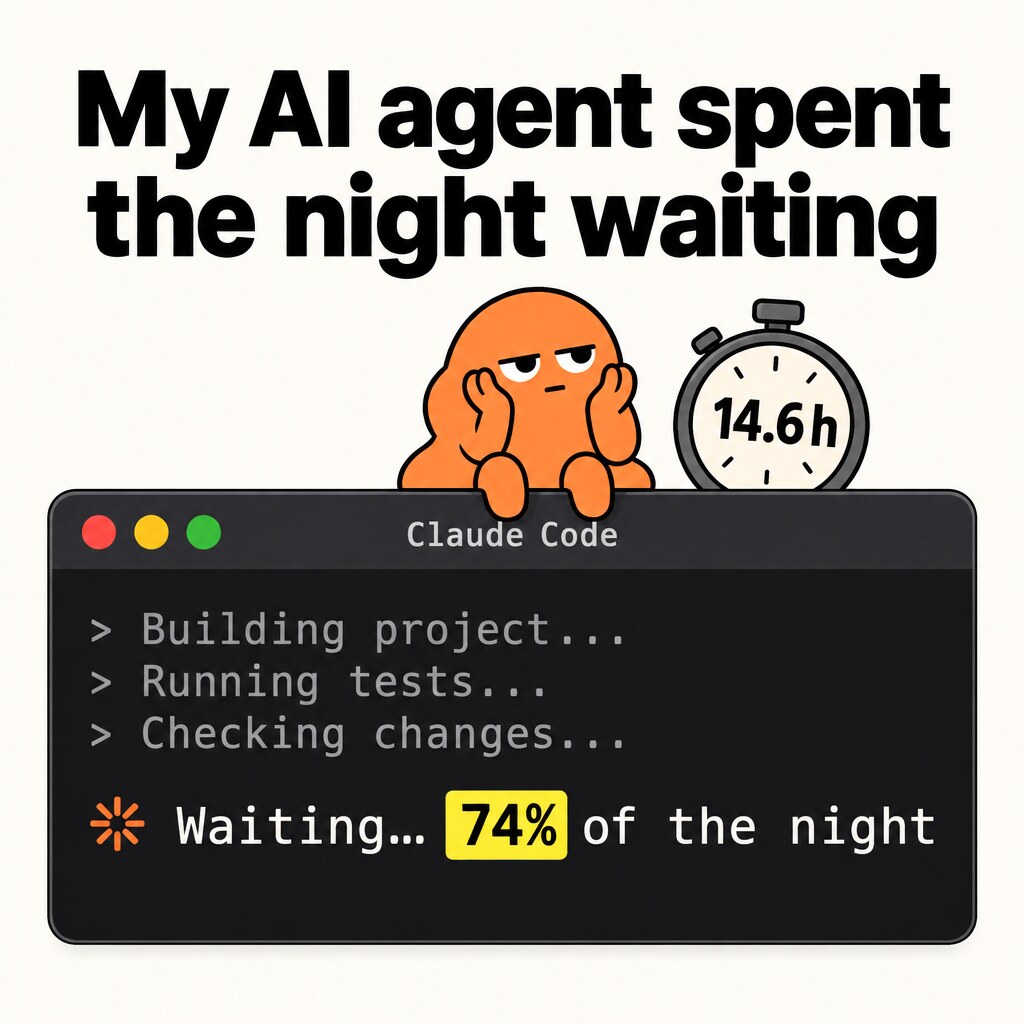
AI coding agents spend most of their time waiting for simulator checks and tests rather than actually generating code.
Deep dive
- Agents spent only 26% of 14.6 hours on model generation.
- 66% of total time was dedicated to UI test suites and simulator proof video recording.
- Fix rounds (iterating on review feedback) were the single largest time sink.
- Moving from serial to parallel feature development significantly increased throughput.
- Optimizing test suites to run on seeded data rather than full app launches saved substantial time.
- Bottlenecks were found in the 'proof' stage—verifying the code via simulators—rather than in the logic generation stage.
Decoder
- Git Worktree: A Git feature that allows you to have multiple branches of a repository checked out at the same time in different directories, useful for running tests in parallel.
Original article
Full article content is not available for inline reading.

Figma Brings its Agent to Dev Mode for Design Handoffs
Figma’s AI agent now operates inside Dev Mode, allowing developers to query designs, diff versions, and generate implementation snippets without leaving the environment.
Deep dive
- Dev Mode agents support version comparison via visual diffs or lists.
- The agent can prepare asset download links (e.g., SVG icons) without requiring a manual export flow.
- AI credit consumption scales based on the complexity of the design task.
- The tool is excluded from Starter, View, and Collab plan tiers.
Decoder
- Dev Mode: A specialized environment in Figma designed for developers to inspect design properties, extract assets, and generate code snippets for production.
Original article
Full article content is not available for inline reading.
The attack of the giant AI design slop monster: a survivor's guide
The ease of generating AI interfaces is creating a 'slop' problem where unvalidated, inconsistent, and unusable prototypes are polluting product roadmaps.
Deep dive
- AI-generated visuals often prioritize aesthetic appeal over functional usability.
- Teams are falling into the trap of accepting 'looks right' prototypes as 'works right' specifications.
- Guardrails are necessary to prevent the accumulation of design debt and inconsistent patterns.
- Design leadership must shift from creating screens to overseeing the quality and logic of automated outputs.
Original article
AI coding tools allow product managers, developers, and designers to create convincing interfaces quickly, but the results can introduce usability problems, inconsistent patterns, and technical risks that designers must subsequently resolve. When AI-generated prototypes become implementation requirements without proper validation, design teams risk spending more time repairing flawed decisions than they would have spent designing the experience correctly. Establishing explicit guardrails for user research, design systems, accessibility, and security can help teams use AI effectively while maintaining responsibility for the quality of the resulting products.

Figma Prototype Usability Testing: How to Test with Users before You Build
Usability testing on Figma prototypes allows teams to establish performance baselines like task success rates before writing a single line of code.
Deep dive
- Establish a before-and-after baseline by testing the prototype against the future production version.
- Avoid leading questions or specific click-by-click instructions.
- Use login-free links to remove friction for testers.
- Focus on metrics: success rates, time-on-task, and path accuracy.
- Convert design debates into data-driven decisions.
Decoder
- Usability Testing: A technique used in user-centered interaction design to evaluate a product by testing it on users.
Original article
Full article content is not available for inline reading.
GLM-5.4
Z.ai released GLM-5.4, a flagship model that uses a Loop Transformer architecture to achieve high-parameter performance without increasing total model size.
Decoder
- Loop Transformer: A model architecture that reuses a fixed set of transformer layers iteratively to deepen reasoning capacity without expanding the total parameter count.
Original article
Z.ai has released GLM-5.4, its first flagship model built on a Loop Transformer. The design reuses a shared block of layers to reason more deeply without adding parameters. Z.ai says it reaches intelligence comparable to 2T to 3T parameter models, and it is available now on the GLM Coding Plan.
I used to orchestrate agents. Now I orchestrate orchestrators
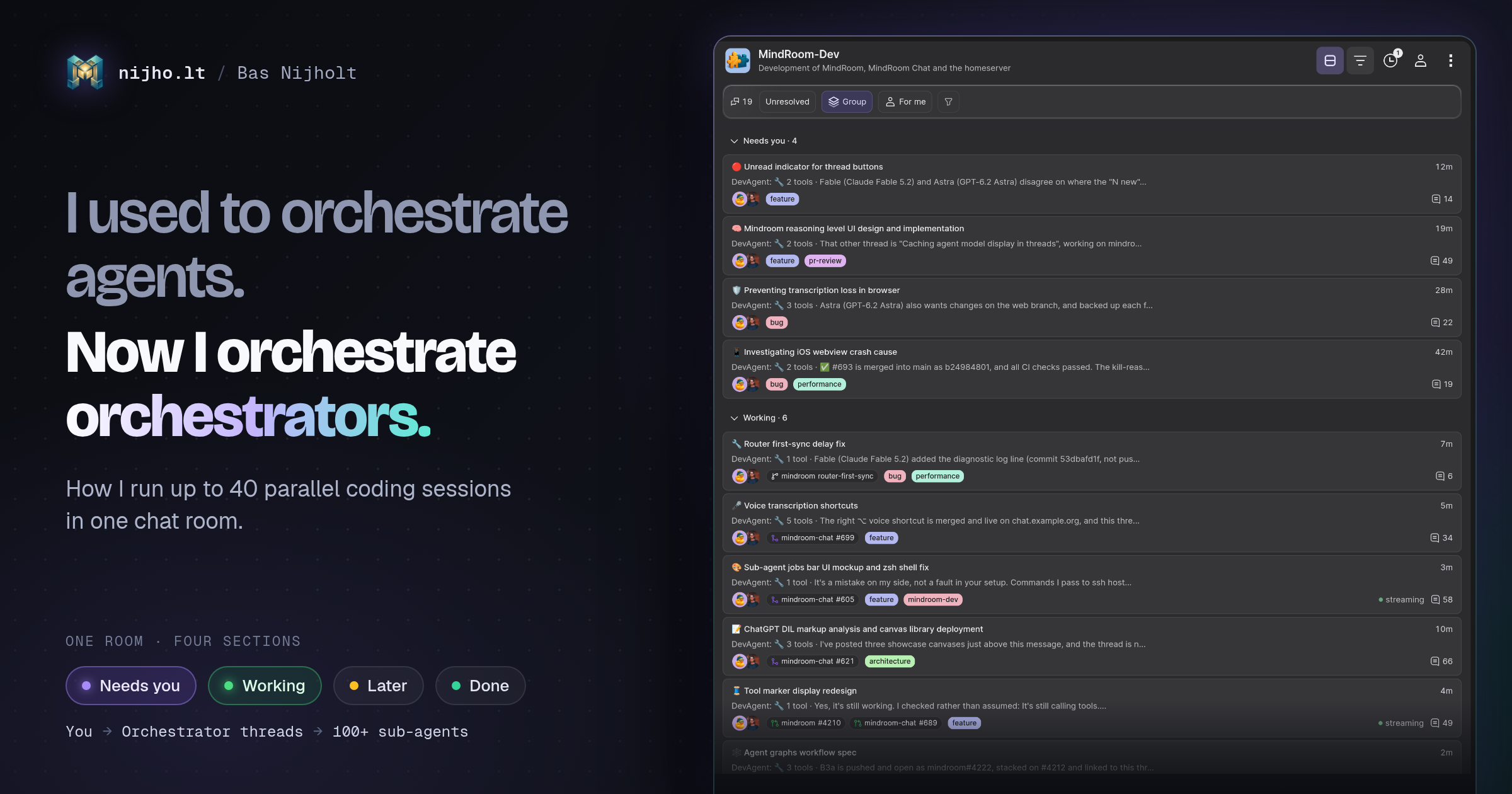
MindRoom developer Bas Nijholt explains his transition to managing up to 40 concurrent AI-driven coding threads using a card-based orchestration interface.
Deep dive
- Workflow: Agents follow TDD, create plans, and consult other models before requesting human input.
- Orchestration: A parent agent delegates specific tasks to minimal sub-agents to save on token costs.
- UI: The compact, card-based interface uses AI-generated titles to track thread status.
- Efficiency: The user reports managing 15-40 parallel sessions, offloading hours of work per session to autonomous agents.
- Tooling: MindRoom is open-source (Apache-2.0) and uses plugins for GitHub PR and git worktree management.
Decoder
- Worktree: A Git feature that allows multiple branches of a repository to be checked out in separate directories simultaneously.
Original article
I’m a huge terminal nerd. I maintain at least twenty different CLI tools, and I use many of them every day. For a long time, all my coding with AI happened strictly in the terminal. At peak I had probably thirty terminal windows and panes open at once.
So it was hard for me to accept that my next step was a desktop app. The step after that was a chat room.
I still use my beloved iTerm2. I used to orchestrate agents in terminal windows. Now I orchestrate orchestrators. My coding agents live in MindRoom, in a room where every task is a thread, and that room shows me which thread needs me. This post walks through how I got there: the tools I used, why each one stopped working for me, and how the room in MindRoom changed along the way.
Thirty terminal windows
In August 2025 I described working on 6 features at once: one terminal tab per feature, and a round through all of them every 10 to 15 minutes. In January I made that setup one command with agent-cli dev, which creates a git worktree and opens a new tab with an agent already working in it.
That worked because a task took minutes. I’d start one, move to the next tab, and by the time I came back around there was something to review.
Then the models got better and I handed over more scope per task. The more I hand off, the longer an agent takes to finish. So I started doing more things in parallel. Thirty terminal windows was the ridiculous max, when I worked on five to eight things at once and each one had a couple of sub-panes, one with Codex and one with Claude Code. I was the orchestrator myself, jumping between panes to keep every agent moving. Keeping track of what’s running and what’s done becomes exceedingly hard in the terminal. Thirty panes all look the same, and the only way to find out what one of them is doing is to open it and read.
In June 2026 I experimented with cmux for a couple of months to improve oversight and clarity. It’s a terminal built for this, with vertical tabs and notifications for coding agents.
The apps in between
My next step was the Codex desktop app, now rebranded as the ChatGPT app. I started using it around GPT-5.2, when the OpenAI models were, at least in my opinion, undoubtedly better. I absolutely loved it. It was a massive bump in my productivity, because it gave a much clearer view of what was running and what was done.
Then Fable 5 came out in June, and it felt better than the OpenAI models, so I went back to the Claude Code CLI. Switching back and forth between the Codex desktop app and the Claude CLI wasn’t optimal, so I looked for something that unified the two. That same month I found T3 Code, which I really adored as well. It calls itself “the open-source control plane for coding agents”. I think of it as a harness for harnesses: it wraps Claude Code, Codex and OpenCode, and shows them in one web interface.
T3 Code wasn’t perfect for massively parallel work either. With more than twenty concurrent sessions, my relatively beefy AI machine started to struggle. The machine wasn’t overloaded. As far as I could tell, too many database writes went through a single thread. Opening a long thread took several seconds. And threads with background tasks still running showed up as idle, as if they needed me, which added to the confusion. Another thing I didn’t like was that T3 Code’s iOS app and web app were separate apps with different interfaces. In MindRoom Chat I fixed that for myself too: the web app and the iOS app are built from the same codebase, so they work the same way.
The awesome bit is that T3 Code is completely open source. So I ported my favorite functionality and its best ideas to MindRoom, and fixed the things that annoyed me.
Why I stayed with the native harnesses
All of these tools have one thing in common: they run the coding harness of the company that made the model. The Codex app runs Codex, Claude Code is Anthropic’s own, and T3 Code drives both.
I stayed with them because I felt a model must just work better in its native harness, since that’s what it was trained with. It’s why I wrote seven weeks ago that “for writing code, dedicated tools like Claude Code and Codex are better”.
Then I tested that belief. Over more than 4,000 runs of short terminal tasks, giving a model the tools of its own harness made only one model clearly more efficient. What did matter was how much the agent sends with every request: a minimal agent with one shell tool and a 12-line prompt used 58 to 76% fewer tokens than MindRoom’s standard agent.
That got me over the mental block. If the native harness doesn’t buy much, my agents can just as well work in the place where I already keep everything else. Even better, leaving the native harnesses makes it easy to support every model in the same room. Claude Code is Anthropic only, the Codex app is OpenAI only, and T3 Code wraps separate harnesses like Claude Code, Codex and OpenCode. In MindRoom I can mix models from Anthropic, OpenAI and Google inside one thread. Each sub-agent runs in that same minimal mode, which keeps the token count down. Most of my coding now happens in MindRoom threads.
Tasks that run for a day
Two things changed how long an agent can work without me.
The first is the models. With Claude Opus 5.5 and Claude Fable 5.2 I had another massive boost in productivity, simply because they can handle such an insanely large scope right now.
The second is my skills, which are public as baspowers. They dictate a workflow where the agent follows established good engineering practices: it writes a spec and a plan, and it works test-first. But instead of involving me whenever something is ambiguous, it cross-checks with another frontier model, like GPT-6.2 Astra. Only if that doesn’t resolve it does it involve me.
This is what reaches me, replayed from a real thread. Fable and Astra disagreed about a design choice, so the agent stopped and asked me. It lists both options and says which one it recommends. I answer with one click, and the agent goes on.
I wrote last month that you don’t need skills to start with AI, and I still think so. In one test, agents wrote a failing test before fixing a bug in 0 of 32 runs without my test-driven development skill, and in 32 of 32 runs with it. As I wrote there: “That matters when agents run on their own for hours.”
The result is that any task I start might run from just an hour to more than a day autonomously. That means I can run fifteen parallel sessions extremely comfortably. After a good night’s sleep, with a lot of focus, I’m able to orchestrate up to forty. Knowing which session needs me is just the baseline requirement. The real hard part is context management in my own head, remembering what every thread is doing. When I’m tired, I can’t hold that many in my head at once. When I’m rested and focused, I can still context switch between them almost instantly, as long as the room makes it clear what’s going on.
Orchestrating orchestrators
One session is rarely just one agent, so forty sessions can easily mean a hundred agents in flight. In every thread I only talk to one parent agent, my development agent running on Opus 5.5. That parent agent carries my skills, my memories, and how I like to work. It knows my review standards, my git workflow, and when to cross-check a design decision instead of interrupting me.
Instead of doing every edit and review itself, that parent delegates the heavy lifting to minimal sub-agents. Each sub-agent starts with a much shorter system prompt in minimal mode, which keeps token overhead low and keeps it focused on one bounded job. In principle a sub-agent can look up how the parent agent works, though it rarely needs to because the parent already holds the context, memories, and workflow rules.
The parent picks the model per job using rules in its system prompt. By default it writes code with Gemini 4 Neon, which only came out a couple of days ago. It’s still pretty expensive, and in the few days I’ve used it, the performance has been incredible, especially on UI work. Then GPT-6.2 Sol, GPT-6.2 Astra and Opus 5.5 review the full diff in parallel, and no model reviews its own code. After a fix round, a fresh reviewer checks the full diff so it doesn’t fixate on earlier findings. Fable 5.2 only writes code when a task is very complicated, or when two review rounds still find major issues. Simple lookups go to Claude Haiku 5.5.
That split is why the jump from thirty terminal panes to forty sessions works. I’m no longer shuttling prompts and review comments between Codex and Claude Code tabs by hand. Each thread is its own orchestrator, and everything in the rest of this post is the interface I built to orchestrate those orchestrators.
About those lines of code
Programming is my biggest passion. Before AI coding got really good, I looked at every line of my code, and every comma mattered to me. I’d often lie in bed scrolling through my own code in the GitHub app, trying to find a place where I could make it a little cleaner, more DRY or more elegant.
In January I gave a presentation to a group of people who weren’t very AI native. I told them that I had written about a million lines of code in the last year, and I felt slightly embarrassed to say that. In the first twenty days of this month, the count is almost four million.
I strongly feel that lines of code is not a measure of quality at all. It’s like measuring how good you are at building airplanes by how much weight you added to them.
The numbers come from trueloc, a tool of mine that counts every line added and deleted in every commit of my merged pull requests, plus my direct commits. Even when a pull request is squash-merged into one commit on main, trueloc still counts the separate commits that went into it. That includes churn, generated files, and code that an agent wrote and then rewrote. From November 2024 through October 2025 that was about 1.4 million lines in 848 merged pull requests. In the twelve months after that it was about 10 million lines in 5,148 pull requests, and about two thirds of those lines are in code files.
So read the chart as the amount of work in flight, because that’s what I had to keep track of.
A thread is the agent’s context window
MindRoom started out as just a basic chat interface. My idea was that every conversation in a room happens in a thread, and the thread is the context window that the agent sees. The agent has tools to look into other threads if it wants to. But its context is just that one thread, which is compacted once the context window fills up.
So one task is one thread, and a room is a list of tasks. For coding, each thread also gets its own git worktree, and the pull requests the agent opens are linked to the thread.
I don’t even have to start a session by picking a repository in a UI. I keep one meta-repo checkout holding all my repositories, and the agent already knows that folder. When I describe an issue, it figures out which repo I mean from context alone, and I only name the project when it’s brand new or genuinely ambiguous. Lately I also record short screen recordings on my phone, attach one to a thread, and dictate the rest by voice. Sometimes I land an entire large pull request without typing a single word. We even have an Apple Watch app now for orchestration in a pinch: one big record button starts a new task from my wrist, and I can read the replies there too.
From first messages to four sections
The room view went through six versions. You can click through the steps and try the filter, sort, group and section buttons below in a small mock-up of the same room.
First messages. In a typical chat room, like Slack, you see the first message of a thread and then you click into it. Maybe you see a couple of avatars of who’s active in the thread. But that first message isn’t always indicative of what the thread is about. “Ok next thing, see what we discussed” tells me nothing an hour later.
Titles. So I added AI-generated titles to every thread and showed those in the room. A title is a few words that say what the thread is actually about.
Resolve. Then I realized it was hard to scroll through a room and know which thread is active, which one is done, and which one I was completely done with. So I added a sense of status. I can resolve a thread, which means I’m completely done with it, and it turns green.
Sort and filter. I added filters, so I could hide the resolved threads, and filter on streaming or not, on scheduled or not, and more. Now I could sort on latest message, filter out the resolved threads, and know from the room which ones I had to address.
Cards. That view still had a lot of cruft that obscured what’s important. I’d much rather see the AI-generated title, who’s currently working, and when the last reply was. So I came up with the Compact view, where every thread is one card. A card has three lines: the title and the time of the last reply, then what the agent is doing right now or the start of its last answer, and then who’s in the thread, its git worktree or pull request, its tags, and the number of replies.
Sections. Then, inspired by the sections in T3 Code, I added that type of grouping too. The cards now sit under four headers:
- Needs you: the agent finished or asked me something, and nothing is running in the thread.
- Working: the agent is replying, or a sub-agent or background job in the thread is still running.
- Later: the thread is snoozed or has something scheduled, so it comes back on its own.
- Done: I resolved it.
A thread with a background job counts as Working. That’s the fix for the thing that confused me in T3 Code: a thread that is still working in the background no longer shows up as needing me.
Hiding what you don’t need to see
I believe that to be productive with AI, you should be exposed to its raw power. It should be possible to see the agent’s reasoning, to see every tool call it makes, and to read the actual output of the model.
But nobody should be overwhelmed by it. In many cases you don’t care how the agent got there, and some people will never care.
So while an agent works, MindRoom Chat shows its reasoning and its tool calls as they happen. When it’s fully done, all of that folds away behind one row, and what stays is its conclusion. One click opens it again.
What you read is still the direct output of the model. The conclusion isn’t a summary written by a different model, and the folded work is still there when you want it. The folding is another idea I took from T3 Code, where a finished turn collapses into a “Worked for” row.
What I took from T3 Code
The sections and the folded replies aren’t the only things I ported.
- The model picker has an Effort column for the reasoning level.
- Pull requests show up as cards, with a side panel that has the changed files and their diffs.
I ported the code directly from T3 Code, with its MIT license linked in the repositories. Because I control the full source, I tailored the app to how I actually work. For example, the pull request viewer hides test files by default because I no longer read them, whereas T3 Code still showed all of them. I also made the whole interface keyboard-first, so I can navigate rooms, threads and actions without ever touching the mouse. Neither the pull request panel nor the git worktree support is built into MindRoom Chat itself. Both live in plugins, such as the pull request plugin, because the chat app only knows about rooms, threads and agents. Not every one of these features strictly has to be a plugin. I’ve been pushing hard on MindRoom’s plugin ecosystem to keep it extensible, and building real features as plugins is how I know the plugin interface is strong enough.
I could change the room view this often because I own the client. MindRoom Chat is open source as well, under Apache-2.0. If my four sections don’t fit how you work, you can change them, the same way I took what I liked from T3 Code.
Interactive canvases
Not every decision fits a text reply or three buttons. When an agent proposes a UI change, it can send an interactive HTML canvas right inside the thread. I can click through the variants, toggle states and send my choice back to the agent directly from the page.
A software factory without the rigid harness
A lot of people are talking about building heavily structured “software factories” with strict agent harnesses. That feels very anti-Bitter Lesson to me. The models already orchestrate work well enough on their own that you don’t need rigid pipeline structure around them.
Even without a strict harness, I end up with the software factory people want anyway. A plugin reports errors automatically into a room. An agent triages the error on its own and starts working on a fix. By the time I check in, there’s a pull request waiting for me with an agent I can question directly about the trade-offs, or even jump on a voice call with.
What the numbers do and don’t show
The chart is not a measure of good code, as I said above. It can’t credit MindRoom either. The big jump is in September 2026, which is when GPT-6 Astra and Claude Opus 5.5 came out. The sections landed on November 17, a few days before I wrote this. So the chart shows the problem I had, which is far more work in flight than I could follow in terminal tabs.
Forty sessions is a peak, and fifteen is a normal day. And I built the tool I’m praising, so of course it fits me. Before MindRoom, I loved the Codex app and then T3 Code. I also wrote last month that “most new AI tooling is not very good, and MindRoom may well be included”.
Before I merge a pull request, I no longer read the code line by line. In the pull request viewer I built, hovering over the diff size opens a breakdown of source code, documentation and tests. Nowadays I mostly ignore the test size and use the source code diff to judge whether the complexity is worth it. Before a pull request even reaches me, three other models have already reviewed it, always at least two models different from the one that wrote the code. The exact mix changes almost by the day, currently from Sol, Astra, Neon, Opus and sometimes Fable. My own review is mostly asking the agent targeted questions about how it solved something, what the trade-offs were, and why it did it that way. Then I either press merge myself in the sidebar, or I tell the agent to do it.
Fifteen parallel sessions can cost a lot. I’ve been spending anywhere from $50,000 to $100,000 a month in model usage, though luckily I don’t pay the bill.
I couldn’t think of a recent run that went badly wrong. The models have gotten so much better that the hooks I wrote about two months ago feel like they barely matter any more. When I tell an agent not to merge a pull request, it just doesn’t, and it waits until I ask.
Conclusion
I still have iTerm2 open all day. A year ago I cycled through five or six tabs every 10 to 15 minutes to see which agent was done. Now I open one room and look at Needs you.
Going all in on MindRoom also kick-started the best productivity optimization loop I’ve ever had. Before this, building my own development environment felt impractical, because I would have had to force myself to work inside an inferior tool (I hadn’t optimized MindRoom for coding yet), feel slow, and fall back to other apps. Now it’s genuinely the best place I can imagine developing in, so everything I find wrong with it, I fix right from inside it.
You can try the same view on mindroom.chat, and the showcase has recordings of what else it does.
I also wrote that with every new model, my workflow changes. So this is how I develop right now, and I expect it to look different in a few months.
NVIDIA Board Reinstates Jensen Huang as President, CEO, and Board Director
NVIDIA has reinstated Jensen Huang as CEO following a government investigation that cleared him of national security concerns.
Original article
NVIDIA reinstates Jensen Huang as President, CEO, and Board Director following unanimous Board approval and US government input confirming no national security risk. A committee of independent directors is investigating claims of Huang being targeted by foreign intelligence and will proceed with legal counsel's support. NVIDIA is forming a National Security and Export Control Committee and will appoint a Chief Compliance Officer to enhance oversight.
Amazon snaps up Decart's AI optimization tech for $7.5B as it prepares to sell Trainium chips
Amazon acquired Decart and its optimization stack for $7.5 billion to bolster its AI infrastructure and Trainium chip ecosystem.
Deep dive
- The acquisition includes Decart's personnel and the Decart Optimization Stack (DOS).
- DOS software is platform-agnostic, supporting Nvidia, Amazon, and Google hardware.
- The deal is valued at $7.5 billion.
- Decart previously specialized in real-time AI and generative video models.
- The technology aims to lower costs for training and inference by optimizing hardware utilization.
Decoder
- Inference: The process of running a trained machine learning model to generate predictions or content.
- Trainium: Amazon’s custom machine learning accelerator chip designed to compete with Nvidia’s GPU offerings.
Original article
Amazon has acquired the technology behind the Decart Optimization Stack (DOS), as well as Decart's founding team and team of AI researchers and engineers, for $7.5 billion. Decart has made a name for itself by building interactive real-time models and AI video-generation tools. Its DOS software helps AI models run efficiently on Nvidia, Amazon, and Google's hardware. More efficient compute means better training, better reinforcement learning, faster inference, and better models for customers at a lower cost.

Trump sealed deal for Nvidia to rehire Jensen Huang as CEO
President Donald Trump personally intervened to secure Jensen Huang's reinstatement as Nvidia CEO following assurances regarding national security compliance.
Decoder
- Megaspeed: A Singapore-based company under investigation by the U.S. Department of Justice and Department of Commerce for the alleged diversion of restricted semiconductor chips to China.
Original article
- Nvidia's board of directors voted to reinstate Jensen Huang after getting assurances from President Donald Trump that he had not broken U.S. national security laws.
- Other factors that contributed to Huang's return were Nvidia's plunging stock price and concerns by some investors and employees about the leadership of then-interim CEO Colette Kress.
- "I made the deal," Trump told CNBC's Eamon Javers about Huang's reinstatement.
The stunning decision by Nvidia's board to bring back Jensen Huang as CEO was sealed by a personal promise from President Donald Trump on Sunday that Huang had not broken national security laws, three people familiar with the board's thinking told CNBC.
Several other factors also set the stage for Huang's return and accelerated discussions with him over the weekend, said the people, who spoke on condition of anonymity to discuss internal deliberations close to Nvidia's board.
A sharp stock price drop after his resignation and questions about the leadership of interim CEO Colette Kress also spurred the board's decision, the people said.
"I convinced them," Trump told CNBC's Eamon Javers in a phone interview Monday morning, shortly after Nvidia announced Huang's return.
"I made the deal," the president said. "It was a lot easier to convince them yesterday than it was a week and a half ago.
Trump said Nvidia's board asked for guarantees that Huang, who resigned less than two weeks ago, was not a threat to national security.
"And we gave them assurances, at least with everything we know," the president said. "We believe he's fine. He's absolutely fine."
Senior Trump administration officials reached out to the board overnight Friday to inform them that Huang had not violated U.S. national security laws, people familiar with the board's actions said.
After the White House outreach, the board contacted Huang, who joined meetings on Saturday and Sunday to discuss his potential return, the people said.
Huang's spokesman did not respond to a request for comment when asked about his contact with the board and other events leading up to his return.
The Nvidia founder resigned on Nov. 12 after reports that he had an affair with an Nvidia employee and with Alice Huang, a former executive at the Singapore-based company Megaspeed who is suspected of being a spy for China. A report of an affair with a second Nvidia employee broke right after he quit.
Nvidia's board named Kress, the company's chief financial officer, as the interim CEO while it searched for a permanent successor.
But within days of Kress taking over, some employees and investors who spoke to CNBC questioned her stewardship, as many of them clamored for Huang's return.
Kress' performances at an all-hands company meeting on Wednesday and on Nvidia's earnings call with analysts a day earlier were seen by some investors as uninspiring and underwhelming.
As the board faced those concerns amid a stock drop of more than 25% over the past week, Huang was aggressively working the phones with major tech CEOs who wanted to see him return to Nvidia, according to sources close to Huang.
In the days after he resigned, Huang spoke with OpenAI CEO Sam Altman, OpenAI President Greg Brockman, and Elon Musk, CEO of SpaceX and Tesla, one of the sources said.
Huang wanted his job back, but he was not sure what the return path looked like, the sources said.
On Nov. 17, less than a week after quitting, Huang issued a public statement saying he was open to returning as CEO.
"I've seen an outpouring of calls from NVIDIA's employees, investors, business partners, and customers for me to return as CEO," he said.
"NVIDIA is a once-in-a-generation company," he added. "If the Board of Directors decides that my return is in the best interest of our shareholders, our employees, the company, and America, I would be honored to answer these calls and return as CEO."
On the same day, Nvidia's newly appointed board chair, Harvey Jones, told analysts on the company's earnings call that the board did "not intend to reinstate Jensen as CEO."
Kress, the following day, told company employees at the all-hands meeting, "Let's move forward."
Nvidia's public stance against Huang returning came as members of Congress moved ahead with plans to interview him at hearings and as criticism grew over the company's business in Asia.
The Department of Justice and the Commerce Department, in an unusual joint public statement on Nov. 17, said they were investigating Megaspeed for possible diversion of advanced Nvidia semiconductor chips to China in violation of U.S. export control law.
"Sensitive technologies like semiconductors are among the most valuable and strategic assets of the U.S. economy," the departments said.
But days later, senior Trump administration officials contacted Nvidia's board to tell them that Jensen Huang himself was not a risk, according to the sources.
The Department of Commerce added Megaspeed to a trade blacklist later Monday.
Trump, during his interview Monday with CNBC, was asked what Attorney General Todd Blanche had told him about potential criminal liability for Huang and the question of whether Nvidia chips had ended up in China in violation of U.S. export laws.
"They did a pretty good investigation, and they felt that he, himself, was exonerated," Trump said.
Both Trump and Vice President JD Vance became convinced that Huang was a singular figure who is preventing closed-source model AI companies, such as Anthropic, from getting too powerful, according to a person familiar with the matter, who spoke on condition of anonymity to disclose private discussions.
The person said Trump and Vance were briefed on the national security elements of the situation and saw no evidence that Huang did anything illegal or untoward in that regard.
Trump believes his administration's close working relationship with Huang gives the U.S. its best opportunity to protect national security and prevent cutting-edge AI chips from reaching banned customers, according to the person.
Trump said he spoke with Huang on Sunday, after Nvidia had voted unanimously to reinstate him.
"I called him up, and I said: 'I ask you to do one thing, Jensen. Work hard,'" Trump said.
"He knows what to do and what not to do," Trump said. "But I just said work hard because if you work hard, there's nobody that can capture what you've done. Nobody, nobody close."
OpenAI Staffer Likely Captured Secrets on Hidden Bug, US Says
A former OpenAI engineer, Abdulrahman Alfozan, faces eavesdropping charges after allegedly planting a device in a conference room to steal trade secrets.
Original article
Abdulrahman Alfozan, a former engineer at OpenAI, has pleaded not guilty to an eavesdropping charge for bugging an office conference room, likely to intercept trade secrets. He has requested bail, but there are concerns that he may try to flee before trial given his relatively weak ties to the US and the considerable resources and connections he has to Saudi Arabia. The government has so far located hundreds of audio files on Alfozan's computer, many of which involve discussions of what may be trade secrets. He appears to have uploaded at least some of the recordings to Dropbox.

Human empowerment in a few fake graphs
Maintaining human sovereignty over AI may require capping the rate of technological progress rather than just focusing on alignment.
Decoder
- Vulnerable World Hypothesis: The theory that there is an absolute level of technological intelligence/capability that, if reached by malicious or misaligned actors, makes it impossible to prevent the destruction of humanity.
Original article
One view of AI’s trajectory can be captured by this “fake graph” (with the gray region reflecting roughly where we are):
AI is improving in intelligence while human intelligence is fixed. At some point AI will be so powerful that there is no way for humans to comprehend what it is doing, and hence at this point AI will necessarily take over control. The only question is whether the AI will be aligned (i.e. be a “benevolent dictator”) or misaligned (i.e., “if anyone builds it everyone dies”). Indeed, some people in the AI safety community view the former version of a “handover”, “handoff”, or “passing the torch” to AI as a positive outcome.
I disagree with this view. I believe that ceding control to AI is by no means necessary, and, even more importantly, we should preserve human autonomy and sovereignty regardless of how aligned we can make AIs.
While the biological capacity of human brains hasn’t changed in the last hundred thousand years, by any reasonable measure the intelligence of humanity as a whole has been growing. Without any biological enhancement, humanity invented concepts like writing, democracy, markets, technology, that enabled us to exercise greater control of our environment. We’ve been creating and hill climbing benchmarks, including the “build cities”, “feed billions” and “reach the moon” benchmarks, for thousands of years.
Given that, what we really should be comparing is not the intelligence of AI and an average (or even the smartest) human, but rather the intelligence of AI and humanity as a whole, and the latter quantity has been growing over time.
However, humanity’s intelligence has not been growing nearly as fast as AI, and so perhaps all this argument does is buy us some extra time. That is, the graph looks like this: (with the shaded area still corresponding to the present).
But there is a more optimistic possibility. We have a history of enabling humans to supervise projects of growing complexity. Around the 19th century, science became complex enough so that no one person could know it all (e.g. Thomas Young, who died in 1829 is often called “the last man who knew everything”). In the 20th century, people have constructed artifacts with complexity far outstripping anything that was done before, including aircraft carriers, particle colliders, and large-scale software projects.
We can use AI itself to expand our mechanisms to comprehend and control AI. That is, we will make sure that humans remain the key decision makers, but use AI to make the space of options legible and controllable by them. This will be “bend the humanity curve upwards” in the graph above. But, especially with the prospect of AI being used to accelerate its own progress (aka “recursive self improvement”), I believe that if we continue on our current path, AI’s capabilities will grow beyond our ability to comprehend and control it. If that is the case, then using AI to control and explain AI will not be enough to avoid takeover or handoff. Rather we would need to “bend the AI curve downwards” to achieve a graph that looks like the following:
Crucially, we do not necessarily need to “cap” the absolute intelligence of AI, but we may need to cap its rate of progress to maintain human control. I do not have the answers as to how such mechanisms would be implemented, nor to the way to determine the precise “speed limit” for AI growth. But if we want to avoid an AI takeover or handoff, we need to be working on these questions. I suspect we will need a combination of both regulations and technical means to achieve this.
Misalignment and misuse
The discussions above implicitly assumed that AIs are aligned, and that they are not actively trying to destroy the world. But, realistically, some fraction of the total intelligence in the world will be misaligned or misused. So the best case we could hope for is something like:
With the total intelligence (some function of model capabilities and inference compute) directed at aligned goals dominating that directed at misaligned goals. Much of the work of technical AI safety can be thought of as working toward increasing the gap between the two lines above.
Will that be enough? The answer depends on whether you believe in the Vulnerable World Hypothesis. If you believe the VWH, then there is an absolute level of intelligence required to destroy the world, and when misaligned/misused AIs achieve it, this will be “game over”.
I don’t believe the VWH. I think the technological level that was needed to effectively destroy humanity has increased over time. We are more resilient today than we were in the past. You can’t imagine an army killing possibly up to 10 percent of the world’s population using horses, bows, and swords, as the Mongols did in the 13th century. About half of the European population died from the “Black Death”, which is easily treatable today with antibiotics. This the “world destroying threshold” rises over time, and if we use AI for resilience, we could increase it faster and get a graph that looks like this:
If we combine all of the above, we get a graph that looks like the following:
It requires a combination of using AI to improve resilience and human control, technical AI safety to reduce the powers of misaligned AI, and agreements to ensure AI does not grow too fast for us to maintain these invariants. I believe we can navigate all of these “fake graphs”, and chart a path that ends up in both human prosperity and sovereignty. But we cannot count on this happening by default. Ensuring this path will require a combination of technical means, including progress on safety and alignment, regulations, and international cooperation, including on pacing the rate of AI advancement. We have our work cut out for us!
Design Tools Just Got Personal
Designers are increasingly treating 'building tools' as a core part of their craft, with nearly 60% creating AI-augmented solutions in the last six months.
Original article
Building your own tools is part of the design job again. In the UX Tools prototyping survey, 59% of 1,478 respondents had built a tool of their own with AI in the previous six months. Those tools encode a designer's judgment and way of working, making them more worth showing in a portfolio than finished screens.
The Feedback Layer for Prototypes (Website)
Inflight allows teams to translate design feedback and video walkthroughs into actionable tasks for coding agents.
Original article
Turn pinned comments and video replies into clear next steps for your coding agent.
Adobe's Democratization of Design Doesn't Have to Be the Death of Human Creativity
Adobe’s focus on broad accessibility at MAX 2026 has designers questioning if the company’s heavy AI integration is devaluing professional human craft.
Deep dive
- Adobe's latest AI initiatives focus on lowering barriers for entry, positioning software as a tool for all skill levels.
- Veteran designers report feeling alienated as AI potentially automates tasks that previously required years of training.
- The distinction between 'innovative' utility tools (like the lighting-aware Project Deep Brush) and full-scale generative AI is a central friction point.
- The pressure to produce high volumes of content is driving the adoption of automation, leading to a potential homogenization of creative output.
- The article highlights an existential shift where the role of the professional designer is being redefined by their ability to manage AI tools rather than just traditional manual execution.
Decoder
- Adobe MAX: Adobe's annual creativity conference where they announce new product features and software updates.
- Sneaks: A segment of the Adobe MAX conference where engineers and researchers preview experimental, non-guaranteed features or research projects.
- Generative AI (Gen AI): AI systems capable of generating new content, such as images or text, from simple human prompts.
Original article
Full article content is not available for inline reading.
Become a founding member of TLDR's AI community (2 minute form)
TLDR is establishing a private community for AI developers to discuss emerging industry news.
Original article
TLDR is launching a curated community for AI builders to discuss major news and launches. The best links and comments will be featured in TLDR AI. Apply here to join.
OpenWorks
OpenAI's OpenWorks initiative connects AI experts with small businesses to build custom technical solutions for free.
Original article
OpenAI's OpenWorks initiative partners AI experts with US small businesses to offer free, hands-on AI support.
Watching users is how you make products better
Observing real users struggle with your product is the most uncomfortable but effective way to identify critical design flaws.
Original article
Observing someone try to use your product is humbling and often excruciating. Watching a real user do realistic tasks will reveal problems you would have never guessed at, no matter how much careful thought you put into it. Some people have great difficulty acknowledging that the thing they helped make is the problem. Being afraid of feedback is a surefire way to create bad products.
Jensen Huang Is Back at Nvidia. Major Investigations Still Surround Him
Jensen Huang remains under investigation despite recent executive leadership changes at Nvidia.
Original article
The wave of scrutiny surrounding Jensen Huang before his resignation isn't going away.

Why has North Korea redesigned its flag? It's not about aesthetics...
North Korea has officially altered its national flag's proportions to 1:1.65, a move likely signaling a hardening of its stance against reunification.
Decoder
- Vexillology: The scientific and scholarly study of flags, including their history, symbolism, and usage.
Original article
North Korea has changed its national flag's proportions from 1:2 to 1:1.65, thickening the white stripes and shifting the star closer to the center. The move may reflect its increasingly explicit rejection of reunification with South Korea rather than a purely aesthetic redesign.
Bing tests a homepage search bar redesign with a “What's on your mind?” prompt
Microsoft is experimenting with a conversational 'What's on your mind?' prompt on the Bing homepage to bridge the gap between search and AI chat.
Original article
Microsoft is testing a redesigned Bing homepage search bar that replaces the traditional "Search the web" placeholder with the more conversational "What's on your mind?" prompt. The interface introduces a dedicated web search button and reorganizes the plus menu into separate Attach and Tools sections, with options for adding images and generating them. The changes bring Bing closer to an AI chatbot experience while preserving conventional search functionality, although the scope of the experiment remains unclear.
Free AI Image Detector (Website)
Checko is a web-based utility that attempts to detect AI generation, synthetic edits, and face swaps in uploaded images.
Original article
Show Checko a photo. It looks for AI generation, AI edits, and face swaps, then tells you what it found and why.
HD GIF & WebP Maker (Website)
Gifrun provides a web interface for generating high-quality GIF and WebP clips from existing video sources.
Decoder
- WebP: An image format developed by Google that provides superior lossless and lossy compression for images and animations on the web.
Original article
Create high-quality GIFs and WebP clips from YouTube videos, uploads, and video links.
Hochburg brings together pizza and hip-hop in L'Artista's identity
Design agency Hochburg rebranded Neapolitan pizza brand L'Artista using a visual language inspired by 90s hip-hop culture and vintage MTV graphics.
Original article
Stuttgart-based Hochburg has created a distinctive identity for Neapolitan pizza brand L'Artista, combining traditional pizza-making with the visual energy of hip-hop, vintage MTV graphics, and New York street culture. The system centers on a hand-drawn wordmark with multiple variations that change shape and proportion, supported by bold Rekind Expanded typography, Ivar Mono, and expressive motion graphics. Oversized lettering extends across pizza boxes, menus, merchandise, and restaurant interiors, giving L'Artista an identity that feels closer to an independent hip-hop label than a conventional pizzeria.
Verve casts legacy software as the Stone Age in rebrand for AI startup Zero
Design studio Verve rebranded AI startup Zero by framing legacy CRM systems as primitive, fossilized tools to highlight the company's technical leap.
Decoder
- CRM: Customer Relationship Management system; software used to manage interactions with customers and potential leads.
Original article
Amsterdam-based Verve has rebranded Helsinki AI startup Zero, positioning its software as an evolutionary leap that could make traditional customer relationship management platforms obsolete. The identity depicts legacy CRM systems as a prehistoric landscape of cracked earth and fossilized tools, contrasted with Zero's futuristic, alien-inspired technology and a character named Zorb. Designed as both a brand identity and an expandable campaign platform, the system combines unconventional creative concepts with AI-assisted production to support future marketing, events, and product communications.
Creative Repute Details Six-Step UX/UI Design Process for Clients
Philadelphia agency Creative Repute is standardizing its client services by enforcing a six-step UX/UI methodology across all projects regardless of industry.
Deep dive
- The process begins with discovery, focusing on user needs and competitive research to define project goals.
- Wireframing is handled primarily in Figma to test navigation and information architecture before visual design.
- High-fidelity design phase utilizes Figma, Sketch, or Adobe XD for detailed visual specifications.
- Prototyping tools like ProtoPie are used to test usability and interactivity with clients prior to writing code.
- Development covers a wide range of platforms, from PHP-based Laravel and JavaScript-based Svelte to CMS options like WordPress and Wix.
- The agency emphasizes post-launch support and maintenance as a formal step to ensure long-term site health and accessibility.
Decoder
- UX/UI: User Experience (UX) focuses on the interaction and logic of a product, while User Interface (UI) focuses on the visual design and layout.
- Wireframing: The process of creating a low-fidelity visual guide or blueprint that represents the skeleton of a website or application.
- High-fidelity mockup: A realistic, detailed version of a design that includes colors, images, and fonts, intended to represent the final product appearance.
Original article
Philadelphia agency Creative Repute runs every UX/UI project through the same six-step, research-driven process, from discovery and Figma wireframes to prototyping, build, launch, and support.