Introducing OpenDocRouter: every document model under one API
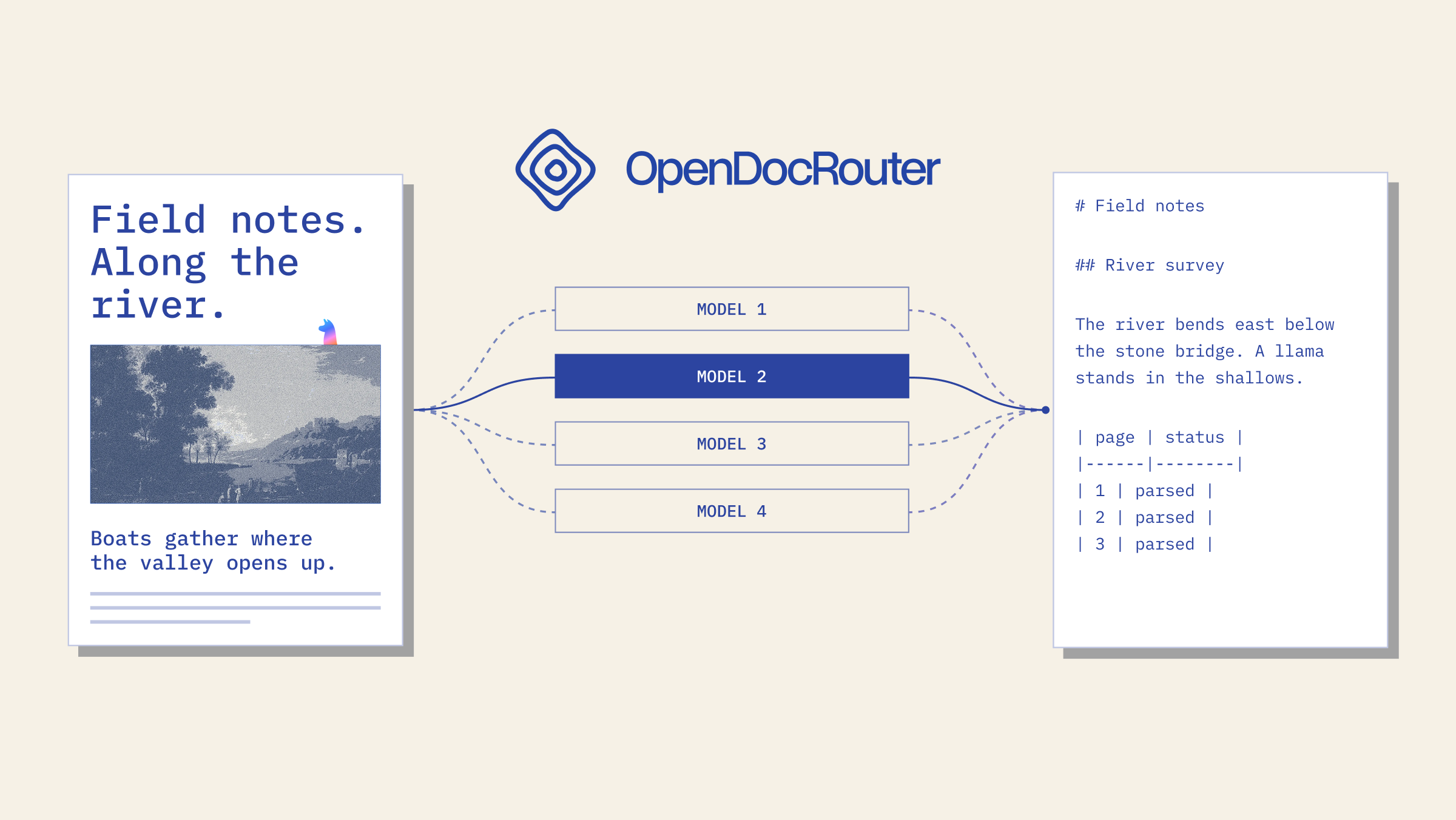
LlamaIndex launched OpenDocRouter, a unified API for document-to-Markdown parsing that routes tasks across various open-source and frontier models.
Deep dive
- Provides unified access to multiple OCR and document parsing models through a single REST API.
- Features a "grounding engine" to enforce standardized bounding box and layout output across heterogeneous models.
- Offers both synchronous (max 50 pages) and asynchronous (polling-based) job modes.
- Implements token-based pricing with distinct tiers for input, output, and optional layout features.
- Uses ParseBench to rank models by quality and price, currently including models from Anthropic, Google, and open-source projects like MinerU.
Decoder
- OCR: Optical Character Recognition, the process of converting images of text into machine-readable text.
- Frontier Model: Large-scale AI models at the current performance limits of the industry.
- ParseBench: A specific benchmarking dataset/framework used to evaluate document parsing accuracy and cost.
Original article
There are a lot of OCR models, with more releasing every week. A quick search on HuggingFace for “ocr” shows thousands of models posted. Furthermore, frontier labs are pushing new models nearly every month that also read documents well (albeit at sometimes costly price points). Using these models for document parsing usually requires the same few steps: figuring out prompts (if applicable), handling rate limits, managing deployments and related costs, and benchmarking new models as they come out.
This is something we at LlamaIndex have gotten particularly good at, and today we are launching OpenDocRouter as a way to share that work.
What is OpenDocRouter?
OpenDocRouter is a platform for document → markdown parsing using the latest open-source and frontier models. Each model runs a versioned recipe consisting of prompts, processing, and settings. Using the API is dead simple:
curl https://www.opendocrouter.ai/v1/parse \
  -H "Authorization: Bearer $API_KEY" \
  -H "Content-Type: application/json" \
  -d '{
    "model": "opendatalab/mineru2.5-pro",
    "document": { "url": "https://arxiv.org/pdf/1706.03762" },
    "layout": true
  }'
The API accepts PDFs, PNG, JPEG, or URLs to those file formats. The API lets you toggle between synchronous responses (the result is returned directly) and asynchronous responses (a job is created that requires polling). Synchronous responses are supported up to 50 pages. Requests can process inputs that have at most 500 pages or are 50MB.
Every model is benchmarked on ParseBench both in terms of quality and cost. At launch, we selected a set of models covering every corner of our benchmarks:
- Frontier Models: Claude Opus 5.5, Gemini 3 Flash, Gemini 3.8 Flash, GPT-5.6 Terra, GPT-6 Luna.
- OSS Models: Infinity-Parser2-Flash, MinerU2.5-Pro, TeleOCR, dots.mocr, PaddleOCR-VL-1.6
Bounding boxes and layout
Every model makes different guarantees about bounding boxes and layout. Some models output boxes natively, some need prompting, and some can't do it at all.
To close this gap, we built a grounding engine that we can apply to any model. Set layout: True in your request to generate markdown with grounded bounding boxes and layout elements in reading order. This also means all models produce the same layout classes: title, section_header, text, list_item, table, picture, chart, formula, caption, footnote, page_header, page_footer, code, form, key_value.
Pricing
OpenDocRouter is launching with pure token-based billing, and is fairly straightforward. New accounts receive $5 in credits. Paid top-ups start at $10, plus a 5% processing fee. Enabling layout adds $0.2 per million tokens, and if any page fails during processing, it is not charged.
As of October 7th, 2026, our pricing is as follows:
| Model | Input ($/1M) | Cached input ($/1M) | Output ($/1M) | Cost per 1k Pages (ParseBench) |
|---|---|---|---|---|
| Claude Opus 5.5 | $4.00 | $0.20 | $20.00 | $48.82 |
| Gemini 3 Flash | $0.50 | $0.05 | $3.00 | $19.67 |
| Gemini 3.8 Flash | $0.75 | $0.08 | $3.75 | $5.91 |
| GPT-5.6 Terra | $2.00 | $0.20 | $12.00 | $19.89 |
| GPT-6 Luna | $0.10 | $0.01 | $0.50 | $0.80 |
| Infinity-Parser2-Flash | $0.24 | - | $1.16 | $4.34 |
| MinerU2.5-Pro | $0.08 | - | $0.39 | $0.86 |
| TeleOCR | $0.25 | - | $1.22 | $2.70 |
| dots.mocr | $0.31 | - | $1.53 | $3.97 |
| PaddleOCR-VL-1.6 | $0.24 | - | $1.20 | $2.17 |
Adding new models
When new models ship that we can offer, we have processes in place to add them to OpenDocRouter quickly. We run them through ParseBench, and use that to calibrate prompts, costs, and other settings, to give the best user experience we can.
We also plan to keep improving the most popular models: whether through better prompts, better hosting for decreased latency, and more.
OpenDocRouter vs. LlamaParse
We view OpenDocRouter as a platform for quickly hosting the latest models, while allowing developers to easily switch and route between existing models, while only paying for exactly what you use. The API itself is easy to use, while providing broad access to models.
LlamaParse is our managed document platform. It ships with hand-tuned parsing tiers, enterprise controls, self-hosted deployments, and other APIs like schema extraction and indexing.
Try OpenDocRouter today
OpenDocRouter is live now to try. Browse the models and docs, sign up and generate an API key, and parse your docs today.
Fresh dev news, AI-digested daily. Never miss a trend at devoured.fyi