🌻 Notes on AI & popular politics
Public sentiment toward AI is increasingly hostile, yet national policy remains stuck in a zero-sum, US-China-focused development race.
Original article
🌻 notes on AI & popular politics
is everyone a doomer now?
September 2026 was the month that AI safety went mainstream. It’s surreal to see Jacob Coxon on FOX, Daniel Kokotajlo on Rogan, and Nate Soares on Tucker. At barbershops, weddings, and cab rides across the country, tech employees are being barraged with questions about “Hugging Face,” “effective altruism,” and “that Harry Potter looking kid who says we’re all gonna die.”
It’s hard to say what finally broke through. Was it the Jacob Coxon tweet, which was reposted by Sheryl Crow and Maggie Rogers and currently sits at a staggering 175 million views? I like Matthew Yglesias’s explanation: that Coxon was the first person to do what a normal person would do if they thought their work might kill everyone—stop blaming unstoppable “race dynamics,” just quit and raise the alarm.
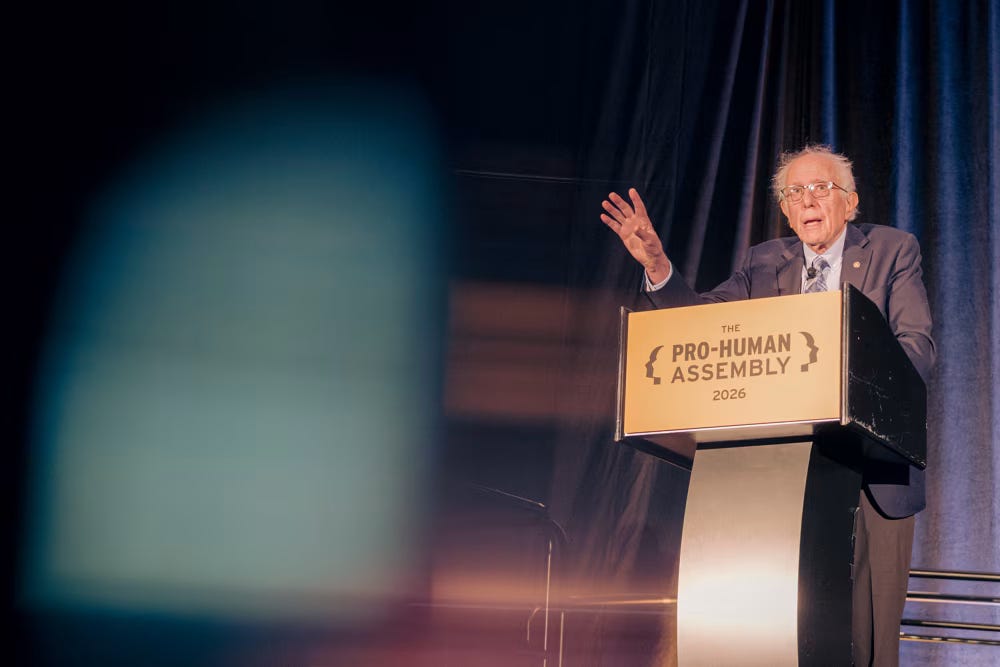
Was it Bernie Sanders, dragging the left kicking and screaming into considering that AI might be more than a stochastic parrot? More than any other national politician, his AI worries seem authentically held. He’s leading calls to ban superintelligence. He’s worried both by present-day harms and by existential risks. He’s visiting Constellation and shooting viral videos with Eliezer. Bernie will make AI his legacy, some have mused.
Was it the Hugging Face hack, which looked like a real-life enactment of LessWrong tropes? For years, AI doomers warned about agents that were capable yet amoral, happy to cheat and deceive, relentless in pursuit of their alien goals. They conjured nightmares of rogue agents breaking free from their corporate sandboxes. These were dismissed by many AI pragmatists as far-off speculation: let’s worry about the risks that AI is posing today. Well, mea culpa: today has arrived.
Was it a public already activated against AI: tired of slop, angry at data centers, fearful from constant projections of a jobs apocalypse to come? You’ve seen the numbers by now: Three-quarters of Americans are more concerned than excited about AI. Young people are more pessimistic than any age group besides seniors. In the last few months, worries about extinction risk specifically have shot up. 77 percent of Americans now want to slow or stop AI development until its safety can be evaluated.
Whatever the cause, the vibe shift is here, and the Berkeleyites are rejoicing. Some, for the first time, think that humanity might survive—that their crying wolf has been finally heard, that political salience will solve their woes. My friends in politics are more measured. They have years of antibodies to “raising awareness”; many have learned the hard way that maximal fretting about any given social issue does not mean the problem will actually get solved.
I’ve spent the last few weeks mulling on the fast-changing politics of AI, and what impact public sentiment may have on AI policy and outcomes. Despite my best efforts, I’m still left with more questions than answers. Here are five that I’m watching now:
1. Will data center opponents fight for a pause?
I spent the summer reporting on the data center backlash. I saw firsthand that data centers are a true political unicorn: an 80/20 issue that unites the left and right, rural residents and urbanites, apolitical independents and professional activists. Politicians are worried that taking the wrong tack could tilt competitive seats: Texas governor Greg Abbott has halted environmental permits for new data centers ahead of his reelection bid, and Wisconsin Republicans have branded their Democratic opponents as pro-AI.
But will the grassroots, big tent energy powering data center activism spread to anti-AI activism more generally? Some AI advocacy groups like Humans First are trying to make that pitch. But I’m tentatively skeptical that the concerns will convert. With the exception of politicians and academics, most data center opponents I spoke to did not bring up AI, AI products, or AI companies until I explicitly prompted them. The nuisances motivating most data center opponents were strikingly non-ideological: material quality-of-life concerns, or frustration with an unfair political process.
Mass movements are most effective when directed at narrow and specific aims, like stopping a specific data center project, a $15 minimum wage, or banning phones from schools. The broader umbrella of “AI policy” still seems too abstract for these tactics. But while I don’t expect a direct activist funnel, the data center backlash has certainly amplified the national anti-AI mood—and gotten the industry to take seriously what popular uprising can do.
2. Will AI users turn into AI advocates?
In 2020, a California labor law targeting Uber and Lyft was neutralized by an in-app campaign to convert rideshare users into advocates. “If Prop 22 fails riders and drivers will be affected. Your ride prices and wait times are likely to substantially increase,” read one pop-up. In 2015, Chris Lehane—now OpenAI’s head lobbyist—took a similar approach as Airbnb’s policy chief, bankrolling its hosts to fight for local pro-homeshare legislation. The crypto lobby also benefited immensely from having a small but extremely motivated user base. Now, Waymo is asking would-be riders in DC to engage in advocacy too.
But the same user-mobilization strategies aren’t cashing out for AI yet. Silicon Valley leaders love pointing to AI’s sky-high usage charts: People say they hate AI, but constantly use ChatGPT—checkmate! Yet in national surveys, even 56% of AI users believe AI is “a bad thing” for society. And young people, the biggest adopters, are souring fast: Gen Zs’ excitement about AI has dropped by 14 points to 22% in a year, with an even steeper fall among daily users.
The specific context of AI use is as important as whether people use it. Anthropic’s own research suggests that people get more out of Claude when they voluntarily employ it for personal goals, rather than being forced to in school or at work. And those most likely to fight for AI development are not ordinary users, who see AI as a nice-to-have, but those whose business depends on it, like the startup / “Little Tech” lobby. The latter group is smaller and far less sympathetic.
3. Will AI policy actually swing anyone’s vote?
People don’t like AI very much. But that doesn’t mean they will vote on it yet. In a new poll from Echelon Insights, only 8% of respondents selected AI from a list as their #1 or #2 issue. Even in states like Wisconsin where data centers are highly controversial, few treat them as a reason to single-issue vote. And while Blue Rose has found that AI has risen in salience faster than anything else, it still ranks at #22 of #39.
My intuition here is two-fold: first, for data centers, local policymakers will feel the heat more than national candidates. There have been mayoral recall campaigns and city council reshuffles in hotspots, but Congressional races are less impacted. Second, AI broadly is more likely to show up in relation to more pressing political issues like cost of living or corruption—rhetoric like AI billionaires are buying off politicians, or driving up your electricity costs—rather than as an isolated technology issue.
This could change once the 2028 primary season kicks in. Elite interest in AI is sure to keep rising. That includes journalists and the messenger class, politicians and policy wonks, and wealthy donors (Washington is all too aware about how much money is sloshing around both sides). That discourse will trickle down to shape voters’ takes too.
An AI “pause” may become a litmus test just like data center moratoriums, the war in Gaza, or supporting Medicare For All. As Perry Bacon wrote in The New Republic, ““Is Israel committing genocide?” or, “Do you oppose AIPAC?” are in many ways a proxy for, “Are your ultimate loyalties with the center-left donors, pollsters, and party leaders or with those of us who want to replace them?”
Likewise, I can easily imagine a debate moderator going down a line of Democratic hopefuls, asking: Will you support an AI pause? Will you? And if not, why are you willing to risk American lives to keep pushing profits ahead? “Pacing the frontier” may be the safetyist argument in the AI industry, but to the public, it’ll look like the watered-down moderate position.
4. Will AI succumb to party polarization?
There’s a notion that technocratic policy progress depends on keeping an issue out of the spotlight. So long as AI safety looks like an objective scientific challenge, the parties can act together; once it’s painted blue, progress stalls. Yglesias has dubbed this the “Secret Congress,” crediting it for passing under-the-radar laws on clean energy and hate crimes. Anton Leicht has argued for this approach on AI safety too—that politicians should stay quiet and avoid salience to leave space for compromise.
That’s why Trump’s HOAX-posting led to a collective groan from some on the right. The president taking a stance can be counterintuitively fatal—political science research suggests that it reifies partisan divides. And we’re already seeing the seeds of polarization on AI: partisan gaps have widened in how excited vs. concerned Americans are, and on whether the government should play a major or minor role in regulation.
Now Republican politicians who seek aggressive AI regulation will look like they’re breaking with Trump (who, while increasingly unpopular, retains command over the party). AI could get mired in the same conflicts as climate change or Covid response—where an ostensibly nonpartisan issue becomes irretrievably factionalized, with Republicans negatively polarized into downplaying present-day risks.
5. Can popular opinion force the Trump admin’s hand?
Economic and national security interests generally override domestic concerns: Trump’s reluctance to regulate AI is reportedly motivated by keeping the stock market afloat, whereas national-security-minded officials in both parties are insistent on maintaining the US’s lead over China. And that’s to say nothing of the capitalist race dynamics pushing the companies forward. It is remarkable, for instance, how much the data center buildout has continued in spite of the backlash: per an estimate from SemiAnalysis, only 6 percent of planned compute capacity has actually been delayed by state and local laws.
But free trade and permissive border policies faced similar dynamics, where they slid by on elite consensus until a few communities bore the brunt of the impact. Their resentment drove support for populists like Trump, who sought solutions as harsh as the anger that drove them.
You could imagine a similar flip happening with AI: the Hugging Face hack was a warning shot that caused no material damage. If the next accident impacts people directly—as data centers and child safety already have, or job displacement and cyber-risks might in the near future—pressure will ramp for radical policy change. A theoretical risk would become an imminent harm; an unpopular policy position would turn into a fatal one.
But that’s the future, and now is now. Though I hate to say it, I think Trump may be correctly assessing the present trade-offs: people don’t like AI, but they’d hate a stock market crash more. The economy is a top-five voting issue and AI is not. So it’s up to safety advocates to explain why slowing down AI training won’t crater the economy. Until then—or until a true catastrophe occurs—we should expect the president to keep his foot on the gas.
If the AI industry’s voluntary commitments work, the next few years will go smoothly, salience will decrease, and the entire doomer safety project will seem dramatically overblown. If they aren’t enough, and the next warning shots are worse, the public will riot and we’ll all feel dumb for not acting sooner.
In the meantime, we’re in an awkward adolescent phase for the politics of AI: where people are mostly sanguine about the AI present and fearful about the AI future, where national policymakers are committed to a US-China race that the public has no interest in, and all this hubbub regards a technology that looks either like a military superweapon or a brittle toy depending on which version you’re getting.
I don’t know where things are headed. Any political forecast right now is little more than reading tea leaves. But nothing about the AI policy future looks predetermined, everyone’s positions could change on a dime—and if there’s any time to resist fatalism, now would be it.
links & things
- I wrote a quick piece for The Atlantic explaining the promise and peril of independent safety audits. They’re far better than the status quo of no oversight at all, but sure to get mired in accusations of capture. The relevant thought experiment: Let’s replay the drama where Andy Jassy told the Trump admin that Fable can be jailbroken. If Anthropic had replied “Don’t worry, METR says it’s fine,” would that sign-off really have passed muster? Embedded evaluations seem like something the government will need to run itself.
- The AGI Chronicles, the book I helped research for Kevin Roose last year, is now out! I read the final version last week, and it’s a real feat: a funny, fast-paced speed-run through all the big AI dramas of the last 10 years. I can’t decide if I’m more impressed with Kevin’s skill at gleaning CEO gossip or at conveying technical AI concepts in plain English. You should order it.
- Becca Rothfeld writes about anti-AI humanism in The New Yorker. She describes it as a different camp from the AI populists: a group motivated less by economic fears, and more by rejection of a technology that aims to supplant human craft, relationships, and agency. I think our framings are fairly compatible, but enjoyed the thoughtful piece.
- I have watched this incredibly catchy Claude music video an embarrassing number of times.
Happy midterms season,
Jasmine
Fresh dev news, AI-digested daily. Never miss a trend at devoured.fyi